
Rufous-breasted piculet
The rufous-breasted piculet is a small bird found in parts of South America, inhabiting riverine areas and forest edges. It is characterized by its rufous-colored underparts and distinctive crown markings, which differ between males and females. This species typically forages close to the ground, feeding on insects.
Key Facts
- ›Measures between 9 to 11 cm in length and weighs 12 to 21 g.
- ›Adult males have a black crown with red tips and rufous underparts, while females have white dots on their crown.
- ›Found in Bolivia, Brazil, Colombia, Ecuador, and Peru, often near rivers.
- ›Forages on bamboo stalks and small branches, pecking and probing for insects.
- ›Vocalizations include a slow, descending series of high, lisping notes.
- ›Assessed by the IUCN as Least Concern with a stable population trend.

Rufous-Breasted Piculet
South America
Riverine Forest Undergrowth, Forest Edges, Dense Growth Along Roads, Small Gardens
Male's Black Crown With Red Tips, Female's White Crown Dots, Rufous Or Rufous-Chestnut Underparts
Insects
Forages within 3 meters of the ground, Clings to bamboo stalks and small branches, Pecks and probes bark, Can forage upside down
- Slow, Descending Series of High, Lisping Notes
- Single Quick Seep Notes
- Rapid Tsit Tsit In Flight
About Rufous-breasted piculet
The rufous-breasted piculet (Picumnus rufiventris) is a small bird species belonging to the woodpecker family Picidae, specifically within the subfamily Picumninae. This species is found across several South American countries, including Bolivia, Brazil, Colombia, Ecuador, and Peru.
Description and Identification
This piculet measures between 9 to 11 cm in length and typically weighs between 12 to 21 grams. Adult males are distinguished by a black crown adorned with wide red tips on most feathers, complemented by small white to buff spots on the sides and rear border. Their face, a narrow collar on the nape, and underparts are a rich orange rufous or rufous chestnut. The upperparts are yellowish olive, and the flight feathers are dark with yellowish olive edges. The tail is black, with specific feather pairs featuring white inner webs and pale buff tips, and outer pairs showing a wide buff stripe near the end. Their chin and throat are pale buffish white with narrow blackish edges. Adult females share many characteristics but are identifiable by white dots scattered throughout their crown instead of the red markings seen in males. Juveniles are duller, with a brown crown and narrow buff edges to the feathers.
There are three recognized subspecies: the nominate P. r. rufiventris, P. r. grandis, and P. r. brunneifrons. P. r. grandis is notably larger and paler, while P. r. brunneifrons falls between the other two in size and has a darker crown pattern.
Distribution and Habitat
The rufous-breasted piculet primarily inhabits areas close to rivers. Its preferred habitat includes the dense undergrowth along these waterways, particularly bamboo thickets, as well as the edges of other forests, dense roadside vegetation, and small gardens. The nominate subspecies is found in southeastern Colombia, eastern Ecuador, western Brazil, and northern Peru, while P. r. grandis is in central and southern Peru, and P. r. brunneifrons resides in northwestern and central Bolivia.
Behavior and Ecology
This species typically forages close to the ground, usually within about 3 meters. They are often observed alone, in pairs, or as part of mixed-species foraging flocks. Their foraging technique involves clinging to bamboo stalks and small branches, sometimes in an upside-down position, where they peck and probe the bark. Their diet is known to include insects, although detailed dietary studies are limited.
Vocalizations
The vocalizations of the rufous-breasted piculet include a distinctive song described as a "slow, descending series of high, lisping notes (generally 2): seep seep." They also produce calls such as "single quick seep notes or a rapid tsit tsit in flight."
Breeding
Breeding in the rufous-breasted piculet occurs between January and March in Bolivia and Peru, and apparently later in Ecuador. Beyond these seasonal timings, little else is documented regarding their breeding biology.
Conservation Status
The International Union for Conservation of Nature (IUCN) has assessed the rufous-breasted piculet as Least Concern. The species possesses a very large range, and although its population size is not precisely known, it is believed to be stable. No immediate threats have been identified that would significantly impact the species in the short term, although localized effects from habitat destruction are acknowledged.
Source: Wikipedia ↗
Frequently Asked Questions
What is the scientific name of the rufous-breasted piculet?
The scientific name of the rufous-breasted piculet is Picumnus rufiventris. It belongs to the woodpecker family Picidae.
What are the different subspecies of the rufous-breasted piculet?
There are three recognized subspecies: the nominate P. r. rufiventris, P. r. grandis, and P. r. brunneifrons. These subspecies differ slightly in size and plumage characteristics.
Where is the rufous-breasted piculet found?
The rufous-breasted piculet is distributed across Bolivia, Brazil, Colombia, Ecuador, and Peru. Its habitat is primarily found near rivers, in dense undergrowth, and along forest edges.
What does the rufous-breasted piculet eat?
While its diet has not been extensively detailed, the rufous-breasted piculet is known to consume insects. It forages by pecking and probing the bark of bamboo stalks and small branches.
What is the conservation status of the rufous-breasted piculet?
The rufous-breasted piculet is listed as Least Concern by the IUCN. It has a large range, a believed stable population, and no immediate threats have been identified.
How does the male rufous-breasted piculet differ from the female?
Adult males have a black crown with red tips on the feathers and rufous-colored underparts. Adult females are similar but have white dots scattered throughout their crown instead of red markings.
Related Woodpecker species

Fine-barred piculet
The fine-barred piculet is a small bird found in Brazil and Peru, known for its distinctive barring and reddish-orange crown markings in males. It inhabits forests, often near rivers, and forages for insects on branches and vines. While its population size is unknown, it is currently assessed as Least Concern.
Dot-fronted woodpecker
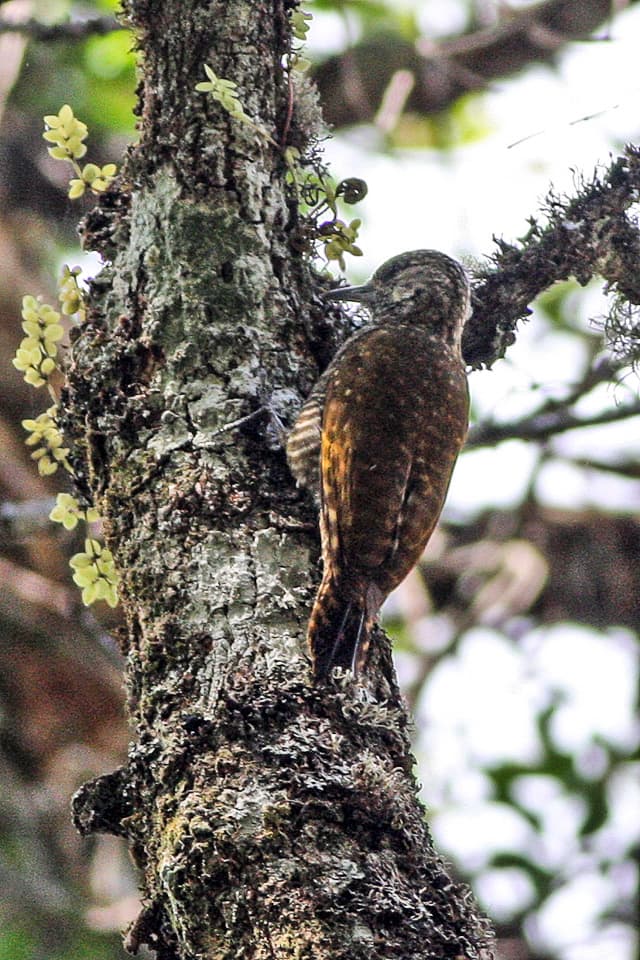
The dot-fronted woodpecker (Veniliornis frontalis) is a species found in Argentina and Bolivia, inhabiting dry montane woodlands and humid forests. Measuring approximately 16 cm in length, it is characterized by its olive to gray-brown forehead with white spots, and males display red on their crown and nape.

Chestnut woodpecker
The chestnut woodpecker is a bird species found across much of mainland South America and Trinidad. It is characterized by its chestnut plumage, a bright red malar area in males, and a distinctive call. This species primarily inhabits forests and secondary growth areas, where it forages for ants and termites.