
Fire-bellied woodpecker
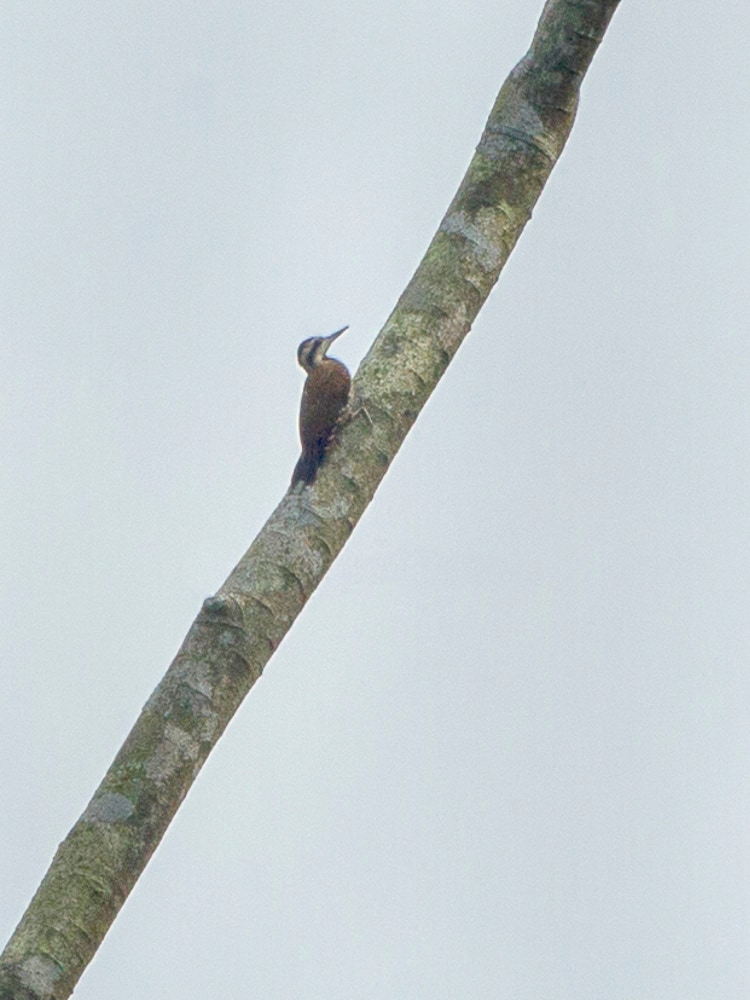
The fire-bellied woodpecker is a bird species found across tropical West Africa, inhabiting various wooded environments from primary rainforest edges to savannahs. It is characterized by its olive-bronze upperparts, crimson rump, and a striking scarlet belly, with males displaying a red crown and females a black one. This species is common and its population is considered stable or increasing, leading to a 'least concern' conservation status.
Key Facts
- ›Native to tropical West Africa, with a range extending from Guinea to Cameroon.
- ›Inhabits clearings and edges of primary rainforest, gallery forests, scattered woodlands, and wooded savannahs.
- ›Distinguished by olive or bronze upperparts, a crimson rump, and a scarlet belly.
- ›Males have a red crown and nape, while females have these areas black.
- ›Feeds primarily on insects, especially beetle larvae, foraging in the canopy and on dead trees.
- ›Considered a 'least concern' species by the IUCN due to its wide range and commonality.
West Africa
Primary Rainforest Edges, Gallery Forest, Scattered Woodland, Wooded Savannah, Scrubby Bush, Partially Logged and Degraded Areas
- Crimson Rump and Upper Tail Coverts
- Blackish Malar Streak Extending Onto the Breast
- Post-Ocular Streak Extending Onto the Ear-Coverts
- Dark Chevrons On Flanks
- Male Has Red Crown and Nape
- Female Has Black Crown and Nape
Insects, Beetle Larvae
Forages Mainly In the Canopy, Forages On Dead Standing Trees, Sometimes Descends Onto Fallen Trees
Tree Cavities
- Drums in short rapid bursts during the dry season
About Fire-bellied woodpecker
The Fire-bellied Woodpecker
The fire-bellied woodpecker (Chloropicus pyrrhogaster), sometimes placed in the genus Dendropicos, is a bird species native to the tropical regions of West Africa. Its range extends from Upper Guinea and Sierra Leone eastward to southern Nigeria and western Cameroon, encompassing countries like Benin, Ivory Coast, Ghana, Liberia, Mali, Nigeria, Sierra Leone, and Togo.
Description and Habitat
This woodpecker is characterized by its olive or bronze upperparts with slight barring, brown wings with light barring, and a blackish upper-tail. A striking crimson covers its rump and upper tail coverts. The head and throat are white, marked by a bold blackish malar streak that extends onto the breast, and a post-ocular streak reaching the ear-coverts. Its breast is cream-colored with dark chevrons on the flanks, while the central region and belly are a vibrant scarlet. The beak and legs are grey. Sexual dimorphism is evident, with males displaying a red crown and nape, while females have these areas black. Females also possess a longer tail and shorter beak compared to males, with less distinct red on their belly. Juveniles are duller and browner than adults, and both young males and females exhibit some red on the crown.
The fire-bellied woodpecker inhabits lowlands and foothills, preferring clearings and edges of primary rainforest. Its habitat also includes gallery forest, scattered woodland, partially logged and degraded areas, wooded savannah, and scrubby bush. The presence of large dead trees is often noted within their range.
Ecology and Conservation
Typically observed in pairs or small family groups, the fire-bellied woodpecker sometimes associates with other insectivorous birds. Its diet primarily consists of insects, particularly beetle larvae, which it forages for mainly in the canopy and on dead standing trees. Occasionally, they will descend to fallen trees in search of food. During the dry season, both sexes engage in drumming, producing short, rapid bursts of 14 to 38 strikes per second.
The species is non-migratory. The fire-bellied woodpecker is considered a common or fairly common species across its very wide range. Its population size appears to be increasing, partly due to the practice of leaving some large trees standing when forests are cleared. Consequently, the International Union for Conservation of Nature (IUCN) has assessed its conservation status as 'least concern'.
Source: Wikipedia ↗
Frequently Asked Questions
What is the scientific name for the fire-bellied woodpecker?
The scientific name for the fire-bellied woodpecker is Chloropicus pyrrhogaster. Some taxonomic authorities also classify it within the genus Dendropicos.
Where can the fire-bellied woodpecker be found?
This woodpecker is native to tropical West Africa, with its range spanning from Upper Guinea and Sierra Leone eastward to southern Nigeria and western Cameroon. It is present in countries such as Benin, Ivory Coast, Ghana, Liberia, Mali, Nigeria, Sierra Leone, and Togo.
What kind of habitat does the fire-bellied woodpecker prefer?
The fire-bellied woodpecker thrives in lowlands and foothills, favoring clearings and edges of primary rainforest. It is also found in gallery forests, scattered woodlands, partially logged areas, wooded savannahs, and scrubby bush, often near large dead trees.
How can you tell the difference between male and female fire-bellied woodpeckers?
The sexes are dimorphic: males possess a red crown and nape, whereas females have these areas black. Additionally, females tend to have a longer tail and a shorter beak than males, and their red belly coloration is less prominent.
What does the fire-bellied woodpecker eat?
The primary diet of the fire-bellied woodpecker consists of insects, with a particular fondness for beetle larvae. They forage mainly in the canopy and on dead standing trees, occasionally descending to fallen logs to find their food.
What is the conservation status of the fire-bellied woodpecker?
The fire-bellied woodpecker is classified as a species of 'least concern' by the International Union for Conservation of Nature (IUCN). This assessment is due to its very wide distribution and its status as a generally common or fairly common species with a potentially increasing population.
Related Woodpecker species

Mottled piculet
The mottled piculet is a small bird found in the Atlantic Forest and related habitats across southeastern Brazil, Uruguay, and northeastern Argentina. It is characterized by its olive-brown plumage with buff or rusty tinges, and males display a red patch on their forehead. This species primarily feeds on insect larvae found in dense vegetation.

White woodpecker
The White woodpecker is a striking South American bird recognized by its bright white plumage, black wings, and a small, distinct yellow eye patch. It inhabits wooded grasslands and various open woodland environments across a wide range of South America, from Suriname and French Guiana down to Argentina. This species is noted for its varied diet and adaptability to different habitats, including urban areas.

Great spotted woodpecker
The great spotted woodpecker is a medium-sized bird characterized by its pied black and white plumage and a distinctive red patch on its lower belly. It inhabits diverse woodlands across the Palearctic region and parts of North Africa. This adaptable species is known for its varied diet, including insect larvae, seeds, and even the eggs and chicks of other birds, and its habit of excavating tree cavities for nesting.