
Red-necked woodpecker
The red-necked woodpecker is a large bird found across much of mainland South America, primarily within the Amazon Basin. It is characterized by its striking red head and neck, black upperparts, and bright red underparts. This species inhabits various forest types and woodland areas, foraging on tree trunks for insect larvae and some fruit.
Key Facts
- ›Found in every mainland South American country except Argentina, Chile, Paraguay, and Uruguay.
- ›Measures approximately 30-35 cm in length and weighs between 178-236 g.
- ›Adult males have entirely red heads and necks, while females have a distinctive whitish strip from the bill to the ear coverts.
- ›Inhabits rain, terra firme, and Várzea forests, as well as woodland along watercourses.
- ›Diet includes beetle and moth larvae, and some fruit.
- ›Nests are typically located high in dead trees or palms.

Red-Necked Woodpecker
South America
Rainforest, Terra Firme Forest, VáRzea Forest, Secondary Forest, Woodland Along Watercourses
Black, Brownish Black, Rufous, Bright Red, Orange
- Entirely red head and neck
- Small black and white spot on ear coverts
- Wide whitish strip with black edges from bill to ear coverts
- Long grayish white to ivory chisel bill
- Yellowish white iris
Larvae of Beetles, Larvae of Moths, Fruit
- Forages on trunks and limbs from mid-level to near the canopy
- Hunts near the ground on rotten stubs
- Usually forages in pairs or small family groups
Dead Tree, Palm
Explosive Nasal Call, Churring Calls When Agitated, Loud Double-Rap Drum
About Red-necked woodpecker
The red-necked woodpecker (Campephilus rubricollis) is a species of bird belonging to the woodpecker family, Picidae. It is a prominent resident of the Amazon Basin and is found in every mainland South American country with the exception of Argentina, Chile, Paraguay, and Uruguay. The species is characterized by its striking plumage, with adult males displaying an entirely red head and neck, complemented by black upperparts and bright red underparts. Females share similar body coloration but possess a distinctive whitish strip from the bill to the ear coverts.
Distribution and Habitat
This woodpecker inhabits a variety of forest environments, including rain, terra firme, and várzea forests. It is also found at forest edges, in secondary growth, and in woodland areas along watercourses within savannah regions. While it generally prefers elevations from sea level to 600 meters, it can be found at higher altitudes in certain parts of its range, reaching up to 1,800 meters in southern Venezuela and northwestern Brazil, and as high as 2,400 meters in Bolivia.
Behavior and Diet
The red-necked woodpecker is a year-round resident. It typically forages on the trunks and limbs of trees, ranging from the mid-levels of the forest towards the canopy, but also hunts near the ground on decaying stubs. These birds are usually observed foraging in pairs or small family groups. Their diet consists primarily of the larvae of beetles and moths, supplemented with some fruit.
Breeding and Vocalizations
Nesting cavities are usually excavated high up in dead trees or palms. The breeding season varies geographically, occurring between January and May in the northern parts of its range, in November in Ecuador, and in September in Peru. The clutch size is estimated to be between two and four eggs, though other aspects of its breeding biology remain largely undocumented. The red-necked woodpecker is known for its distinctive vocalizations, including an explosive nasal call and churring calls when agitated, as well as a loud double-rap drumming sound.
Conservation Status
The International Union for Conservation of Nature (IUCN) has assessed the red-necked woodpecker as being of Least Concern. Despite its vast range, its population size is not precisely known and is believed to be declining. While no immediate threats have been identified, deforestation and the conversion of its natural habitat to secondary growth or exotic tree plantations pose potential long-term risks to the species.
Source: Wikipedia ↗
Frequently Asked Questions
What is the scientific name of the red-necked woodpecker?
The scientific name of the red-necked woodpecker is Campephilus rubricollis. This binomial name was coined by Pieter Boddaert in 1783.
Where is the red-necked woodpecker found?
The red-necked woodpecker is distributed throughout most of mainland South America, excluding Argentina, Chile, Paraguay, and Uruguay. Its range is concentrated within the Amazon Basin.
What does the red-necked woodpecker eat?
The diet of the red-necked woodpecker is not fully detailed but is known to include the larvae of beetles and moths. It also consumes some fruit.
What are the distinctive features of the red-necked woodpecker's plumage?
Adult males are notable for their entirely red head and neck. Adult females possess a wide whitish strip bordered by black, extending from their bill to their ear coverts. Both sexes have black upperparts, rufous wings, and bright red underparts.
What kind of habitats does the red-necked woodpecker prefer?
This species favors the interior of rain, terra firme, and várzea forests. It can also be found at forest edges, in secondary forests, and in woodland areas adjacent to watercourses within savannah landscapes.
What sounds does the red-necked woodpecker make?
Its most common vocalization is a repeated, explosive nasal call, often described as 'ngkah-ngkah' or 'kikka'. When agitated, it produces 'churring calls' (ca-wa-rr-r), and its drumming is a loud double-rap.
Related Woodpecker species
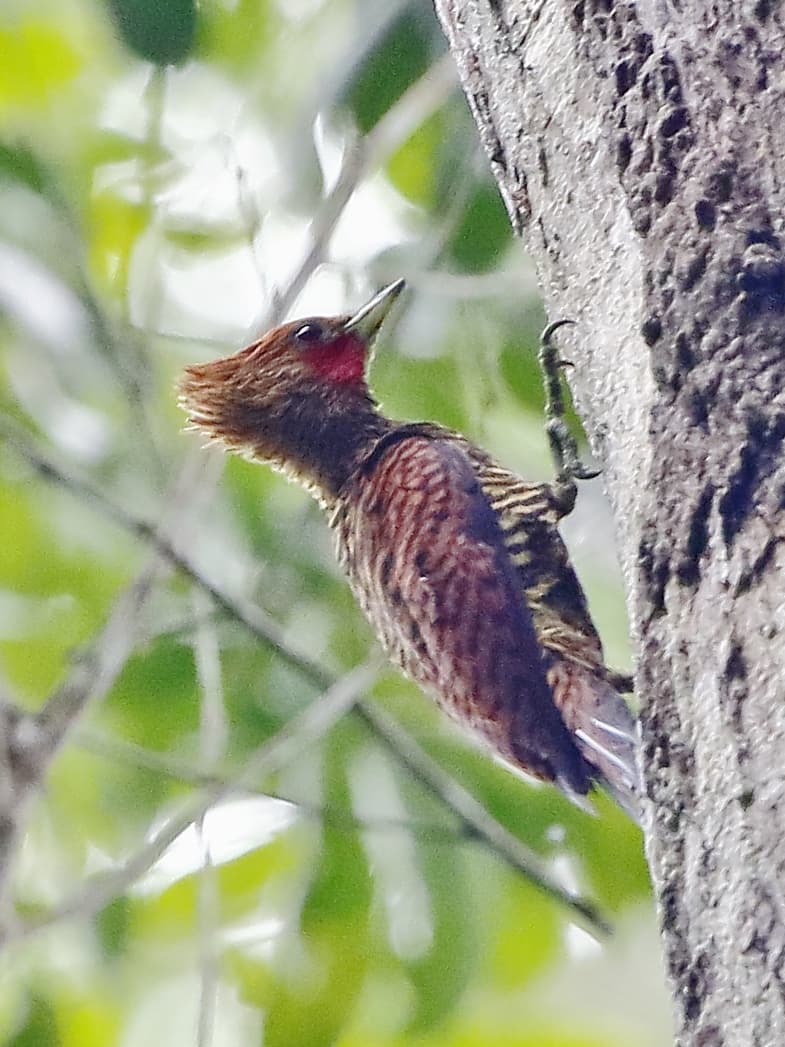
Waved woodpecker
The Waved Woodpecker (Celeus undatus) is a species found across much of northern South America, inhabiting various wooded landscapes from rainforest edges to savannas. It is characterized by its rufous-chestnut plumage, often marked with wavy black bars, and a distinctive crest. Primarily feeding on ants and termites, this species excavates its nest cavities in trees.
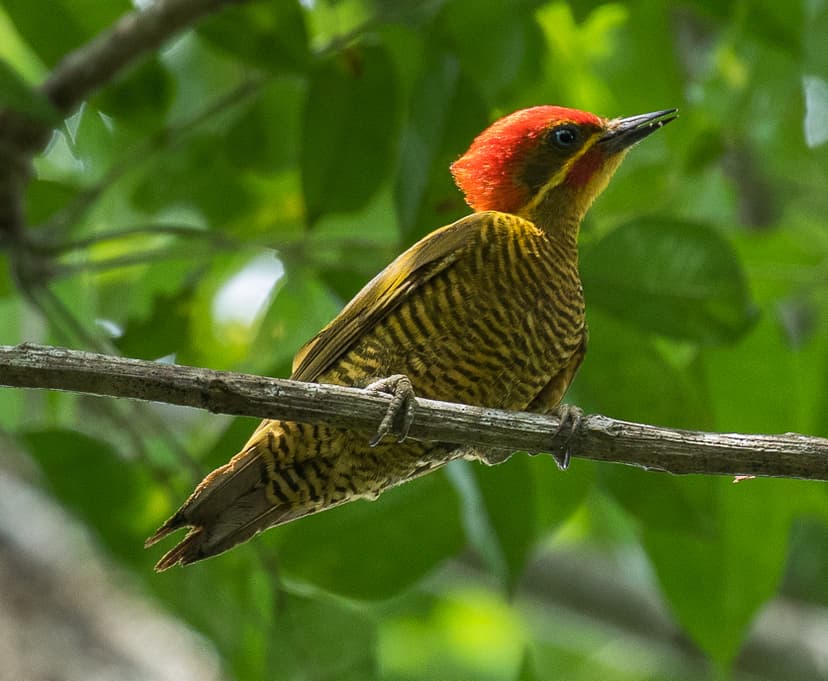
Golden-green woodpecker
The golden-green woodpecker is a South American bird found in a variety of wooded habitats across the continent. Characterized by its size and distinctive head markings that vary between sexes and subspecies, it primarily feeds on ants and termites. This species is generally considered to be of Least Concern, despite a suspected decreasing population trend.

Beautiful woodpecker
The beautiful woodpecker is a species endemic to Colombia, found primarily in the Magdalena River valley. This bird is characterized by its striking plumage, with males and females differing in head patterns, and it feeds on a mixed diet of insects and fruits, foraging high in forest canopies. Its conservation status is assessed as Least Concern.