
Great slaty woodpecker
The great slaty woodpecker (Mulleripicus pulverulentus) is the largest confirmed living woodpecker species, recognized for its imposing size and distinctive dark grey plumage. It inhabits primary forests across the Indian subcontinent and Southeast Asia, preferring areas with large, mature trees for foraging and nesting.
Key Facts
- ›It is the largest confirmed living woodpecker species, measuring 45–55 cm in length.
- ›The species is found across the Indian subcontinent and Southeast Asia, including countries like India, Thailand, and Vietnam.
- ›Its habitat preference is primary semi-open, moist deciduous and tropical evergreen forests with large trees.
- ›The plumage is predominantly dark grey or blackish slate-grey with small white spots and a paler throat.
- ›They typically forage in groups, feeding on social insects like ants and termites, and larvae.
- ›The great slaty woodpecker is classified as Vulnerable on the IUCN Red List due to habitat loss.
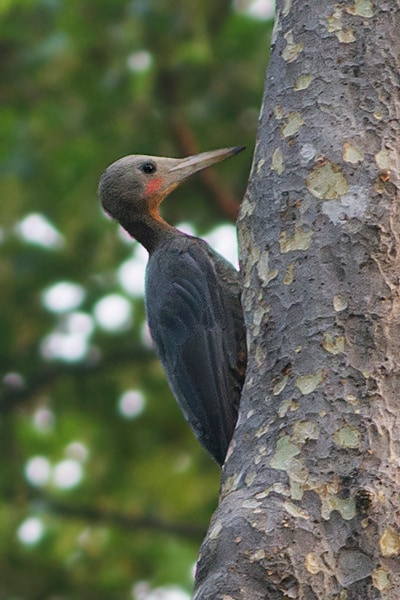
Great Slaty Woodpecker
Indian Subcontinent, Southeast Asia
Primary Semi-Open Forests, Moist Deciduous Forests, Tropical Evergreen Forests, Secondary Forests, Clearings With Scattered Tall Trees, Park-Like Areas, Dipterocarp Forests, Teak Forests, Sal Forests, Swamp Forests, Mangroves
Dark Grey, Blackish Slate-Grey, White Spots, Paler Grey, Yellowish
Very Long, Strong Chisel-Tipped Bill, Elongated Neck, Long Tail, Slight Crest, Small Red Moustache
Social Insects, Insect Larvae, Wood-Boring Beetles, Stingless Bees
- Gleaning
- Probing
- Pecking
- Prising Off Bark
- Hammering
- Excavating Wood
- Foraging In Groups
- Working Trees Upwards
- Flying Long Distances Between Foraging Patches
Tree Holes, Very Large Trees
Whinnying Cackle, Single Dwot Calls, Soft Mewing, Sharp Taw-Whit Or Dew-It Calls
About Great slaty woodpecker
The great slaty woodpecker (Mulleripicus pulverulentus) is a remarkable bird species distinguished by its immense size, holding the title of the largest confirmed living woodpecker. This species is found across a wide range encompassing the Indian subcontinent and Southeast Asia, inhabiting primary forests with large, mature trees. Its presence is a key indicator of healthy, undisturbed forest ecosystems.
Description and Identification
Measuring between 45 to 55 cm in length and weighing up to 563 grams, the great slaty woodpecker is an imposing avian. Its plumage is predominantly a dark grey or blackish slate-grey, often adorned with small white spots on the head and neck, and a paler, sometimes yellowish, throat. Males are further distinguished by a small red moustache. Distinctive features include a very long and strong chisel-tipped bill, an elongated neck, and a long tail, which, along with its sheer size, readily sets it apart from other bird species, sometimes leading to initial confusion with hornbills.
Habitat and Distribution
This species thrives in primary semi-open, moist deciduous, and tropical evergreen forests. It shows a preference for areas with sprawling stands of large trees like dipterocarps and teak, as well as mature sal forests, swamp forests, and mangroves. While usually found below 600 meters, it can inhabit montane areas up to 1,100 meters and occasionally even higher. Its range extends across Bangladesh, Bhutan, Brunei, Cambodia, India, Indonesia, Laos, Malaysia, Myanmar, Nepal, the Philippines, Singapore, Thailand, and Vietnam.
Ecology and Behavior
Great slaty woodpeckers are often observed in groups of three to six individuals, typically comprising a breeding pair and their older offspring. Their diet primarily consists of social insects such as ants and termites, along with insect larvae, which they extract from tree nests. Foraging involves gleaning, probing, pecking, and hammering into wood, with their long necks and bills allowing them to reach into crevices. They are known to fly considerable distances between foraging sites. Unlike many large woodpeckers, their voice is relatively weak and quiet, consisting of whinnying cackles and single calls. Breeding pairs are believed to maintain lifelong bonds and may raise young cooperatively. Nests are excavated in large trees, often at significant heights.
Conservation Status
The great slaty woodpecker is currently listed as Vulnerable on the IUCN Red List. Its population is in decline due to extensive habitat loss, particularly the logging of old-growth forests, which are crucial for their survival. Reductions in population density of over 80% have been observed in logged forests, highlighting their dependence on pristine forest environments.
Source: Wikipedia ↗
Frequently Asked Questions
What is the largest living woodpecker species?
The great slaty woodpecker is the largest confirmed living woodpecker species. It measures between 45 to 55 cm in length, making it larger than most other woodpecker species.
Where can the great slaty woodpecker be found?
This species is widely distributed across the Indian subcontinent and Southeast Asia. Its range includes countries such as Bangladesh, Bhutan, India, Indonesia, Laos, Malaysia, Myanmar, Nepal, the Philippines, Singapore, Thailand, and Vietnam.
What kind of habitat does the great slaty woodpecker prefer?
The great slaty woodpecker favors primary semi-open forests, including moist deciduous and tropical evergreen forests. They are often found in areas with large, mature trees, such as dipterocarp and teak stands, as well as sal forests, swamp forests, and mangroves.
What does the great slaty woodpecker eat?
Their diet primarily consists of social insects such as ants and termites, as well as the larvae of various insects. They are often observed foraging on the nests of these insects found in large trees. Small fruits may occasionally supplement their diet.
Why is the great slaty woodpecker considered vulnerable?
The great slaty woodpecker is classified as Vulnerable due to the significant loss of forest cover and the logging of old-growth forests across its range. Their dependence on large, old trees for feeding and nesting makes them particularly susceptible to habitat degradation.
Related Woodpecker species
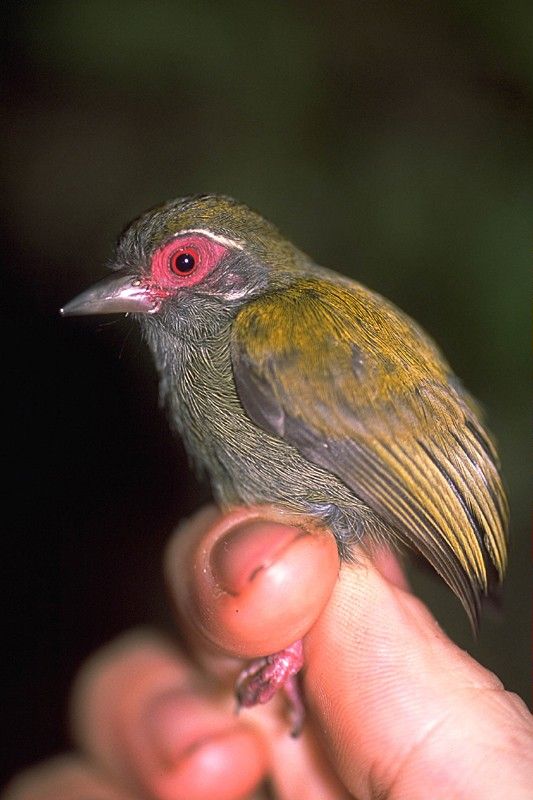
African piculet
The African piculet is a small bird found in lowland secondary forests across several African countries. It is characterized by its dark greenish-yellow upperparts, greyish underparts, and a distinctive chestnut or reddish forehead in males. This species is known for its active foraging behavior, hammering branches to find beetle larvae.

White-bellied piculet
The white-bellied piculet is a small bird found in parts of Brazil, Guyana, and Venezuela, inhabiting various wooded landscapes. It is characterized by its distinctive black and white barring and spotting, with males featuring a red patch on their forehead. This species is currently listed as Vulnerable due to threats from deforestation.
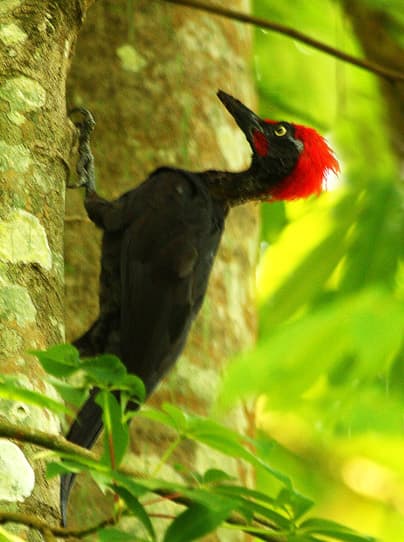
Andaman woodpecker
The Andaman woodpecker is a species of bird endemic to the Andaman Islands of India, inhabiting tropical moist lowland forests. This bird is characterized by its predominantly slate-grey to black plumage, a striking red crest, and a length of approximately 38 cm. Sadly, it faces a vulnerable conservation status due to ongoing habitat loss.