
Grey-and-buff woodpecker
The grey-and-buff woodpecker is a small bird found in tropical forests across Southeast Asia, from Myanmar to Indonesia. It is characterized by its plump body, large crest, and distinctive grey and buff scalloped plumage. Primarily insectivorous, it forages by gleaning and nests in tree cavities.
Key Facts
- ›Found in lowland and montane tropical moist broadleaf forests of Southeast Asia.
- ›Characterized by a plump body, short tail, and a large, cone-shaped crest.
- ›Plumage features scalloped patterns of blackish feathers edged with white or buff.
- ›Feeds primarily on insects and fruit, foraging by gleaning rather than drilling.
- ›Nests in deeper holes or crevices, with a breeding season between December and July.
- ›Conservation status is assessed as 'least concern' by the IUCN, though numbers are declining.

Red-Crested Woodpecker
Southeast Asia, Brunei, Indonesia, Malaysia, Myanmar, Thailand
Lowland Tropical Moist Broadleaf Forests, Montane Tropical Moist Broadleaf Forests, Subtropical Moist Broadleaf Forests, Evergreen Rainforests, Plantations, Bamboo Thickets, Cleared Areas, Wooded Urban Areas, Cultivated Land
- Plump body
- Short rounded tail
- Large, cone-shaped crest
- Scalloped plumage
- Fine white, wavy line on head from cheek to mantle
- Long, slender grey beak with black tip
- Gland on back of unknown function
Insects, Fruit, Mistletoe Berries
Gleaning
Deeper Holes, Crevices
About Grey-and-buff woodpecker
The grey-and-buff woodpecker, scientifically known as Hemicircus concretus, is a bird species belonging to the family Picidae. It is native to the tropical forests of Southeast Asia, with its range extending from southern Myanmar and peninsular Thailand through Malaysia to the islands of Sumatra and Borneo in Indonesia. It has, however, become regionally extinct in Singapore.
Description and Characteristics
This woodpecker is recognized by its plump body, a relatively short and rounded tail, and a notably large, cone-shaped crest that makes its head appear substantial. The plumage is a distinctive pattern of blackish upperparts and wings, edged with white or buff, creating a scalloped or scaled appearance. The underparts are typically grey. Males can be distinguished by a red forehead, while females have grey on both the forehead and crest. Both sexes have a fine, wavy white line running from the cheek towards the mantle. The beak is long, slender, and grey with a black tip, and the iris is chestnut. A peculiar gland, found on the back and of unknown function, sometimes stains the white rump with its secretions.
Habitat and Behavior
The grey-and-buff woodpecker primarily inhabits lowland and mid-elevation evergreen rainforests. It is also found in secondary habitats such as plantations, bamboo thickets, cleared areas, wooded urban environments, and cultivated land, often frequenting clearings and forest edges. These birds are usually observed alone or in pairs, and occasionally join mixed-species foraging flocks in the canopy. Their foraging technique predominantly involves gleaning insects and other prey from surfaces, rather than drilling into wood. Their diet also includes fruits, such as mistletoe berries.
Reproduction and Status
Nesting takes place in deeper holes or crevices within trees. The species exhibits communal roosting behavior, excavating shallow holes in dead wood for overnight shelter. The breeding season typically spans from December to July. Despite inhabiting a variety of environments, the population of the grey-and-buff woodpecker is believed to be experiencing a gradual decline due to habitat loss. Nevertheless, the International Union for Conservation of Nature (IUCN) currently classifies its conservation status as 'Least Concern' due to its very large range and general description as uncommon.
Source: Wikipedia ↗
Frequently Asked Questions
Where does the grey-and-buff woodpecker live?
The grey-and-buff woodpecker is native to tropical southeastern Asia. Its range includes Brunei, Indonesia (Sumatra and Borneo), Malaysia, southern Myanmar, and southern Thailand. It inhabits lowland and mid-elevation evergreen rainforests, as well as plantations and wooded urban areas.
What does the grey-and-buff woodpecker look like?
This woodpecker has a plump body, a short rounded tail, and a large, cone-shaped crest. Its head is largely grey, with a fine white, wavy line from cheek to mantle. The body's upper parts and wings are blackish with white or buff edging, creating a scalloped effect, while its underparts are grey.
What is the diet of the grey-and-buff woodpecker?
The grey-and-buff woodpecker's diet mainly consists of insects and fruit. It typically feeds by gleaning insects from surfaces rather than by drilling into wood.
How does the grey-and-buff woodpecker nest?
Nesting occurs in deeper holes or crevices in trees. The birds also roost communally at night in shallow holes they excavate in dead wood.
What is the conservation status of the grey-and-buff woodpecker?
The International Union for Conservation of Nature has assessed the grey-and-buff woodpecker's conservation status as 'least concern'. However, its numbers are thought to be in gradual decline due to habitat loss.
Related Woodpecker species
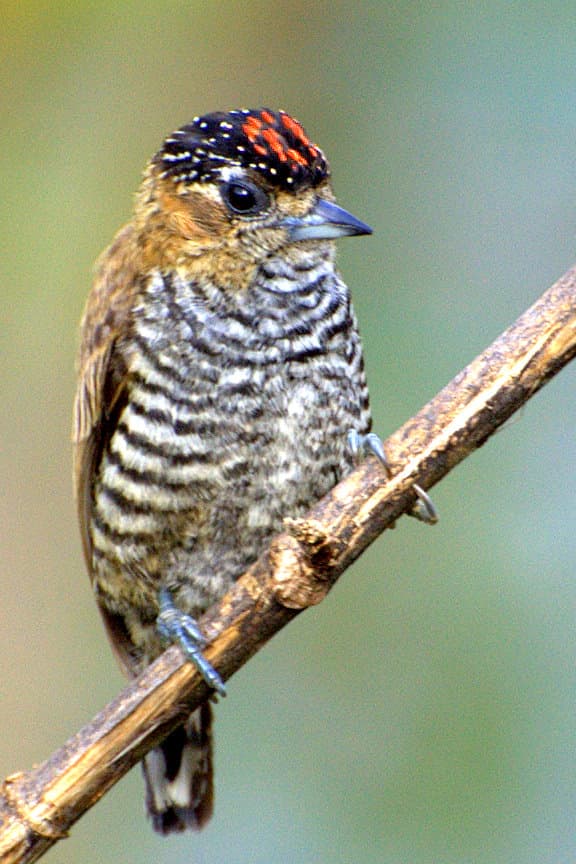
Ochre-collared piculet
The ochre-collared piculet is a small woodpecker species found in Argentina, Brazil, and Paraguay. It is characterized by its cinnamon-buff collar and has a black cap with red tips (in males) and white spots. This species primarily inhabits lowland rainforests, secondary growth, and thickets.
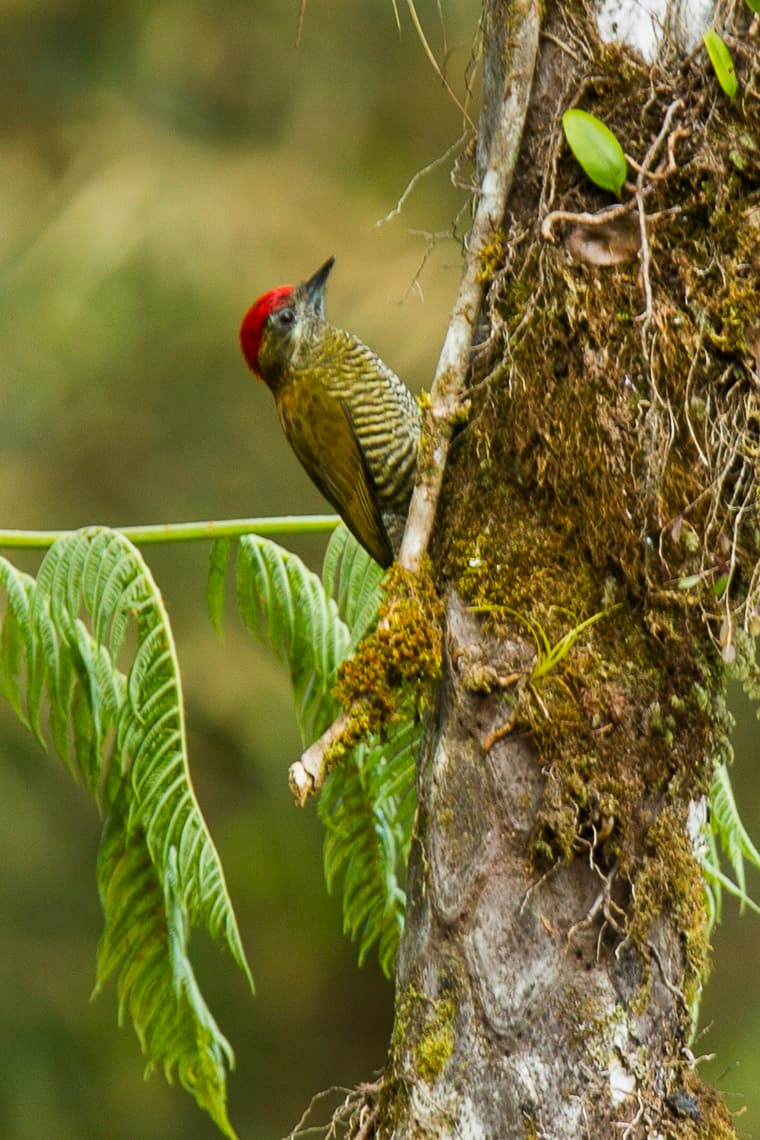
Bar-bellied woodpecker
The bar-bellied woodpecker (Veniliornis nigriceps) is a species of bird found in the montane forests of Bolivia, Colombia, Ecuador, and Peru. This species is characterized by its olive-brown plumage with distinctive dark olive bars on its underparts, and differences in head coloration between males and females. It inhabits humid to wet forests, often favoring areas with dense undergrowth and bamboo.

Mottled piculet
The mottled piculet is a small bird found in the Atlantic Forest and related habitats across southeastern Brazil, Uruguay, and northeastern Argentina. It is characterized by its olive-brown plumage with buff or rusty tinges, and males display a red patch on their forehead. This species primarily feeds on insect larvae found in dense vegetation.