
Ringed woodpecker
Near Threatened (C. t. torquatus), Least Concern (C. t. occidentalis), Vulnerable (C. t. tinnunculus)
The ringed woodpecker is a South American bird found in various forests across the continent, excluding some southern countries. It is characterized by its pale cinnamon head with a rufous tinge and a crest, with males displaying a distinctive red facial patch. The species' conservation status varies by subspecies, with one categorized as Near Threatened due to deforestation threats.
Key Facts
- ›Measures between 26 to 29 cm in length.
- ›Males have a red facial patch, while females do not.
- ›Diet includes ants, seeds, and fruit, foraged through gleaning, chiseling, and hammering.
- ›Found in humid tropical forests, Várzea, secondary forests, gallery forests, and cerrado.
- ›Primarily a year-round resident with no known migratory behavior.
- ›Conservation status ranges from Least Concern to Vulnerable depending on the subspecies.

Collared Woodpecker
South America
Humid Tropical Forest, Terra Firme, VáRzea Forest, Secondary Forest, Gallery Forest, Cerrado, Atlantic Forest
Pale cinnamon head with a rufous tinge, Moderately bushy crest, Red facial patch in adult males
Ants, Seeds, Fruit
Gleaning, Chiseling Small Holes Into Wood, Hammering To Open Arboreal Termitaria
- Primary call: Series of 2-7 loud ringing whistles at stable pitch and pace
- Rising call: Series of 4-9 loud strident whistles, gradually rising in pitch and often increasing in amplitude
- Whinny: Short and fast series of some 4-6 shrill notes, the last note at a lower pitch
- Drumming: Typical duration of 1-2s with knocks at a stable pace of ~15-20/s
About Ringed woodpecker
The ringed woodpecker (Celeus torquatus), also known by its Latin name Picus torquatus, is a species of bird belonging to the woodpecker family, Picidae. It inhabits a broad swathe of South America, being found in every mainland country on the continent with the exception of Argentina, Chile, Paraguay, and Uruguay. This species is characterized by its pale cinnamon head, which often has a rufous tinge, and a moderately bushy crest. Adult males are distinguished by a red patch on their face, extending from the malar area to under the ear coverts, a feature absent in females.
Taxonomy and Subspecies
The ringed woodpecker was first described by Georges-Louis Leclerc, Comte de Buffon, in 1780. Later, Pieter Boddaert formally coined the binomial name Picus torquatus. While historically placed in its own genus, it is now recognized within the genus Celeus. The species is divided into three subspecies: C. t. torquatus, C. t. occidentalis, and C. t. tinnunculus. However, some ornithological bodies, such as BirdLife International, recognize the latter two as distinct species based on plumage differences, though no genetic studies have confirmed this split.
Distribution and Habitat
The distribution of the ringed woodpecker varies by subspecies. C. t. torquatus is found in northeastern Venezuela, the Guianas, and northern Amazonian Brazil. C. t. occidentalis inhabits southeastern Colombia, southern Venezuela, northeastern Ecuador, eastern Peru, northern Bolivia, and western and central Amazonian Brazil. C. t. tinnunculus is restricted to the Atlantic Forest in the eastern Brazilian states of Bahia and Espírito Santo.
The preferred habitats also differ. C. t. torquatus and C. t. occidentalis primarily inhabit tall, humid tropical forests, including terra firme, várzea, secondary forests, gallery forests, and cerrado, and can be found at elevations up to 950 meters. In contrast, C. t. tinnunculus is found exclusively in large tracts of closed-canopy Atlantic Forest at lower elevations, typically between sea level and 100 meters.
Behavior and Diet
The ringed woodpecker is a year-round resident throughout its extensive range, exhibiting no migratory behavior. Its diet is diverse, including ants, seeds, and fruits. Foraging methods are varied and include gleaning food from surfaces, chiseling into wood to access insects, and hammering at arboreal termitaria to obtain prey. They typically forage alone or in pairs, but may also join small groups or mixed-species feeding flocks in some areas.
Vocalizations
The vocalizations of the ringed woodpecker's subspecies are quite similar. They produce a distinct 'primary call' consisting of a series of loud, ringing whistles. Another vocalization is the 'rising call,' a series of strident whistles that gradually increase in pitch and amplitude. They also have a 'whinny,' a rapid series of shrill notes. While both sexes drum, it is infrequent, characterized by a steady pace of knocks.
Conservation Status
The conservation status of the ringed woodpecker is assessed individually for each subspecies. C. t. torquatus is listed as Near Threatened, facing threats from accelerating deforestation in the Amazon Basin due to cattle ranching and soy production. C. t. occidentalis is classified as Least Concern, with no immediate threats identified despite a decreasing population trend. C. t. tinnunculus is listed as Vulnerable due to its limited range and the severe fragmentation and loss of its Atlantic Forest habitat, primarily from agricultural and plantation expansion.
Source: Wikipedia ↗
Frequently Asked Questions
What is the scientific name of the ringed woodpecker?
The scientific name of the ringed woodpecker is Celeus torquatus. This binomial name was coined by Pieter Boddaert in 1783.
Where are ringed woodpeckers found?
Ringed woodpeckers are found in every mainland South American country except for Argentina, Chile, Paraguay, and Uruguay. Their specific subspecies inhabit different regions within this broad range.
What do ringed woodpeckers eat?
The diet of the ringed woodpecker is not known in great detail but is understood to include ants, seeds, and fruit. They employ various foraging strategies to obtain their food.
What are the different subspecies of the ringed woodpecker?
The ringed woodpecker is recognized as having three subspecies: C. t. torquatus (the nominate subspecies), C. t. occidentalis, and C. t. tinnunculus. Some authorities treat these as separate species.
What is the conservation status of the ringed woodpecker?
The conservation status varies by subspecies. The nominate subspecies (C. t. torquatus) is listed as Near Threatened, C. t. occidentalis as Least Concern, and C. t. tinnunculus as Vulnerable.
Related Woodpecker species
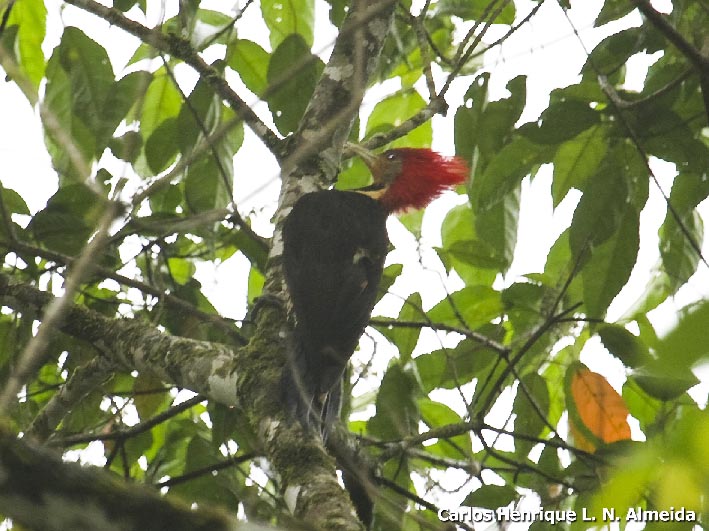
Helmeted woodpecker
The helmeted woodpecker (Celeus galeatus) is a Vulnerable species found in Argentina, Brazil, and Paraguay, primarily inhabiting the Atlantic Forest. This medium-sized woodpecker is distinguished by its cinnamon face, long red crest, and black and buff plumage, with males exhibiting a distinctive red malar patch. It primarily forages by probing soft decaying trees rather than hammering, and its limited vocalizations include a distinctive long call.
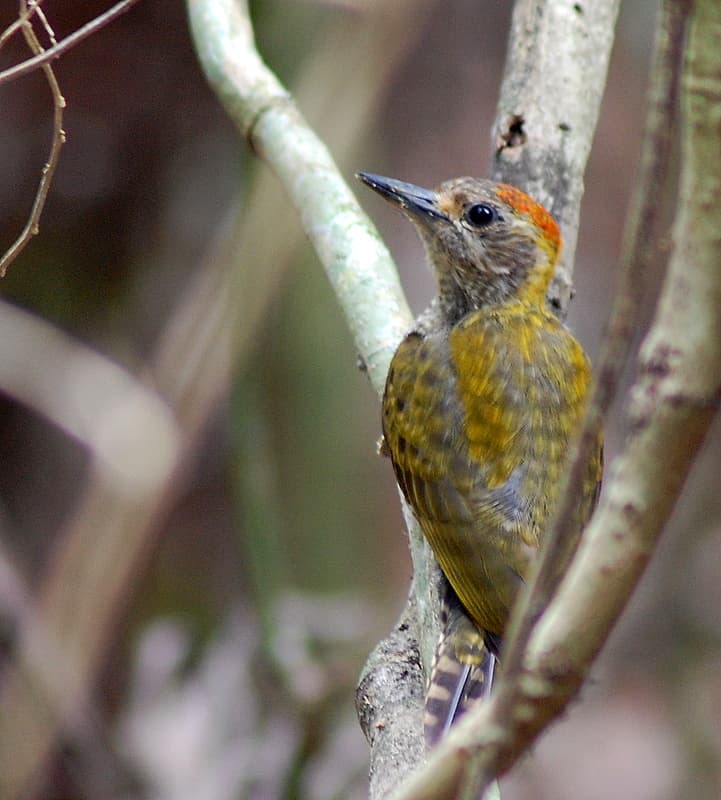
Yellow-eared woodpecker
The yellow-eared woodpecker is a species of bird endemic to eastern Brazil, found between the states of Bahia and Rio de Janeiro. This species inhabits lowlands and hills of the Atlantic Forest, including primary and secondary forests, as well as parks. Adults are approximately 15 cm long and are characterized by olive-brown faces with whitish streaks and a pale golden-yellow nape, with males and females differing primarily in their head plumage.

Campo flicker
The campo flicker is a medium-sized woodpecker found across South America, inhabiting a variety of open and semi-open landscapes. It is known for its terrestrial foraging habits, primarily feeding on ants and termites, and exhibits a complex breeding system.