
Knysna woodpecker
The Knysna woodpecker is a species of bird endemic to South Africa, found in subtropical and tropical moist lowland forests, savannas, and shrublands. It is distinguished by its thickly spotted underparts and olive-green coloration with indistinct barring. This species is currently listed as Near Threatened due to habitat loss and alteration.
Key Facts
- ›Endemic to South Africa, inhabiting moist lowland forests, savannas, and shrublands.
- ›Distinguished by a thickly spotted under-surface with black spots from chin to vent.
- ›Males have olive-green plumage above with indistinct bars, while females have a black head spotted with white and a scarlet occiput.
- ›Feeds primarily on ants, ant larvae, wood-boring beetles, and termites.
- ›Nests are excavated in dead tree trunks or branches.
- ›Listed as near Threatened by the IUCN due to habitat loss.

South Africa
Subtropical Or Tropical Moist Lowland Forests, Moist Savanna, Subtropical Or Tropical Moist Shrubland
Thickly Spotted Under-Surface, Scarlet Occipital Crest, Scarlet Markings On Head and Cheeks
Ants, Ant Larvae, Wood-Boring Beetles, Termites
Pecking, Gleaning, Probing
Dead Tree Trunks, Dead Branches
About Knysna woodpecker
The Knysna woodpecker, scientifically known as Campethera notata, is a bird species endemic to South Africa. It inhabits a range of moist environments, including subtropical and tropical lowland forests, savannas, and shrublands. This species is characterized by its distinctive underparts, which are heavily spotted with black from the chin to the vent, and its predominantly olive-green plumage above, marked with indistinct bars. Males and females exhibit slight differences, with males displaying pale olive-yellow barring and females featuring a black head spotted with white and a scarlet occiput.
Life and Habitat
This woodpecker is found thinly dispersed across the coastal lowlands of South Africa, extending into southern KwaZulu-Natal and westward towards Bredasdorp in the Western Cape. While locally common in some areas, its overall range is less than 50,000 km², with an estimated population of 1,500–5,000 individuals. The Knysna woodpecker relies on moist forests, savannas, and shrublands for survival. Its diet primarily consists of ants, ant larvae, wood-boring beetles, and termites, which it seeks by pecking, gleaning, and probing along branches at all levels of the tree canopy.
Reproduction and Nesting
Breeding for the Knysna woodpecker typically occurs between August and November, with pairs widely spaced. They excavate their nest holes in dead tree trunks or branches. A clutch usually contains 2–4 eggs, which are incubated for 13 to 21 days, followed by a fledgling period of 4 to 6 days.
Conservation Status and Threats
The Knysna woodpecker is classified as Near Threatened by the IUCN Red List, a status assigned in 2012. The primary threat to the species is habitat loss and alteration, with predictions indicating that over 90% of the population could be affected by future changes. Historical range contraction in KwaZulu-Natal has been linked to the clearing of coastal bush for agricultural and development purposes. Conservation efforts are underway, including increasing knowledge of the species and protecting suitable habitats within reserves. Ongoing actions focus on estimating population size, monitoring trends, and researching limiting factors.
Source: Wikipedia ↗
Frequently Asked Questions
What are the main physical characteristics of the Knysna woodpecker?
The Knysna woodpecker is recognized by its underparts, which are thickly covered with black spots from the chin to the vent. Males are olive-green above with subtle barring, while females have a black head with white spots and a scarlet occiput.
What does the Knysna woodpecker eat?
Its diet primarily consists of ants and their larvae, along with wood-boring beetles and termites. The woodpecker actively forages for these insects at all levels of the tree canopy.
Where can the Knysna woodpecker be found?
This species is endemic to South Africa and is found across the coastal lowlands, extending into southern KwaZulu-Natal and west to near Bredasdorp in the Western Cape. Its natural habitats include moist lowland forests, moist savanna, and moist shrubland.
What is the conservation status of the Knysna woodpecker?
The Knysna woodpecker is listed as Near Threatened by the IUCN Red List as of 2012. This status is primarily due to habitat loss and alteration, which are predicted to significantly impact its population.
How does the Knysna woodpecker reproduce?
Breeding occurs between August and November, with pairs nesting in holes excavated in dead tree trunks or branches. Females lay a clutch of 2–4 eggs, which are incubated for 13–21 days.
Related Woodpecker species

Beautiful woodpecker
The beautiful woodpecker is a species endemic to Colombia, found primarily in the Magdalena River valley. This bird is characterized by its striking plumage, with males and females differing in head patterns, and it feeds on a mixed diet of insects and fruits, foraging high in forest canopies. Its conservation status is assessed as Least Concern.
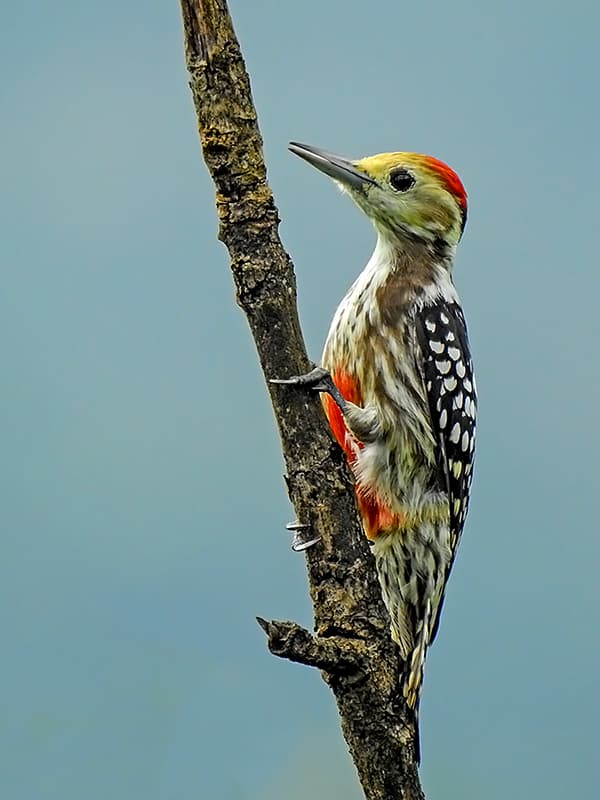
Yellow-crowned woodpecker
The yellow-crowned woodpecker, also known as the Mahratta woodpecker, is a small pied woodpecker species native to the Indian subcontinent. It is characterized by its pale head, black upperparts heavily spotted with white, and streaked underparts with a red belly patch. Both sexes have distinctive head markings, with the female exhibiting a yellowish crown and nape, while the male displays a scarlet nape and yellow fore-crown.

Great spotted woodpecker
The great spotted woodpecker is a medium-sized bird characterized by its pied black and white plumage and a distinctive red patch on its lower belly. It inhabits diverse woodlands across the Palearctic region and parts of North Africa. This adaptable species is known for its varied diet, including insect larvae, seeds, and even the eggs and chicks of other birds, and its habit of excavating tree cavities for nesting.