
Ladder-backed woodpecker
The ladder-backed woodpecker is a small North American bird recognized by its black and white barred plumage, resembling ladder rungs on its back. It inhabits dry, brushy areas and thickets across the southwestern United States, Mexico, and parts of Central America. This species is known for its unique nesting habits and a diet that includes insects and cactus fruit.
Key Facts
- ›Small woodpecker, typically 16.5 to 19 cm in length.
- ›Distinguished by black and white barred patterns on its back and wings.
- ›Found year-round in the southwestern U.S., Mexico, and Central America.
- ›Nests in cavities excavated in tree trunks or large cacti.
- ›Feeds on insects, their larvae, and fruit from cacti.
- ›Adult males possess a red crown patch, absent in females.
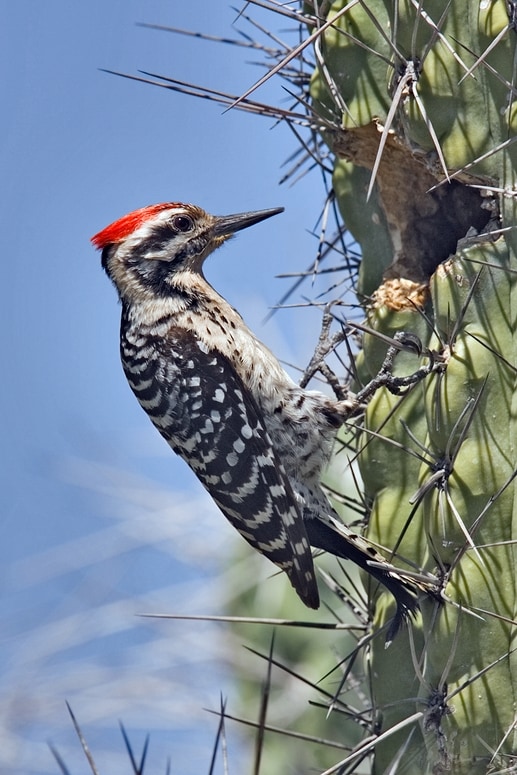
Ladder-Backed Woodpecker
North America, Mexico, Central America
Dry Brushy Areas, Thickets
Barred Pattern On Back and Wings, Red Crown Patch, Speckled Rump
Insects, Insect Larvae, Cactus Fruit
Boring Into Tree Trunks
Tree Trunk Cavities, Cactus Cavities
About Ladder-backed woodpecker
The ladder-backed woodpecker (Dryobates scalaris) is a small North American bird known for its distinctive black and white plumage. Its back and wings feature a barred pattern that resembles the rungs of a ladder, and its rump is speckled with black. The underparts are typically cream-colored, though southern populations may exhibit duskier buff breasts and smaller bills. Adult males are identifiable by a red crown patch, which is absent in adult females.
Range and Habitat
This species is found year-round across a substantial range, extending from the southwestern United States, including areas of southern Nevada and southeastern Colorado, throughout most of Mexico, and locally into Central America as far south as Nicaragua. Ladder-backed woodpeckers prefer dry, brushy areas and thickets, adapting well to arid environments.
Behavior and Diet
As with most woodpeckers, the ladder-backed woodpecker forages by excavating tree trunks with its chisel-like bill, seeking out insects and their larvae. A notable dietary supplement for this species is the fruit produced by cacti. They are cavity nesters, excavating their homes in tree trunks or, in drier regions, within large cacti. The female typically lays between two and seven plain white eggs, which are incubated by both parents, though further details about their nesting period are not widely recorded.
Identification
The ladder-backed woodpecker bears a strong resemblance to Nuttall's woodpecker. Key distinctions include the ladder-backed woodpecker having significantly less black on its head and upper back. Their geographic ranges overlap minimally, primarily in southern California and northern Baja California, where hybridization has been observed.
Source: Wikipedia ↗
Frequently Asked Questions
What does the ladder-backed woodpecker look like?
The ladder-backed woodpecker is a small bird, about 16.5 to 19 cm long. It is primarily black and white with a distinctive barred pattern on its back and wings that resembles ladder rungs. Its underparts are cream-colored, speckled with black, and adult males have a red crown patch.
Where can I find a ladder-backed woodpecker?
These woodpeckers are found year-round across a large range that includes the southwestern United States, most of Mexico, and extend locally into Central America as far south as Nicaragua. They prefer dry, brushy areas and thickets.
What do ladder-backed woodpeckers eat?
Like other woodpeckers, they bore into tree trunks to find insects and their larvae. Additionally, they supplement their diet with fruit produced by cacti.
How does a ladder-backed woodpecker nest?
Ladder-backed woodpeckers excavate nesting cavities in tree trunks. In more arid environments, they are known to use large cacti for their nests. The female lays between 2 and 7 plain white eggs, and both sexes incubate them.
How is the ladder-backed woodpecker different from Nuttall's woodpecker?
The ladder-backed woodpecker is very similar in appearance to Nuttall's woodpecker. However, it has less black on its head and upper back. Their ranges only overlap minimally in southern California and northern Baja California, where hybrids are known to occur.
Related Woodpecker species
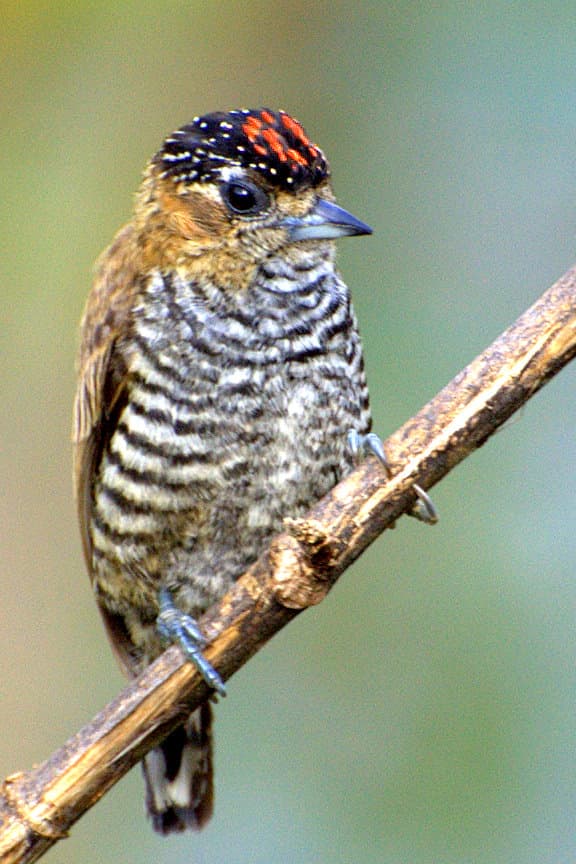
Ochre-collared piculet
The ochre-collared piculet is a small woodpecker species found in Argentina, Brazil, and Paraguay. It is characterized by its cinnamon-buff collar and has a black cap with red tips (in males) and white spots. This species primarily inhabits lowland rainforests, secondary growth, and thickets.
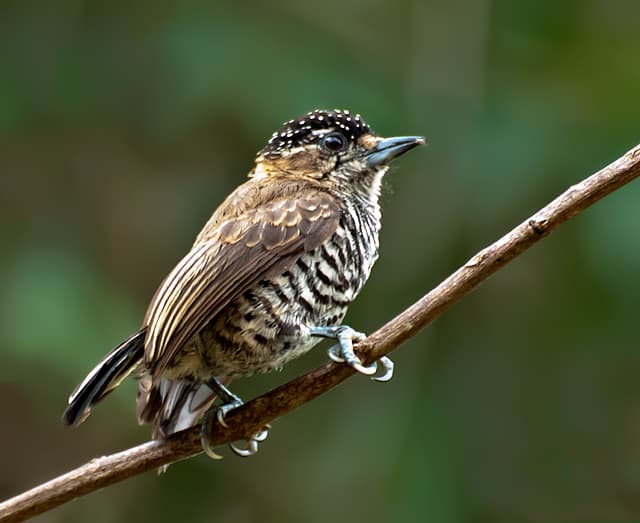
White-barred piculet
The White-barred Piculet is a small bird found across various South American countries, including Argentina, Brazil, and Paraguay. This species is characterized by its distinctive barring on its underparts and a black cap with white spots in males. It inhabits a range of woodland and forest edge environments, feeding primarily on insects and ant larvae.

Beautiful woodpecker
The beautiful woodpecker is a species endemic to Colombia, found primarily in the Magdalena River valley. This bird is characterized by its striking plumage, with males and females differing in head patterns, and it feeds on a mixed diet of insects and fruits, foraging high in forest canopies. Its conservation status is assessed as Least Concern.