
White-barred piculet
The White-barred Piculet is a small bird found across various South American countries, including Argentina, Brazil, and Paraguay. This species is characterized by its distinctive barring on its underparts and a black cap with white spots in males. It inhabits a range of woodland and forest edge environments, feeding primarily on insects and ant larvae.
Key Facts
- ›Found in Argentina, Bolivia, Brazil, French Guiana, Guyana, Paraguay, and Uruguay.
- ›Measures approximately 10 cm (3.9 in) in length and weighs 6.3 to 12 g (0.22 to 0.42 oz).
- ›Adult males have a black cap with a red patch on the forehead and white spots, while females lack the red forehead marking.
- ›Feeds on ants, insect larvae, beetle eggs, and other small invertebrates, often drilling into wood.
- ›Nests are excavated in tree branches, with clutch sizes typically ranging from two to four eggs.
- ›Its primary vocalization is a high, dry, fast trill.
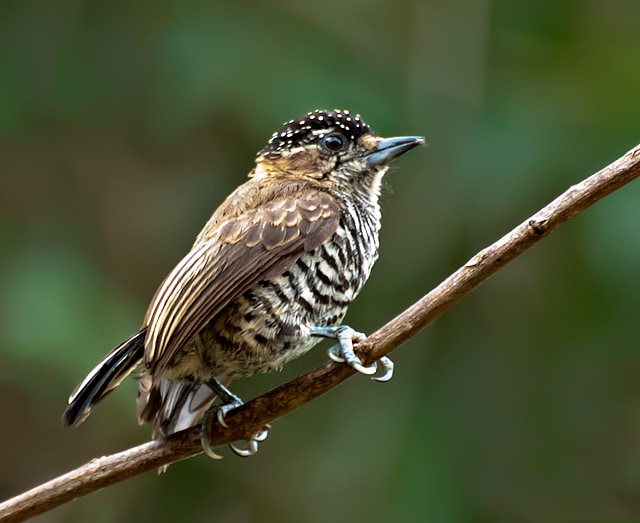
White-Barred Piculet
South America
Wet Woodland, Dry Woodland, Forest Edges, Thickets, Gallery Forest, Savannah, Scrub, Bamboo Clumps, VáRzea, Overgrown Parks, Gardens
Barring On Underparts, Black Cap With White Spots, Red Patch On Forehead
Ants, Insect Larvae, Insect Eggs, Small Invertebrates, Sap
Drills Holes In Wood, Feeds On Twigs and Branch Tips, Clings To Underside of Branches, Feeds On Vines and Bamboo
Slender Tree Branches
High, Dry, Fast Trill, 'Tsirit, Tsick' Call, Loud Staccato Drumming
About White-barred piculet
The White-barred Piculet (Picumnus cirratus) is a small species of bird belonging to the woodpecker family Picidae. It is distributed across a significant portion of South America, with populations found in Argentina, Bolivia, Brazil, French Guiana, Guyana, Paraguay, and Uruguay. This species is characterized by its distinctive barring on its underparts and, in adult males, a black cap featuring a red patch on the forehead and white spots.
Description and Identification
Measuring approximately 10 cm in length, the White-barred Piculet weighs between 6.3 and 12 grams. Adult males are notable for their black cap, which is adorned with a red forehead patch and white spots, while females lack the red marking. Their upperparts are typically dull brownish, and their underparts are white with black barring. The iris is dark chestnut-brown, the beak is black with a pale base to the mandible, and the legs are gray. Juveniles are duller and darker than adults, with an unspotted crown and more prominent barring.
Distribution and Habitat
The White-barred Piculet occupies a variety of habitats, including wet and dry woodlands, forest edges, thickets, gallery forests within savannahs, scrublands, bamboo clumps, várzea (seasonally flooded forests), and even overgrown parks and gardens. Its altitudinal range extends from near sea level up to approximately 2,100 meters (6,900 ft).
Behavior and Ecology
This species is a year-round resident within its range. White-barred Piculets typically forage alone but may join mixed-species foraging flocks. Their diet consists mainly of ants, insect larvae and eggs, particularly those of wood-boring beetles, and other small invertebrates. They actively drill into wood to access food and may also feed on tree sap. Primarily, they forage on twigs and branch tips, vines, and bamboo, often seen clinging to the underside of branches.
Breeding and Vocalizations
The breeding season varies geographically, with northern subspecies breeding between July and December, and southern subspecies from September to March. Both sexes participate in excavating a nest hole, usually in a slender tree branch, at varying heights above the ground. A clutch typically contains two to four eggs. The primary vocalization of the White-barred Piculet is a high, dry, fast trill, often described as 'trrrrriut.' They also produce a 'tsirit, tsick' call, and their drumming on dead wood is a loud, staccato sound.
Conservation Status
The White-barred Piculet is listed as 'Least Concern' by the IUCN. Despite an unknown population size that is thought to be decreasing, its extremely large range and the absence of immediate threats have prevented a more critical conservation rating. While generally common, it faces local threats from habitat deterioration due to urban growth in some areas.
Source: Wikipedia ↗
Frequently Asked Questions
What is the scientific name for the White-barred Piculet?
The scientific name for the White-barred Piculet is *Picumnus cirratus*. The specific epithet 'cirratus' is Latin for 'curly headed'.
Where is the White-barred Piculet found?
The White-barred Piculet has a wide distribution across South America, inhabiting countries such as Argentina, Bolivia, Brazil, French Guiana, Guyana, Paraguay, and Uruguay.
What does the White-barred Piculet eat?
This species primarily feeds on ants, insect larvae, and eggs, particularly those of wood-boring beetles, and other small invertebrates. They are also known to consume sap from trees.
How does the White-barred Piculet build its nest?
Both male and female White-barred Piculets excavate nest holes, typically in slender tree branches. The height of the nest above ground can vary.
What are the main vocalizations of the White-barred Piculet?
The primary vocalization of the White-barred Piculet is described as an extremely high, dry, fast trill. They also produce a 'tsirit, tsick' call and a loud staccato drumming sound on dead wood.
What is the conservation status of the White-barred Piculet?
The International Union for Conservation of Nature (IUCN) has assessed the White-barred Piculet as 'Least Concern'. While its population is thought to be decreasing, it has not reached the thresholds for a more critical rating.
Related Woodpecker species
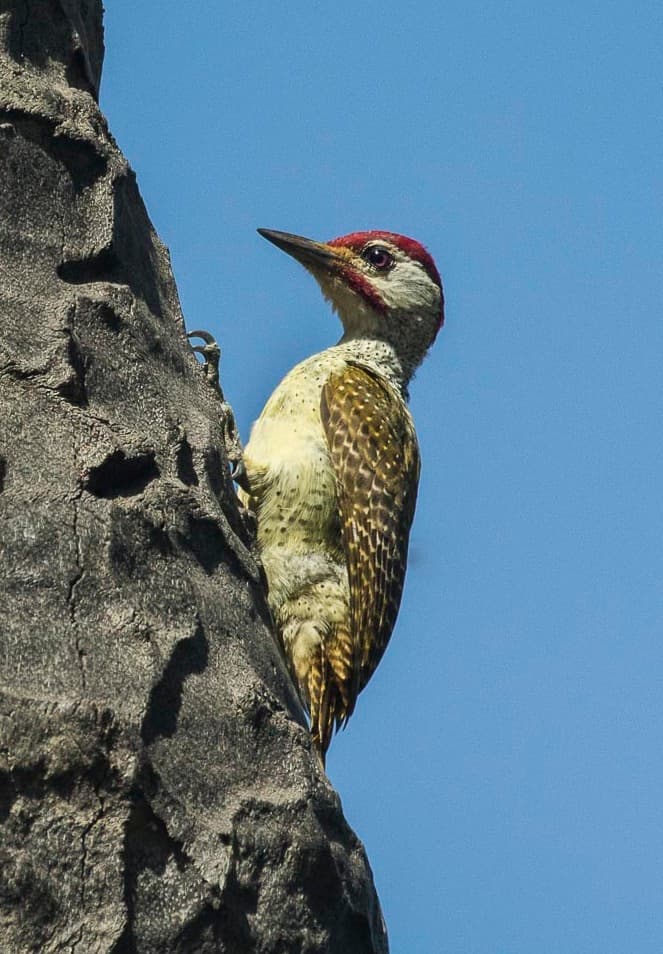
Fine-spotted woodpecker
The fine-spotted woodpecker is a widespread and common resident breeder found across much of west and central tropical Africa. This species is typically found in open forests, savannahs, and bushland, characterized by its green upperparts with fine pale spots and whitish to yellowish underparts marked with dark spots. Both adult males and females exhibit distinct head markings that differentiate them, aiding in identification.
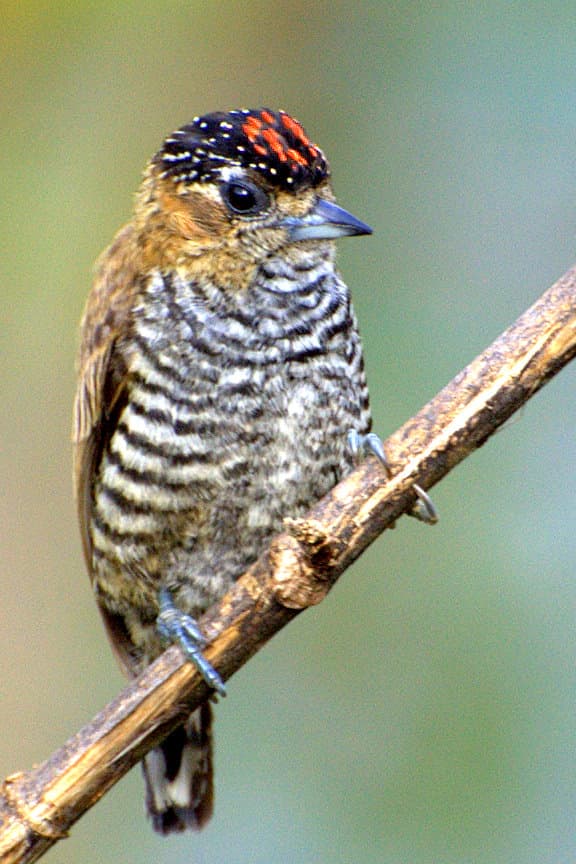
Ochre-collared piculet
The ochre-collared piculet is a small woodpecker species found in Argentina, Brazil, and Paraguay. It is characterized by its cinnamon-buff collar and has a black cap with red tips (in males) and white spots. This species primarily inhabits lowland rainforests, secondary growth, and thickets.

Campo flicker
The campo flicker is a medium-sized woodpecker found across South America, inhabiting a variety of open and semi-open landscapes. It is known for its terrestrial foraging habits, primarily feeding on ants and termites, and exhibits a complex breeding system.