
Plain-breasted piculet
The plain-breasted piculet is a small woodpecker species found in the Amazon basin of Brazil, Colombia, and Peru. It is characterized by its relatively uniform underparts and distinctive crown markings, with males displaying red tips on their black crown feathers. This species primarily inhabits riverine forests and adjacent secondary growth.
Key Facts
- ›The plain-breasted piculet measures 8 to 10 cm in length and weighs approximately 11 to 12 grams.
- ›Adult males have a black crown with red feather tips, while females have an entirely black crown.
- ›It is found along the Ucayali and upper Amazon rivers in Peru, with extensions into southeastern Colombia and western Brazil.
- ›The species primarily inhabits forest on river islands and banks, as well as nearby secondary forests.
- ›Its diet consists of small insects foraged from slender branches and stems.
- ›The IUCN status is Least Concern, though its population is believed to be decreasing.

Castelnau's Piculet
Brazil, Colombia, Peru
Riverine Forest, Forest On River Islands, Forest On River Banks, Secondary Forest, Edges of Pastures, Edges of Gardens
Grayish Olive, Brown, Greenish Yellow, Black, White, Yellowish White
- Red tips on male's black crown feathers
- Whitish crown sides and nape with faint black speckles/bars
- Light brown face with gray and whitish vermiculation
- Black tail with white inner webs on some feathers
- Unmarked dull yellowish white underparts
Small Insects
Forages On Slender Branches and Stems, Hops Along and Among Branches, Picks, Taps, and Probes For Prey
Small Cavities
- Song: 'A High-Pitched, Rapid, Falling Trill: Tree'E'E'E'E'E'E'
- Soft Tapping Sounds While Foraging
About Plain-breasted piculet
The plain-breasted piculet (Picumnus castelnau) is a small bird belonging to the woodpecker family Picidae, specifically within the subfamily Picumninae. It is found in the Amazon basin, inhabiting parts of Brazil, Colombia, and Peru. This species is recognized for its relatively plain underparts and distinct crown markings, with males featuring red tips on their black crowns and females possessing entirely black crowns.
Distribution and Habitat
This piculet is distributed along the Ucayali and upper Amazon rivers. The majority of its range lies within Peru, though it extends slightly into extreme southeastern Colombia and western Brazil. Its preferred habitats include forests situated on river islands and along river banks. It also occupies nearby secondary forests and can occasionally be found in vegetation bordering pastures and gardens. It is particularly common in the canopy of young trees such as Cecropia, Cassia, and Mimosa on islands, and can be found at elevations up to 1,000 meters (3,300 ft).
Behavior and Diet
The plain-breasted piculet forages for its diet of small insects on slender branches and stems, typically at heights of 6 to 15 meters (20 to 49 ft) above the ground, though sometimes lower at forest edges. Its foraging technique involves hopping along branches and using picking, tapping, and probing methods to find prey. These birds are often observed singly, in pairs, or in small family groups of up to four individuals. They also occasionally join mixed-species foraging flocks.
Breeding and Vocalizations
The breeding season for the plain-breasted piculet appears to include at least the months of May through July. Like other piculets, it is assumed to nest in small cavities, but specific details about its breeding biology are largely unknown. The species' song is described as a high-pitched, rapid, falling trill. While foraging, they also produce soft tapping sounds.
Conservation Status
The plain-breasted piculet is listed as Least Concern by the IUCN. While its exact population size is not known, it is believed to be decreasing. No immediate threats have been identified, and the species is considered fairly common. It can adapt to woody second growth and may tolerate moderate habitat disturbance.
Source: Wikipedia ↗
Frequently Asked Questions
What is the size of the plain-breasted piculet?
The plain-breasted piculet is a small bird, measuring between 8 to 10 centimeters (3.1 to 3.9 inches) in length and weighing approximately 11 to 12 grams (0.39 to 0.42 ounces).
How can I distinguish between male and female plain-breasted piculets?
Adult males have a black crown with distinctive red tips on the feathers. Adult females, in contrast, possess an entirely black crown, otherwise being identical to the males.
Where does the plain-breasted piculet live?
This species is found in the Amazon basin, predominantly along the Ucayali and upper Amazon rivers in Peru. Its range also extends slightly into southeastern Colombia and western Brazil.
What kind of habitat does the plain-breasted piculet prefer?
The plain-breasted piculet mainly inhabits forests located on river islands and along river banks. It also occurs in adjacent secondary forests and occasionally on the edges of pastures and gardens.
What does the plain-breasted piculet eat and how does it find food?
Its diet comprises small insects, which it forages for on slender branches and stems, typically at heights of 6 to 15 meters above the ground. It moves by hopping and uses picking, tapping, and probing techniques.
What is the conservation status of the plain-breasted piculet?
The International Union for Conservation of Nature (IUCN) has assessed the plain-breasted piculet as Least Concern. However, its population size is unknown and is believed to be decreasing.
Related Woodpecker species
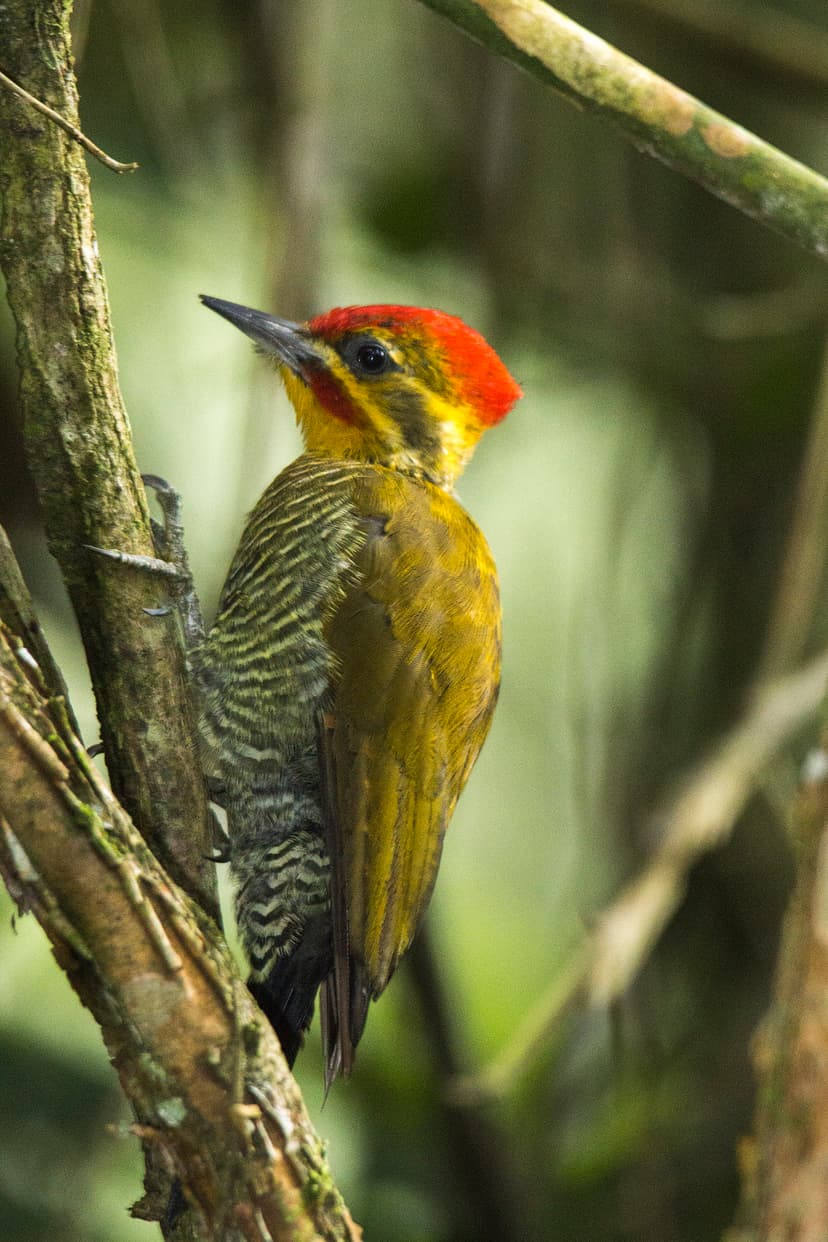
Yellow-browed woodpecker
The yellow-browed woodpecker, also known as the white-browed woodpecker, is a Near Threatened bird species found in Argentina, Brazil, Paraguay, and Uruguay. Measuring between 21 to 22 cm, it is characterized by its olive green upperparts and whitish underparts with dark olive bars, with males and females exhibiting distinct head plumage. This species primarily inhabits humid forests and woodlands, often foraging in the mid-levels for ants and their eggs.
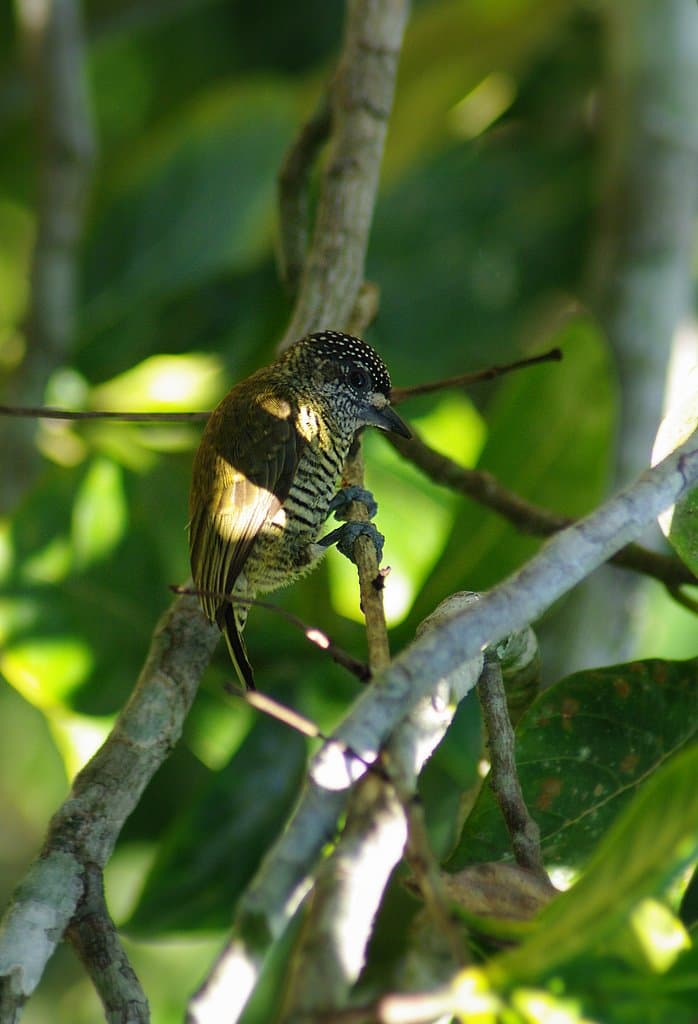
Golden-spangled piculet
The golden-spangled piculet is a small bird found across several South American countries, inhabiting diverse wooded environments from rainforests to savannas. It is characterized by its distinctive plumage, with males and females exhibiting variations in their spotted caps, and is known for foraging in the lower strata of forests and nesting in soft wood.

Olivaceous piculet
The Olivaceous piculet is a small woodpecker found from Guatemala south through Central America and western South America to Peru. It inhabits a variety of forest edges and open woodlands, shunning dense mature forest interiors. Its primary diet consists of ants and termites, which it extracts from drilled holes or gleans from vegetation.