
Speckle-chested piculet
The Speckle-chested piculet is a small bird endemic to Peru, measuring 9 to 10 cm in length. It is characterized by its grayish-brown upperparts with pale gray edges and dark markings, and a distinctive black breast with large white teardrop-shaped spots. This species primarily inhabits humid lowland and montane forests within a very limited range in the eastern Andes.
Key Facts
- ›Endemic to a very small area of Peru, primarily in the Huallaga and Utcubamba Valleys.
- ›Measures 9 to 10 cm in length and weighs approximately 10 g.
- ›Adult males have a black cap with a red forehead patch and white spots, while females have white spots instead.
- ›Inhabits humid lowland and montane forests, including mature secondary forests.
- ›Diet is assumed to be primarily insects, foraged alone, in pairs, or in small family groups.
- ›Conservation status is near Threatened due to habitat loss and deforestation.

Peru
Humid Lowland Primary Forest, Montane Forest, Mature Secondary Forest
Grayish Brown, Black, Red, White, Pale Gray, Off-White
- Black cap with red patch on forehead
- White spots on forehead
- Scalloped appearance on upperparts due to feather markings
- Black breast with large teardrop-shaped white spots
- White belly and undertail coverts with wide black bars
Insects
- Forages mostly in the forest canopy
- Observed feeding at lower levels
- Feeds alone, in pairs, or in small family groups
- Joins mixed-species foraging flocks
- Song: A High-Pitched, Rapid, Falling Trill
- Vigorous Tapping During Foraging Can Produce A Distinctive Rattling Sound
About Speckle-chested piculet
The Speckle-chested piculet (Picumnus steindachneri) is a small avian species endemic to Peru, belonging to the woodpecker family Picidae. It is distinguished by its compact size, measuring between 9 and 10 cm in length, and an average weight of approximately 10 grams. The plumage of adult males features a black cap with a noticeable red patch on the forehead and white spots elsewhere, contrasting with grayish-brown upperparts marked by pale gray edges and dark, scalloped patterns. Their breast is a striking black adorned with large, teardrop-shaped white spots, and their underside is white with broad black bars. Adult females share a similar appearance but have small white spots on the forehead instead of red.
This piculet occupies a very restricted geographic range, primarily found in the central Huallaga Valley and parts of the Utcubamba Valley, situated in the foothills of the eastern Andes. Its preferred habitats include humid lowland primary forests, montane forests rich with vines, epiphytes, and bamboos, as well as mature secondary forests. The species has been observed foraging at various levels within the forest, often in the canopy, and is known to feed alone, in pairs, or within small family groups, frequently associating with mixed-species foraging flocks.
While detailed studies on its breeding biology are scarce, juvenile Speckle-chested piculets have been sighted in late August and early September. Its vocalizations include a high-pitched, rapid, falling trill, and its energetic tapping during foraging can create a distinct rattling sound. Unfortunately, the Speckle-chested piculet faces significant threats from deforestation, driven by logging and agricultural expansion for coffee plantations, cattle grazing, and other farming practices. Consequently, its population is estimated to be decreasing, and as of 2023, it is classified as Near Threatened on the IUCN Red List, highlighting its vulnerability to habitat destruction within its limited distribution.
Source: Wikipedia ↗
Frequently Asked Questions
What is the scientific name of the Speckle-chested piculet?
The scientific name of the Speckle-chested piculet is *Picumnus steindachneri*. It is part of the woodpecker family, Picidae.
Where can the Speckle-chested piculet be found?
This species is endemic to Peru, found in a very limited range within the central Huallaga Valley and parts of the Utcubamba Valley in the foothills of the eastern Andes.
What is the size of a Speckle-chested piculet?
The Speckle-chested piculet is a small bird, typically measuring between 9 to 10 cm (3.5 to 3.9 inches) in length and weighing around 10 grams (0.35 ounces).
What are the main threats to the Speckle-chested piculet?
The primary threats to the Speckle-chested piculet are deforestation for timber and land clearance for agriculture, including coffee plantations, cattle grazing, and other farming activities. Its forest-dependent nature makes it vulnerable to habitat destruction.
What is the conservation status of the Speckle-chested piculet?
As of 2023, the Speckle-chested piculet is assessed as Near Threatened on the IUCN Red List. Its population is believed to be decreasing.
What does the Speckle-chested piculet eat?
While its diet has not been extensively studied, it is assumed to consist mostly of insects. They forage alone, in pairs, or in small family groups, often joining mixed-species foraging flocks.
Related Woodpecker species
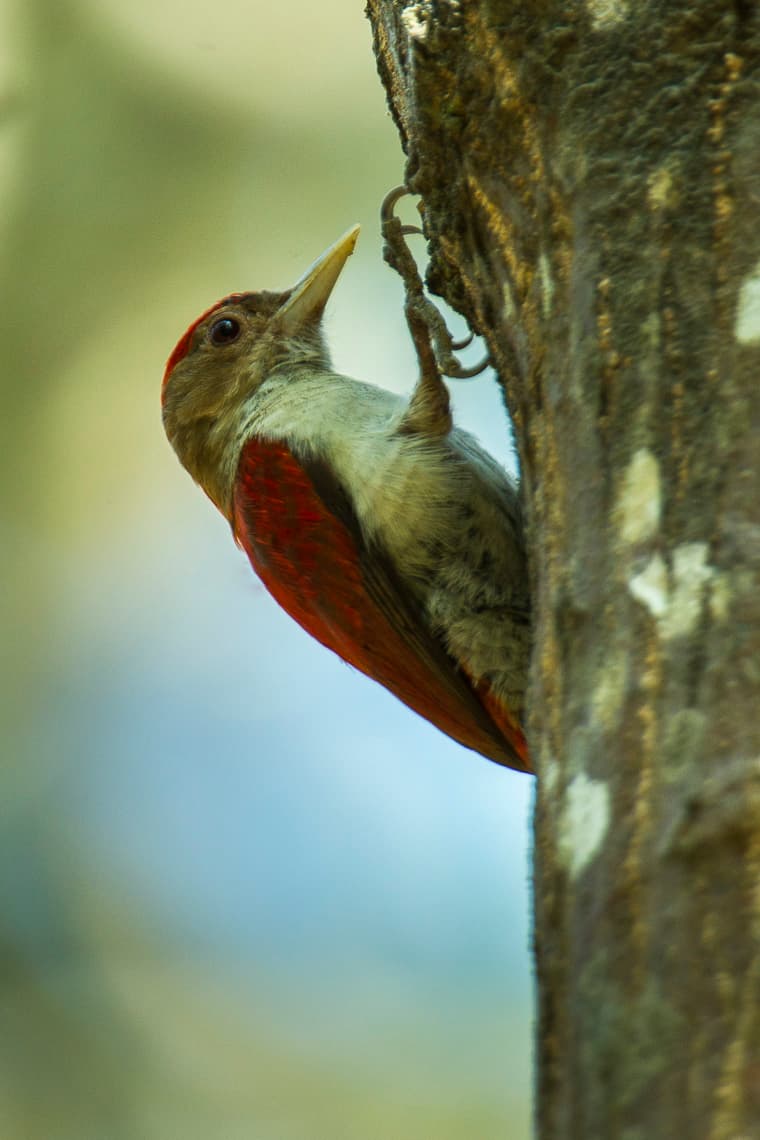
Scarlet-backed woodpecker
The scarlet-backed woodpecker is a small bird found in Colombia, Ecuador, and Peru, notable for its brownish-scarlet upperparts and the distinct head plumage differences between males and females. It inhabits a variety of dry and semi-humid woodlands and scrublands, foraging at all forest levels. Its conservation status is Least Concern, with a population believed to be increasing.

Fernandina's flicker
Fernandina's flicker (Colaptes fernandinae), also known as the Cuban flicker, is a critically endangered species of woodpecker endemic to Cuba. This medium-sized bird is characterized by its buffy cinnamon head, heavily streaked underparts, and distinctive yellow underwings, and is closely associated with palm trees for both foraging and nesting.
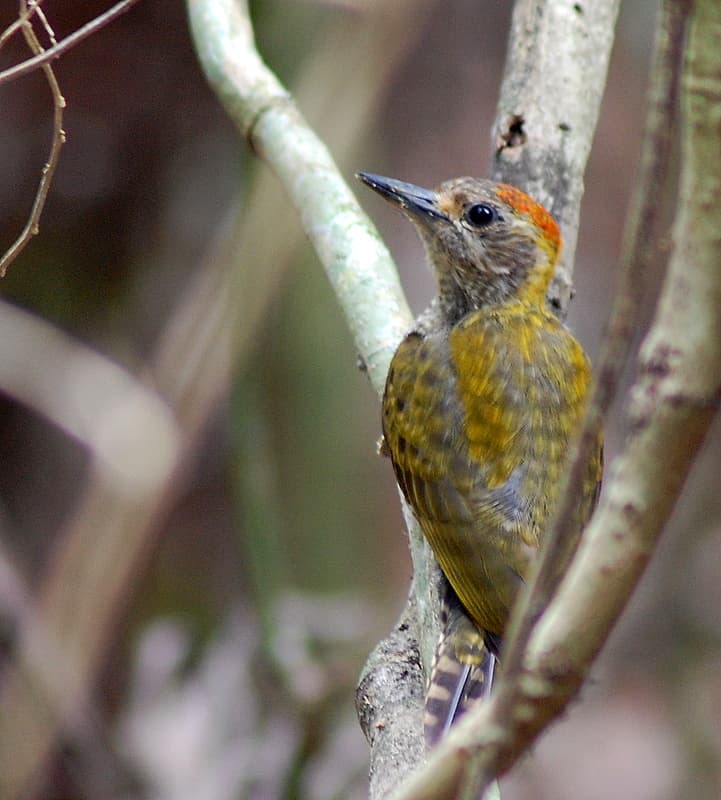
Yellow-eared woodpecker
The yellow-eared woodpecker is a species of bird endemic to eastern Brazil, found between the states of Bahia and Rio de Janeiro. This species inhabits lowlands and hills of the Atlantic Forest, including primary and secondary forests, as well as parks. Adults are approximately 15 cm long and are characterized by olive-brown faces with whitish streaks and a pale golden-yellow nape, with males and females differing primarily in their head plumage.