
Spotted piculet
The spotted piculet is a small bird found exclusively in northeastern Brazil, inhabiting dry woodlands and shrublands. It is characterized by its predominantly brown plumage with distinctive black and white spotting, and males feature a red patch on their forehead. Much of its behavior, including diet and breeding, remains poorly understood.
Key Facts
- ›Endemic to northeastern Brazil.
- ›Inhabits dry open woodlands and caatinga shrublands.
- ›Adults are approximately 10 cm (3.9 in) long.
- ›Males have a black cap with a red forehead patch and white spots.
- ›Females lack the red forehead patch.
- ›Its conservation status is assessed as Least Concern by the IUCN.

Piculet, Pygmy Piculet
Brazil
Dry Open Woodland, Caatinga Shrublands
Black cap with red patch on forehead, White spots on cap, Black and white spotted underparts
- Very High-Pitched, Squeaky 'Tsirrrrr, Tsi, Tsi, Tsi'
- Very High, Descending, Fast, Chivering Trill 'Ttrrrruh'
About Spotted piculet
The spotted piculet (Picumnus pygmaeus) is a distinctive bird species belonging to the woodpecker family, Picidae, specifically within the subfamily Picumninae. This small bird is endemic to Brazil, found exclusively in the northeastern regions of the country. Its preferred habitats are dry open woodlands and the arid caatinga shrublands.
Physical Characteristics
Adult spotted piculets measure approximately 10 cm (3.9 inches) in length. A key distinguishing feature is the male's black cap, which is adorned with a bright red patch on the forehead and further decorated with white spots. The rest of their head and upperparts are generally dark brown, often featuring black and white tips on the feathers, with a paler rump. Their flight feathers are dark brown, edged with buff or cinnamon-buff. The underparts are typically light to darkish brown, frequently with a rufous tint, and marked with prominent black and white spots. Adult females share a similar appearance but lack the red patch on the forehead. Juveniles are duller overall, with less distinct spotting.
Distribution and Habitat
The spotted piculet's range is confined to northeastern Brazil, encompassing areas such as central Maranhão, Pernambuco, northeastern Goiás, and the extreme northern part of Minas Gerais. They thrive in dry, open woodland environments and the characteristic caatinga shrublands, which are adapted to arid conditions.
Behavior and Ecology
As far as is known, the spotted piculet is a resident species throughout its range, meaning it does not undertake seasonal migrations. However, much of its behavioral ecology remains a mystery. Little is documented regarding its specific foraging techniques or its diet. The breeding biology of the spotted piculet is also largely unknown; however, observations include nest building in December and a female feeding a grown chick in October, providing slight clues to its reproductive timing.
Vocalizations
The vocalizations of the spotted piculet have been described by observers. One account characterizes its call as a "very high-pitched, squeaky 'tsirrrrr, tsi, tsi, tsi'." Another description notes a "very high, descending, fast, chivering trill 'ttrrrruh'."
Conservation Status
The International Union for Conservation of Nature (IUCN) has assessed the spotted piculet as Least Concern. While the species possesses a large range, its population size and trend are not precisely known. No immediate threats have been identified, and the lack of detailed knowledge may be due to the species being uncommon or simply overlooked rather than facing significant endangerment.
Source: Wikipedia ↗
Frequently Asked Questions
Where is the spotted piculet found?
The spotted piculet is found only in northeastern Brazil. Its range is bounded by central Maranhão, Pernambuco, northeastern Goiás, and extreme northern Minas Gerais.
What does the spotted piculet look like?
Adult spotted piculets are about 10 cm long, with males having a black cap with a red forehead patch and white spots. Their upperparts are dark brown with black and white tips, and their underparts are spotted with black and white. Females are similar but lack the red on the forehead.
What is the habitat of the spotted piculet?
This species inhabits dry open woodland and caatinga shrublands. These are arid environments characteristic of its native region in northeastern Brazil.
What is the conservation status of the spotted piculet?
The spotted piculet is listed as Least Concern by the IUCN. While its exact population size and trend are not known, no immediate threats have been identified.
What does the spotted piculet eat?
Very little is known about the spotted piculet's diet. Its foraging techniques and specific food sources have not been documented.
When does the spotted piculet breed?
The breeding biology of the spotted piculet is largely unknown. Nest building has been observed in December, and a grown chick was seen being fed in October, suggesting a breeding period around these months.
Related Woodpecker species

Ochre-backed woodpecker
The ochre-backed woodpecker is a species found exclusively in Brazil, inhabiting humid forests, savannas, and orchards. Adults are characterized by their buffy to ochre heads and crests, with variable black markings on cinnamon-buff upperparts, and sooty underparts. They are known for their arboreal ant diet and distinctive calls.
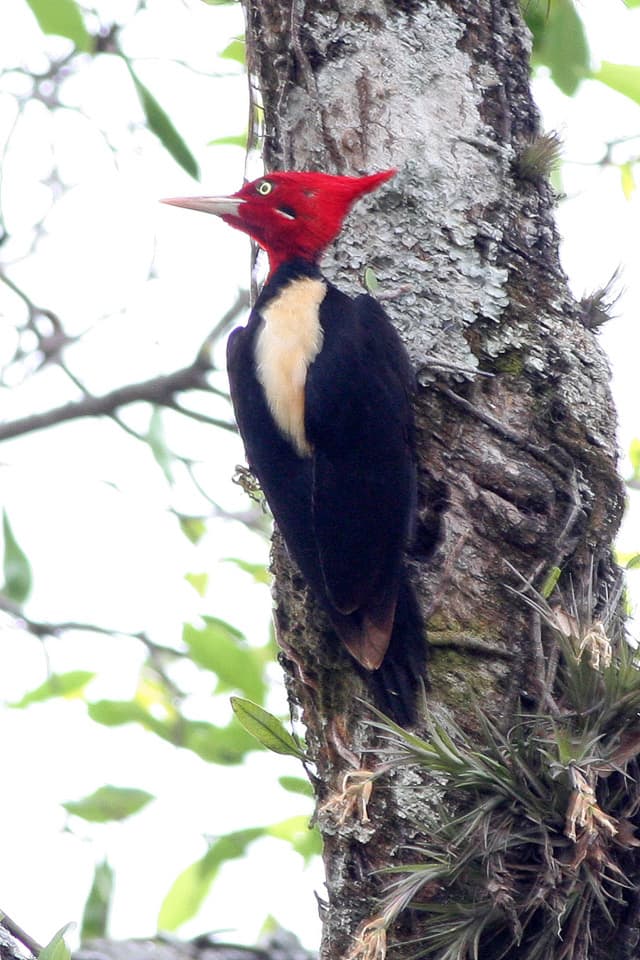
Cream-backed woodpecker
The cream-backed woodpecker is a striking bird found in the open landscapes of South America, including Argentina, Bolivia, Brazil, Paraguay, and Uruguay. Characterized by its mostly black body and a distinctive creamy band across its face, it primarily feeds on beetle larvae. This species is also known for its unique vocalizations and its habit of excavating nest holes in trees and palms.
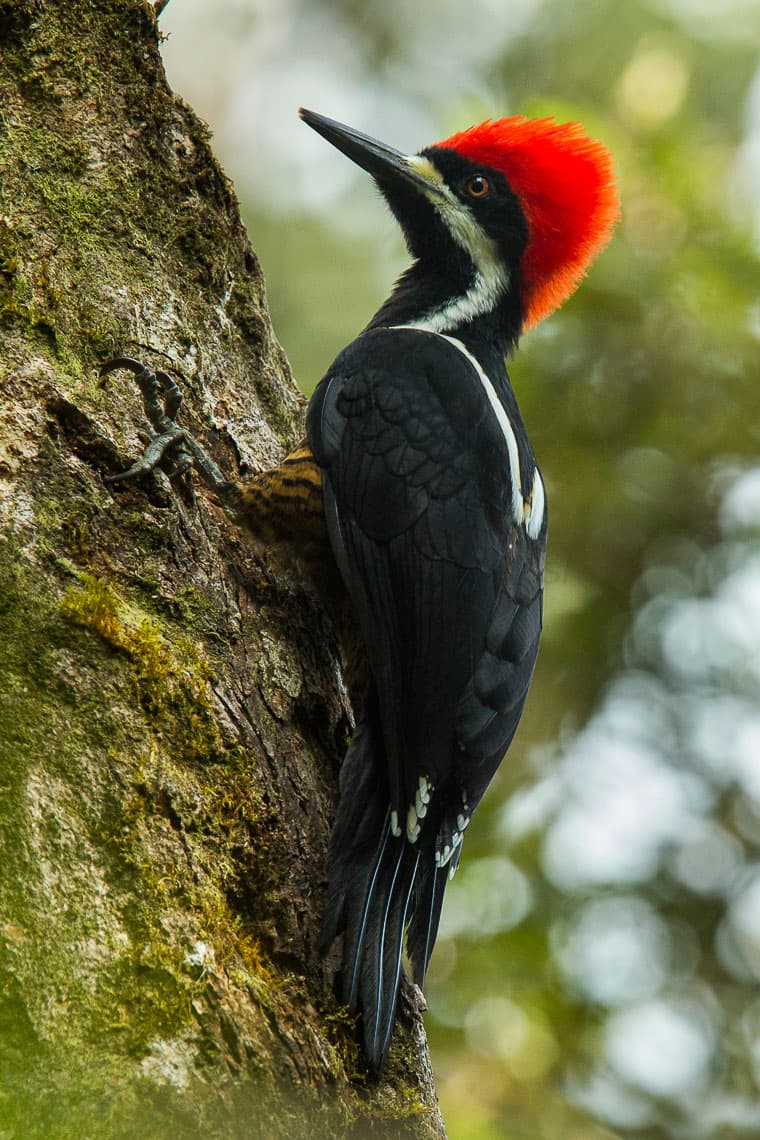
Powerful woodpecker
The powerful woodpecker is a large bird found in the montane forests of Colombia, Ecuador, Peru, and Venezuela. It is characterized by its striking black and white facial markings and the male's red head and crest, while females have black heads. This species is a year-round resident that forages at all forest levels.