
Syrian woodpecker
The Syrian woodpecker (Dendrocopos syriacus) is a medium-sized woodpecker found from southeastern Europe to Iran, with its range recently expanding northwestward into Europe. It inhabits open woodlands, cultivated areas with trees, and parks, often relying on older trees for food and nesting. This species is characterized by its glossy black upperparts, white facial markings, and a crimson patch on the nape of the male, with buffish-white underparts that are reddish on the abdomen and under tail coverts.
Key Facts
- ›Resides in open woodlands, cultivation with trees, and parks.
- ›Distinguished by glossy black upperparts, white facial markings, and a male's crimson nape spot.
- ›Feeds primarily on wood-boring insect larvae, but also consumes seeds, nuts, berries, and has been observed pecking polyethylene irrigation pipes.
- ›Communicates through mechanical drumming, a vibrating rattle produced by rapid bill blows, and a sharp 'quit, quit' call.
- ›Nests in neat, round holes bored into soft or decaying wood, laying up to 11 creamy white eggs on wood chips.
- ›Similar in appearance to the great spotted woodpecker but can be distinguished by its longer bill, more white on the head, and lack of white tail barring.

Southeastern Europe, Iran
Open Woodlands, Cultivation With Trees and Scrubs, Parks
- Crimson spot on the nape
- White on forehead, sides of face and neck
- Large white patch on the shoulder
- White spots on flight feathers forming wingbars
- Reddish abdomen and under tail coverts
- Long slate black bill
- Greenish grey legs
Insects, Bees, Seeds, Nuts, Berries
- Taps bark to locate prey
- Extracts prey with sticky tongue
- Hops rather than climbs
- Probes trees in 'heads-up' position, and sometimes upside-down
- Attacks polyethylene pipes, pecking holes
Bored holes in soft or decaying wood
Mechanical Drumming, Sharp 'Quit, Quit' Call
About Syrian woodpecker
The Syrian woodpecker, scientifically known as Dendrocopos syriacus, is a distinctive member of the woodpecker family, Picidae. It is primarily found in southeastern Europe and extends eastward to Iran, with recent observations noting its expansion into northwestern Europe. This species favors habitats such as open woodlands, cultivated areas featuring trees and shrubs, and parks, often depending on older trees for sustenance and nesting.
Description and Identification
Measuring approximately 23 cm in length, the Syrian woodpecker shares similarities with the great spotted woodpecker, Dendrocopos major. Adult males exhibit glossy black upperparts, a crimson spot on the nape, and white markings on the forehead and face. Large white patches adorn the shoulders, and their flight feathers are marked with white spots creating wingbars. The underparts are a buffish white, with the abdomen and under tail coverts displaying a reddish hue. The bill is long and slate black, complemented by greenish-grey legs. Females lack the crimson nape spot, and juvenile birds have a crimson crown instead. Key differences from the lesser spotted woodpecker include the crimson on the abdomen and the white shoulder patches. Distinguishing it from the great spotted woodpecker involves noting its longer bill, more extensive white on the head, and the absence of the great spotted woodpecker's white tail barring.
Behaviour and Ecology
The presence of the Syrian woodpecker is often revealed by its mechanical drumming, a rapid, vibrating rattle produced by striking a tree trunk or branch with its bill. This drumming serves as a signal for either sex and can be heard from a considerable distance. Its call is a sharp 'quit, quit,' which is softer than that of the great spotted woodpecker. The species' diet primarily consists of wood-boring insect larvae, such as those from moths and beetles, and it also consumes bees. When insect food is scarce, it will eat seeds, nuts, and berries. Unusually, Syrian woodpeckers have been observed pecking holes in polyethylene irrigation pipes in Israel, causing water pressure issues. Foraging involves tapping bark, extracting prey with a sticky tongue, and hopping along trees, often adopting a 'heads-up' or even an upside-down posture while probing for food.
Breeding Habits
Syrian woodpeckers excavate neat, round nesting holes, approximately 5 cm in diameter, in soft or decaying wood. The entrance tunnel leads to a small chamber where they lay up to 11 creamy white eggs on a bed of wood chips. These nesting holes are typically used only once, though other holes may be bored in the same tree. The young are vocal while being fed, chattering at the nest entrance, but quickly retreat inside when alarmed.
Source: Wikipedia ↗
Frequently Asked Questions
Where does the Syrian woodpecker live?
The Syrian woodpecker is a resident breeding bird found from southeastern Europe eastward to Iran. Its range has also been observed to expand further northwest into Europe in recent years.
What does the Syrian woodpecker eat?
Its diet primarily consists of insects that bore into timber, such as larvae of wood-boring moths and beetles, and it also eats bees. When insect food is scarce, it supplements its diet with seeds, nuts, and berries.
How does the Syrian woodpecker communicate?
Communication is achieved through mechanical drumming, a vibrating rattle made by rapidly striking a trunk or branch with its bill, which serves as a signal for either sex. It also has a sharp 'quit, quit' call.
What are the nesting habits of the Syrian woodpecker?
The Syrian woodpecker excavates a neat, round nesting hole in soft or decaying wood. The nest chamber is at the bottom of a shaft, where a clutch of up to 11 creamy white eggs is laid on wood chips.
How can I distinguish a Syrian woodpecker from a Great Spotted Woodpecker?
The Syrian woodpecker is similar to the great spotted woodpecker but can be distinguished by its longer bill, more extensive white on the head, and the absence of the white tail barring characteristic of the great spotted woodpecker.
Related Woodpecker species

Black-cheeked woodpecker
The black-cheeked woodpecker is a medium-sized woodpecker found from Mexico south to Ecuador. It is characterized by its distinctive black "cheeks" extending from the eye down the neck, with males and females differing in head plumage. This species inhabits a variety of forest types and clearings, feeding on arthropods, fruits, and nectar.
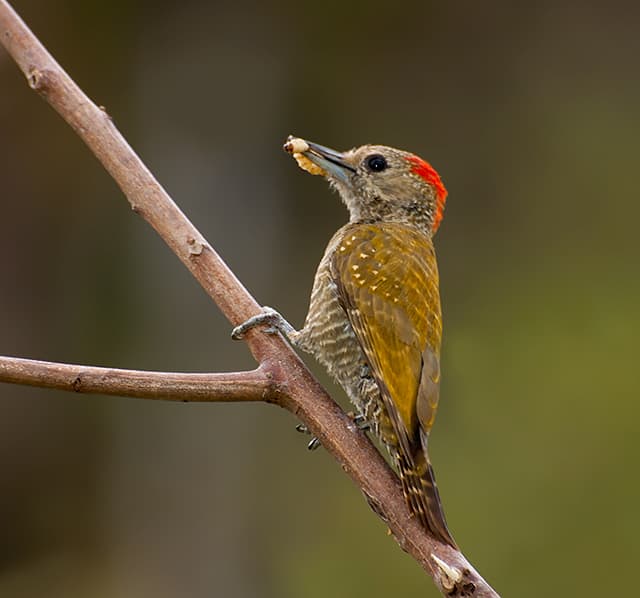
Little woodpecker
The little woodpecker (Veniliornis passerinus) is a small South American bird found in a wide variety of wooded habitats, generally avoiding dense forest interiors. Males and females share similar plumage, with males displaying red on their heads. This adaptable species is widespread across the continent and is currently listed as Least Concern.

Jamaican woodpecker
The Jamaican woodpecker is a striking bird endemic to Jamaica, distinguishable by its black and white barred plumage and red accents. This species inhabits a wide array of wooded environments across the island, from sea level to high mountains. Its diet is a mix of insects and fruits, and it is a year-round resident known for its distinctive calls and drumming.