
Yellow-tufted woodpecker
The Yellow-tufted woodpecker is a South American bird known for its distinctive plumage, featuring bluish-black upper parts, a red breast and belly, and yellow markings on its crown. It inhabits humid lowland forests and degraded areas across several northern South American countries. This social and gregarious species primarily feeds on insects and fruits.
Key Facts
- ›Native to northern South America, including countries like Brazil, Peru, and Colombia.
- ›Adults are approximately 20 cm (8 inches) in length.
- ›Distinguishing features include bluish-black upper parts, a red breast and belly, and yellow tufts on the crown (in some races).
- ›Its diet is omnivorous, consisting mainly of insects and fruits.
- ›Found in humid lowland forests, degraded forests, and woodland verges.
- ›Conservation status is assessed as 'Least Concern' by the IUCN, despite habitat degradation.

Yellow-Tufted Woodpecker
South America
Yellow Tufts On Hind-Crown, Red Fore- and Mid-Crown, Black Fore- and Mid-Crown, Yellow Irises, Yellow Orbital Ring
Insects, Fruits
Forages In Groups, Catches Insects On the Wing
About Yellow-tufted woodpecker
The Yellow-tufted woodpecker (Melanerpes cruentatus) is a species of woodpecker native to northern South America. It is characterized by its striking plumage, which includes bluish-black upper parts, cheeks, chin, throat, and chest, contrasted with a red breast and belly. The flanks and lower belly often display undulating black and white barring, and a noticeable white rump is visible in flight. Adult males can be distinguished from females by the presence of red on their fore- and mid-crowns, while females have these areas black. In some northern and western populations, the brow and hind-crown feature yellow, cream, or buff feathers, which can be tufted, though southern races have these areas black.
This species is found in humid lowland forests, including both varzea and terra firme forests, as well as secondary forests, woodland edges, and degraded areas with scattered trees. Its altitudinal range extends from sea level to approximately 1,200 meters (3,900 ft). The Yellow-tufted woodpecker is a social and gregarious bird, often observed foraging in groups. Its diet is omnivorous, consisting primarily of insects, some of which are captured in mid-air, and fruits. The Yellow-tufted woodpecker is a non-migratory species.
Despite facing habitat degradation due to deforestation, particularly in the Amazon rainforest, the Yellow-tufted woodpecker is considered a common bird with a wide distribution. Consequently, the International Union for Conservation of Nature (IUCN) has classified its conservation status as 'Least Concern'. Information regarding its nesting sites, specific vocalizations, lifespan, weight, wingspan, breeding season, and clutch size is not extensively detailed in available records.
Source: Wikipedia ↗
Frequently Asked Questions
What is the scientific name for the Yellow-tufted woodpecker?
The scientific name for the Yellow-tufted woodpecker is Melanerpes cruentatus. This binomial name was coined by Pieter Boddaert in 1783.
Where is the Yellow-tufted woodpecker found?
The Yellow-tufted woodpecker is found across northern South America. Its range includes eastern Colombia, western and southern Venezuela, the Guianas, northern and central Brazil, eastern Ecuador, eastern Peru, and eastern Bolivia.
What does the Yellow-tufted woodpecker eat?
The Yellow-tufted woodpecker has an omnivorous diet. It primarily consumes insects, some of which are caught in flight, and also eats fruits.
What are the key physical characteristics of the Yellow-tufted woodpecker?
Adults are about 20 cm long. They have bluish-black upper parts, cheeks, chin, throat, and chest, with a red breast and belly. The flanks and lower belly have black and white barring, and they possess yellow irises and orbital rings. Males have a red fore- and mid-crown, while females have these areas black.
What is the conservation status of the Yellow-tufted woodpecker?
The International Union for Conservation of Nature (IUCN) has assessed the Yellow-tufted woodpecker's conservation status as 'Least Concern'. This is despite observations of habitat degradation due to Amazon rainforest destruction.
Does the Yellow-tufted woodpecker migrate?
No, the Yellow-tufted woodpecker is a non-migratory species. It remains in its established territory year-round.
Related Woodpecker species
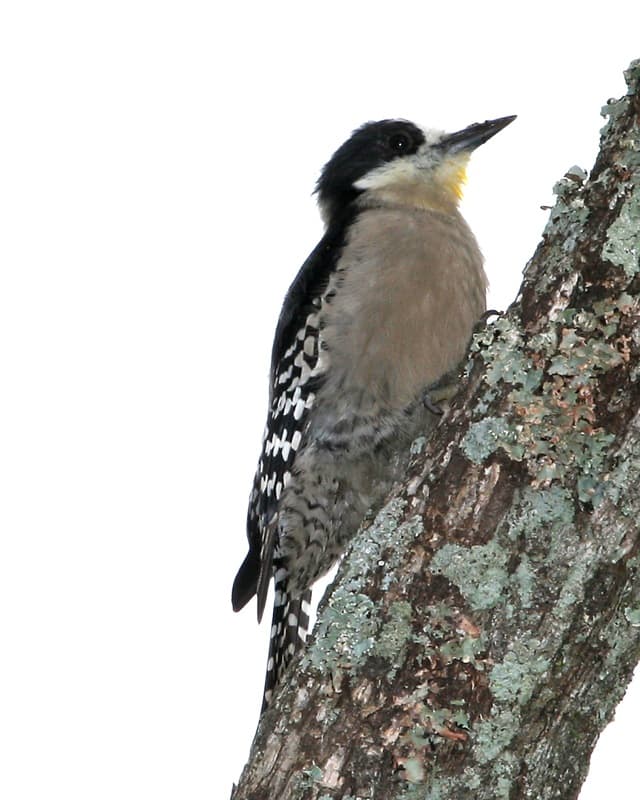
White-fronted woodpecker
The white-fronted woodpecker (Melanerpes cactorum) is a South American bird found in dry forests, shrublands, and savannahs. This species is characterized by its glossy black upperparts with a distinctive white line down the back, and white cheeks and throat, typically measuring around 17 cm in length.

Golden-naped woodpecker
The golden-naped woodpecker is a bird species found in Costa Rica and western Panama, inhabiting subtropical or tropical moist lowland forests and degraded former forest areas. It is closely related to the beautiful woodpecker and is characterized by its yellow nape and distinctive markings on its crown, with males and females exhibiting slight differences. This species is currently listed as "least concern" by the IUCN.
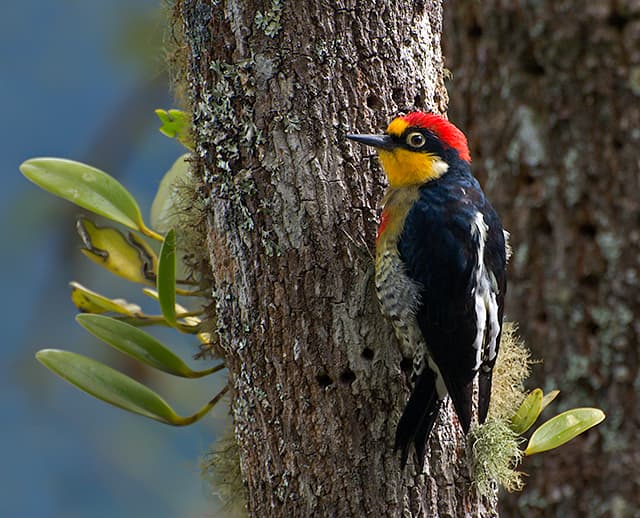
Yellow-fronted woodpecker
The yellow-fronted woodpecker is a colorful bird found in eastern South America, specifically in Brazil, Paraguay, and northeastern Argentina. It inhabits subtropical and tropical lowland forests, as well as degraded former forest areas. This species is characterized by its distinctive yellow fore-crown and throat, with males having a red crown and nape.