
White-throated woodpecker
The white-throated woodpecker is a species of bird found in the Amazon basin and Andean foothills of South America, inhabiting humid forests. It is characterized by its bronze-green upperparts, white throat, and olive barring on its underparts, with males displaying red on their heads. Primarily insectivorous, this species forages by probing bark and is a year-round resident within its extensive range.
Key Facts
- ›Found in Bolivia, Brazil, Colombia, Ecuador, and Peru.
- ›Adults have bronze-green upperparts and a distinctive white chin and throat.
- ›Males have red on their foreheads and cheeks, while females have red only on the nape.
- ›Forages by probing and flaking bark at MID- to upper forest levels.
- ›Assumed to feed on adult and larval insects.
- ›Considered Least Concern by the IUCN, though population size is unknown and believed to be decreasing.
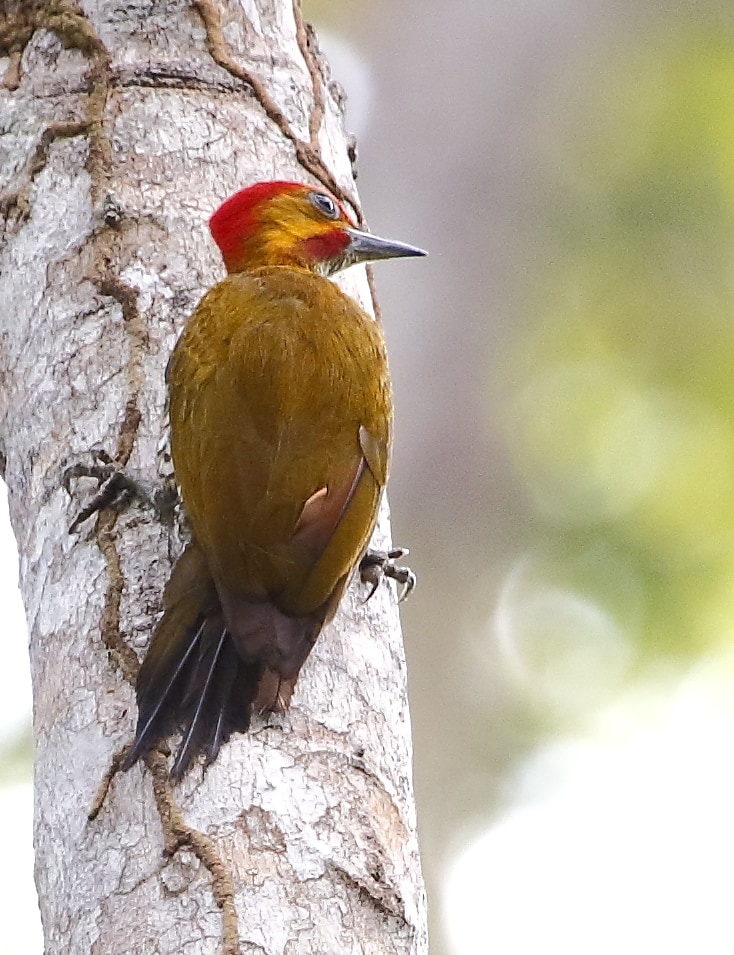
Picus Leucolaemus
South America
Humid Terra Firme Forest, VáRzea Forest
White Chin and Throat, Red On Male's Forehead and Cheeks, Yellow Stripe Above Malar In Males
Insects
Probing Bark, Flaking Off Bark, Forages Alone Or In Pairs, Joins Mixed-Species Feeding Flocks
Hoarse/Hissing 'Sraa-Sraa-Sraa-', Drawn-Out, Hissing, Lowered 'Wheeeeee'
About White-throated woodpecker
The white-throated woodpecker (Piculus leucolaemus) is a species of bird belonging to the Picinae subfamily within the woodpecker family, Picidae. It resides in the diverse ecosystems of South America, with documented populations in Bolivia, Brazil, Colombia, Ecuador, and Peru.
Description and Identification
Adults of this species typically measure between 19 to 20 cm (7.5 to 7.9 in) in length and weigh around 69 g (2.4 oz). They are characterized by their bronze-green upperparts and a prominent white chin and throat, which gives the species its name. The underparts are white with distinct olive barring. While males and females share much of their plumage, males exhibit red coloration from the forehead to the hindneck and broadly on the malar region (cheek), often accompanied by a wide yellow stripe above the cheek. Females, in contrast, display red only on the nape. Juveniles are generally greener than adults, with males having red restricted to the rear crown and hindneck.
Distribution and Habitat
The white-throated woodpecker's range extends from southwestern Colombia southward along the eastern side of the Ecuadorian and Peruvian Andes, reaching central Bolivia. Disjunct populations are also found in western and central Amazonian Brazil. This species inhabits mature, humid forests, specifically terra firme forests and várzea forests. It is typically found in lowland and foothill regions, ascending to elevations of up to 1,000 m (3,300 ft) in Ecuador and 1,400 m (4,600 ft) in Peru.
Behavior and Ecology
As far as is known, the white-throated woodpecker is a year-round resident and does not undertake migratory movements. Individuals usually forage alone, though they may be observed in pairs or as part of mixed-species feeding flocks. Their foraging strategy involves moving through the mid- to upper levels of the forest, where they typically probe and flake off bark in search of food. Although specific dietary details are not fully documented, it is presumed that their diet includes adult and larval insects.
Reproduction and Vocalization
Little is currently known about the breeding biology of the white-throated woodpecker. Their vocalizations have been described as a hoarse or hissing 'sraa-sraa-sraa-' call, or a drawn-out, hissing, lowered 'wheeeeee'.
Conservation Status
The International Union for Conservation of Nature (IUCN) has assessed the white-throated woodpecker as Least Concern. Despite possessing a large geographic range, its population size remains unknown and is believed to be decreasing. No immediate threats have been specifically identified for the species, though it is considered poorly known and uncommon. Uncertainty regarding its taxonomic classification has historically complicated the assessment of past records.
Source: Wikipedia ↗
Frequently Asked Questions
Where is the white-throated woodpecker found?
The white-throated woodpecker is distributed across South America, including parts of Bolivia, Brazil, Colombia, Ecuador, and Peru. Its range extends along the eastern slopes of the Andes and into the Amazonian regions.
What does the white-throated woodpecker look like?
Adults typically measure 19-20 cm in length and feature bronze-green upperparts, a white throat, and olive barring on their underparts. Males are distinguished by red coloration on their heads, while females have red only on their nape.
What does the white-throated woodpecker eat?
While its diet is not precisely known, it is believed to consist of adult and larval insects. The woodpecker typically forages by probing into bark to find its food.
What is the conservation status of the white-throated woodpecker?
The white-throated woodpecker is listed as Least Concern by the IUCN. However, its population size is not well-documented and is thought to be declining.
Does the white-throated woodpecker migrate?
Based on current knowledge, the white-throated woodpecker is considered a year-round resident throughout its geographic range. There is no information suggesting it undertakes seasonal migrations.
Related Woodpecker species
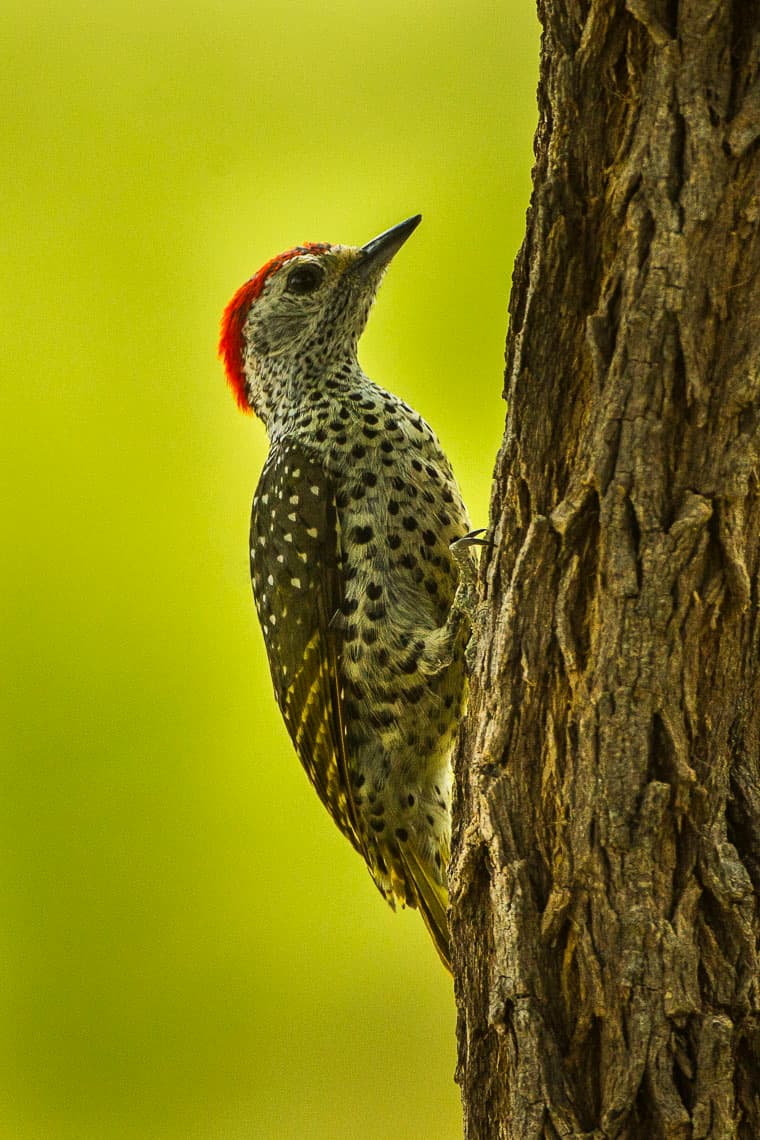
Little green woodpecker
The little green woodpecker is a bird species found across tropical Africa, inhabiting forest edges, clearings, and forest-shrub mosaics. This species is characterized by its yellowish-green or bronze-green upperparts, buff head and neck with brown spots, and olive or blackish beak. It is currently assessed as a least-concern species by the IUCN due to its wide distribution and increasing population.

Stripe-cheeked woodpecker
The stripe-cheeked woodpecker is a species endemic to Panama, characterized by its bronze-green upperparts and buffy white underparts with greenish olive barring. Males and females exhibit sexual dimorphism primarily in head plumage, with males displaying more extensive red coloration. This bird inhabits humid forests at mid-elevations.

Bar-breasted piculet
The bar-breasted piculet is the smallest living species in the woodpecker family, characterized by its small size and distinctive barring on its underparts. It inhabits humid tropical forests primarily in the Amazon Basin, spanning parts of Bolivia, Brazil, Colombia, and Peru.