
A. microta
Ailuropoda microta is the earliest known member of the giant panda genus, Ailuropoda, and is distinguished by its small size and primitive cranial features. Discovered in southern China, this Early Pleistocene species possessed adaptations for herbivory, particularly a diet of bamboo leaves, shoots, and fruits, as indicated by its dental wear patterns and isotopic analysis.
Key Facts
- ›Earliest known member of the genus Ailuropoda, which includes the living giant panda.
- ›Smallest and most primitive member of its genus, weighing around 70 kg and measuring 1 m in length.
- ›Cranial and dental features are intermediate between earlier panda ancestors and the modern giant panda.
- ›Adapted for herbivory, with cheek teeth suggesting a diet of bamboo leaves, shoots, and fruits.
- ›Lived in southern China during the Early Pleistocene, approximately 2.5 to 1.8 million years ago.
- ›Coexisted with other ancient fauna such as Gigantopithecus blacki and various elephant relatives.

Forests
China
About A. microta
Ailuropoda microta
Ailuropoda microta represents the earliest known species within the genus Ailuropoda, the lineage that includes the modern giant panda (Ailuropoda melanoleuca). This extinct bear is notable for being the smallest and most primitive member of its genus, with an estimated body mass of around 70 kilograms and a length of approximately 1 meter. Its discovery, particularly a nearly complete skull found in Guangxi, China, has provided crucial insights into panda evolution.
Cranial and Dental Adaptations
The skull of Ailuropoda microta exhibits cranial and dental features that are intermediate between earlier panda ancestors and the living giant panda. Analysis of its cheek teeth indicates adaptations for herbivory, a trait shared with its modern descendant. However, the morphology of these teeth is relatively simpler compared to the progressively more complex structures found in later Ailuropoda species. Wear patterns on its teeth suggest a diet primarily of bamboo. Due to its smaller size, less complex teeth, and less powerful jaw muscles, it is theorized that Ailuropoda microta may have consumed softer parts of bamboo, such as leaves, shoots, and fruits, rather than the highly fibrous stems that the modern giant panda consumes.
Paleontological Context
Ailuropoda microta lived during the Early Pleistocene epoch in southern China, with fossil evidence dating its existence to roughly 2.5 to 1.8 million years ago. This ancient bear coexisted with a diverse array of other fauna. Among its contemporaries were the giant ape Gigantopithecus blacki, the chalicothere Hesperotherium, elephant relatives like Sinomastodon jiangnanensis and Stegodon huananensis, the tapir Tapirus sanyuanensis, various swine species (Sus peii and Sus xiaozhu), the deer Cervavitus fenqii, the chevrotain Dorcabune, and the bovid Megalovis guangxiensis.
Source: Wikipedia ↗
Frequently Asked Questions
What is Ailuropoda microta?
Ailuropoda microta is the earliest known species in the genus Ailuropoda, which also includes the modern giant panda. It is recognized as the smallest and most primitive member of this lineage.
How large was Ailuropoda microta?
Ailuropoda microta was significantly smaller than its modern descendant. It had an estimated body mass of around 70 kilograms and measured about 1 meter in length.
What did Ailuropoda microta eat?
Evidence from its teeth, including wear patterns and isotopic analysis, suggests Ailuropoda microta was herbivorous. It likely consumed bamboo leaves, shoots, and fruits, though its simpler cheek teeth and less powerful jaw muscles may have limited it from eating fibrous stems.
Where and when did Ailuropoda microta live?
This ancient bear inhabited southern China during the Early Pleistocene epoch, with fossil evidence dating its existence to approximately 2.5 to 1.8 million years ago.
What makes Ailuropoda microta distinctive from modern giant pandas?
Ailuropoda microta is distinctive for its smaller size and less complex dental morphology compared to the modern giant panda. Its skull also shows less verticalization in the occiput region, indicating less powerful jaw muscles.
Related Bears

U. rossicus
Ursus rossicus was an extinct species of bear that inhabited the steppe regions of northern Eurasia and Siberia during the Pleistocene epoch. It is considered part of the cave bear species complex and is distinguished by its broad, domed skull and a diet that leaned heavily towards coarse, dry vegetation, including tubers, as indicated by dental microwear and stable isotope analysis.
Hemicyoninae
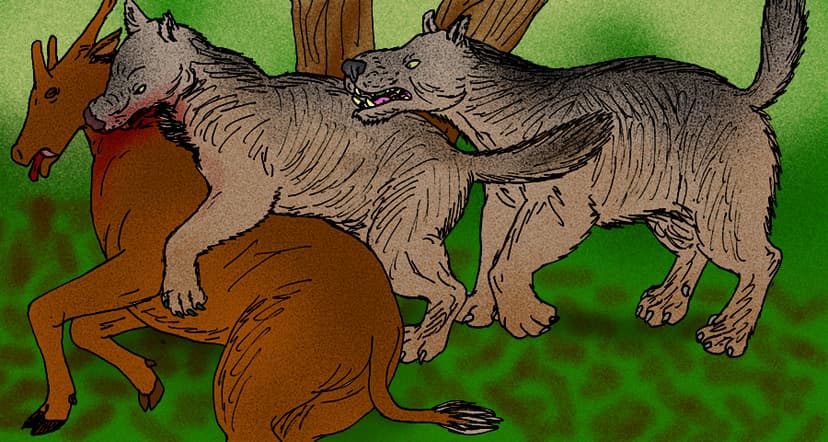
Hemicyoninae, often referred to as dog bears, were an extinct subfamily of Ursidae that existed from the Oligocene through the Miocene epochs. These bear-like carnivorans inhabited parts of Europe, North America, Africa, and Asia, and are notable for their long evolutionary history, spanning approximately 28.6 million years.

Cave Bear
The cave bear (Ursus spelaeus) was a prehistoric species of bear that inhabited Europe and Asia during the Pleistocene epoch, going extinct approximately 24,000 years ago. Named for the prevalence of their remains found in caves, they are believed to have spent more time in these sheltered environments than modern bears, often using them for hibernation. Distinctive for their large size and a predominantly herbivorous diet, cave bears displayed significant variability in size, morphology, and genetics.