
Agriotheriinae
Agriotheriinae represents an extinct tribe of bears that lived from the middle Neogene to the early Quaternary periods. Fossils of these animals have been discovered across Eurasia, Africa, and North America. Unlike their closest living relative, the giant panda, agriotheriins evolved into large, hypercarnivorous predators with unique adaptations for running, setting them apart in bear evolutionary history.
Key Facts
- ›Agriotheriinae fossils are found in Eurasia, Africa, and North America.
- ›They existed from the middle Neogene to the early Quaternary periods.
- ›Key genera include Agriotherium, Huracan, and Indarctos.
- ›Recent research places them within the Ailuropodinae subfamily, alongside giant pandas.
- ›They evolved into large, hypercarnivorous bears.
- ›Agriotheriins developed unique cursorial (running) adaptations.
- ›The ichnotaxon Platykopus has sometimes been associated with this tribe.

Eurasia, Africa, North America
Cursive
About Agriotheriinae
The Agriotheriinae represent an extinct tribe of bears that roamed parts of Eurasia, Africa, and North America during the Neogene and early Quaternary periods. These ancient ursids are distinguished by their evolutionary divergence from their closest living relative, the giant panda. While the giant panda specialized into a herbivorous diet, the Agriotheriinae developed into formidable, hypercarnivorous predators. Their lineage is characterized by significant adaptations for cursoriality, meaning they were uniquely suited for running compared to other bear groups.
Taxonomy and Classification
The tribe Agriotheriini is understood to comprise several genera, with Agriotherium, Huracan, and Indarctos being the most commonly recognized. The taxonomic classification of these bears has seen revisions, with some genera previously placed in other subfamilies. However, recent paleontological research strongly supports their inclusion within the Ailuropodinae subfamily, placing them in a lineage that also includes the giant panda. This classification is supported by distinctive anatomical features, such as large cheek teeth, a modified fourth premolar, and specific proportions of the mandible and molars.
Fossil Evidence and Ichnotaxa
Fossils of Agriotheriinae have been recovered widely across the globe, providing evidence of their ancient distribution. Beyond skeletal remains, the study of fossilized footprints, known as ichnotaxa, has also offered insights. The ichnotaxon Platykopus has, at times, been tentatively associated with Agriotheriini, particularly due to the discovery of large ursid trackways that bear similarities to the footbone morphology of Agriotheriinae specimens. For instance, tracks found in Texas have been linked to the genus Huracan, which is part of this bear tribe. While Platykopus tracks share characteristics like plantigrade, five-digit prints with other ursids, they exhibit unique features such as proportionally sized digit imprints and a less developed metatarsal impression, leading to a longer, narrower foot appearance. Claw marks are typically only slightly visible, resembling those of modern brown bears, and primitive hallux imprints are absent.
Source: Wikipedia ↗
Frequently Asked Questions
When did Agriotheriinae live?
Agriotheriinae lived from the middle Neogene to the early Quaternary periods. This places their existence roughly between 23 million and 2.6 million years ago, spanning a significant portion of Earth's geological history.
Where have Agriotheriinae fossils been found?
Fossils attributed to the Agriotheriinae tribe have been discovered across three continents: Eurasia, Africa, and North America. This wide geographic distribution indicates they were a successful group of bears in ancient times.
What is the relationship between Agriotheriinae and giant pandas?
Recent scientific studies suggest that Agriotheriinae are closely related to giant pandas. Both groups are now classified within the Ailuropodinae subfamily, indicating a shared ancestry.
How did Agriotheriinae differ from giant pandas in their evolution?
While sharing a common ancestor, Agriotheriinae evolved differently from giant pandas. Agriotheriins developed into large, hypercarnivorous bears with specialized adaptations for running, whereas giant pandas became highly specialized bamboo-eaters.
What are some of the key genera within Agriotheriinae?
The tribe Agriotheriini is known to include at least three genera: Agriotherium, Huracan, and Indarctos. There is also a possibility that the genus Miomaci belongs to this group.
What are the distinctive features of Agriotheriinae's teeth and jaw?
Diagnostic features supporting the inclusion of Agriotheriinae with giant pandas include their large cheek teeth, a parastyle on the fourth premolar with an enlarged inner lobe, and wide first and second molars. They also possessed a high mandible relative to their lower tooth row.
Related Bears

Ailuropoda
Ailuropoda is the sole genus of the bear subfamily Ailuropodinae, comprising one living species, the giant panda, and several extinct fossil species. Despite being classified as a carnivoran, the giant panda's diet is almost exclusively herbivorous, consisting mainly of bamboo. Its distinctive cat-like vertical pupils are reflected in its scientific name and common Chinese name, "large bear cat."
Hemicyon
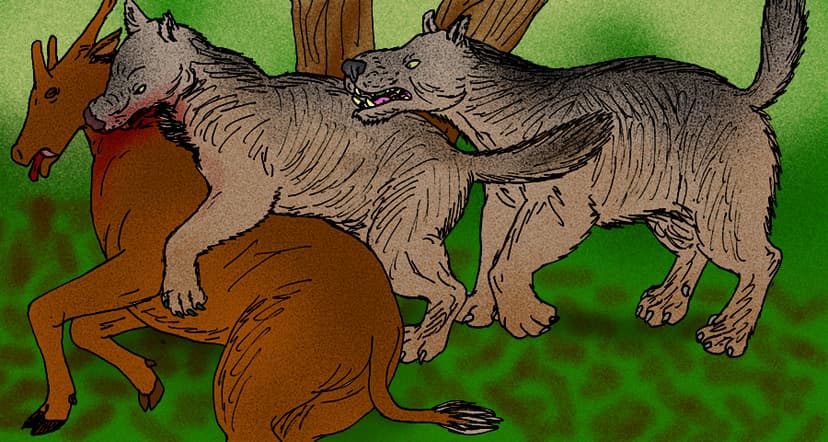
Hemicyon, also known as the "dog-bear," was an extinct genus of hemicyonine bear that likely originated in Eurasia. It existed during the Miocene epoch and is notable for its digitigrade stance, long metapodials, and hypercarnivorous diet, suggesting it was an active hunter and runner. Hemicyon is considered the best-known genus within the Hemicyoninae subfamily, which is positioned intermediate between bears and their Caniform ancestors.