
Plionarctos
Mammalia, Carnivora, Ursidae, Tremarctinae·Omnivore
Plionarctos is an extinct genus of short-faced bear that lived in North America during the Late Miocene and Pliocene epochs. It is recognized as the oldest known genus within the Tremarctinae subfamily and is considered ancestral to later short-faced bears like Arctodus and Tremarctos. Distinctive dental features and its evolutionary position highlight its significance in understanding bear diversification.
Key Facts
- ›Extinct genus of short-faced bear.
- ›Lived in North America from the Late Miocene to the Pliocene (7 million to 2.9 million years ago).
- ›Considered the oldest known genus within the Tremarctinae subfamily.
- ›Believed to be ancestral to genera like Arctodus and Tremarctos.
- ›Characterized by specific dental features such as a deep mandible and a tri-rooted P4 premolar.
- ›Likely preferred more humid, forested habitats.

Humid Forested Habitats, Woodland, Shrubland, Riparian Forests
North America
About Plionarctos
Plionarctos is an extinct genus of short-faced bear that roamed North America during the Late Miocene and Pliocene epochs, approximately 7 million to 2.9 million years ago. This ancient bear holds a significant place in evolutionary history as it is recognized as the oldest known genus within the subfamily Tremarctinae, commonly known as short-faced bears. Its fossilized remains indicate that Plionarctos is likely ancestral to later and more widely recognized short-faced bears, including genera such as Arctodus, Arctotherium, and Tremarctos.
Evolutionary Significance and Taxonomy
Described by Childs Frick in 1926, Plionarctos represents an early divergence within the bear family tree. While once hypothesized to have evolved from Ailuropodinae bears, current understanding suggests it likely evolved from Eurasian ursids such as Ursavus or Protarctos, which migrated into North America. A notable species, Plionarctos harroldum, was identified in 2001 from Washington, based on remains previously attributed to Protarctos abstrusus. Plionarctos is characterized by several distinct dental features that link it to other tremarctine bears, including a deep mandible, a noticeable groove beneath the premolars, and a rectangular M2 molar. Archaic traits that differentiate it from later tremarctines include the absence of a premasseteric fossa and a tri-rooted P4 premolar.
Habitat and Distribution
Fossil evidence indicates that Plionarctos preferred more humid, forested environments, being found in areas that supported woodland, semi-arid wooded shrubland, and riparian forests. Its distribution spanned across various regions of North America, with significant fossil discoveries in California, Oregon, Washington, Arizona, Indiana, Nebraska, Tennessee, and Florida. These locations suggest the bear was present in a range of ecosystems, from coastal mountain systems to inland plains, often associated with wetland environments or areas bordering expanding grasslands.
Extinction and Legacy
Plionarctos eventually went extinct, being last recorded around 2.9 million years ago. Its disappearance paved the way for the emergence of new genera of short-faced bears around the Plio-Pleistocene boundary. The study of Plionarctos provides crucial insights into the diversification of bears and the evolutionary pathways that led to the iconic megafauna of the Pleistocene. Its role as an early tremarctine highlights the dynamic nature of mammalian evolution during the Neogene period.
Source: Wikipedia ↗
Frequently Asked Questions
When did Plionarctos live?
Plionarctos lived during the Late Miocene and Pliocene epochs, with its fossil record spanning from approximately 7 million to 2.9 million years ago.
What is Plionarctos known for in bear evolution?
Plionarctos is significant as the oldest known member of the short-faced bear subfamily (Tremarctinae). It is believed to be an ancestral form from which later, more specialized short-faced bears evolved.
Where has Plionarctos been found?
Fossils of Plionarctos have been discovered across North America, including in California, Oregon, Washington, Arizona, Indiana, Nebraska, Tennessee, and Florida.
What were the key physical characteristics of Plionarctos?
Plionarctos is distinguished by several dental features, including a deep mandible, a groove under the premolars, and a tri-rooted P4 premolar. It is estimated to have weighed around 60–165.5 kg and had a skull length of about 20 cm.
What kind of environment did Plionarctos inhabit?
Evidence suggests Plionarctos preferred more humid, forested habitats rather than open grasslands. Its presence has been noted in areas with woodland, shrubland, and riparian forests.
Related Bears
Helarctos
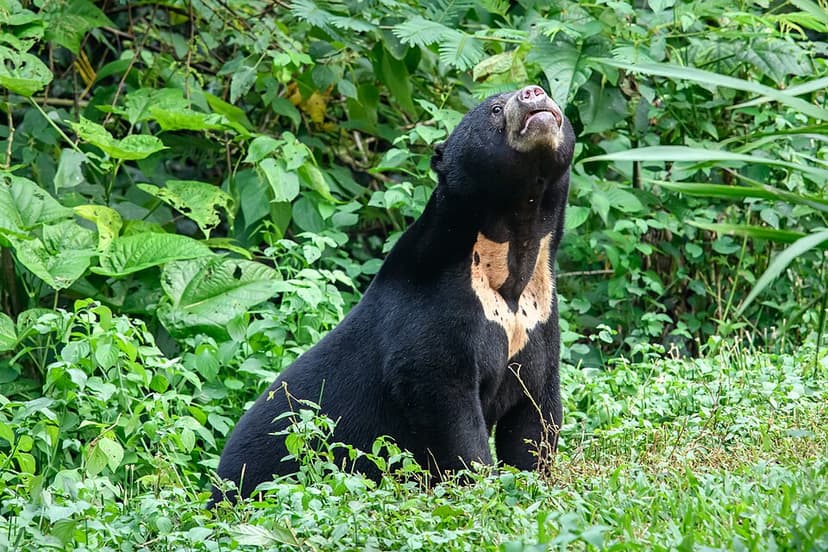
The sun bear (Helarctos malayanus) is the smallest bear species, native to the tropical forests of Southeast Asia. Distinctive for its short, jet-black fur and a characteristic orange to cream-colored chest patch, it is highly adapted for an arboreal lifestyle. Facing significant threats from deforestation and poaching, its population has seen a considerable decline.

Tremarctos
Tremarctos is a genus of bears endemic to the Americas, known for its "short-faced" appearance due to its deep snouts and short nasal bones. The genus includes the extinct Florida short-faced bear (T. floridanus) and the sole living species, the South American spectacled bear (T. ornatus). Tremarctos is distinctive within the bear family for its specific cranial and dental morphology, and the living spectacled bear is the only bear species found in South America.

Ursus
Ursus is a genus of bears in the family Ursidae, encompassing several well-known species such as the brown bear, polar bear, American black bear, and Asian black bear. The genus name itself is derived from the Latin word for 'bear'. These mammals are characterized by their solitary nature, except during mating seasons and when females are raising cubs, and exhibit complex mating systems driven by sexual selection.