
Black caecilian
The Black caecilian (Ichthyophis monochrous) is a species of amphibian found in the tropical moist forests of northern Borneo, specifically in western Kalimantan (Indonesia) and Sarawak (Malaysia), and likely Brunei. It is a relatively unknown species, with only a few specimens documented, and is characterized by its moderately slender body, distinct tail, and glandular skin with numerous annuli.
Key Facts
- ›Endemic to northern Borneo, including western Kalimantan and Sarawak.
- ›Presumably inhabits tropical moist forests and is likely subterranean as an adult.
- ›Possesses a moderately slender body with a short, distinct tail.
- ›Features about 247 ring-shaped folds (annuli) on its strongly glandular skin.
- ›The holotype specimen measured 232 MM in length and approximately 10 MM in width.
- ›Known from only a few specimens, making it a little-known species.

Tropical Moist Forest, Subterranean
Western Borneo Caecilian
About Black caecilian
The Black caecilian, scientifically known as Ichthyophis monochrous, is an amphibian species belonging to the family Ichthyophiidae. It is native to the island of Borneo, specifically found in the northern regions. Its known distribution encompasses western Kalimantan in Indonesia and Sarawak in Malaysia, with a probable occurrence in Brunei as well.
Description and Habitat
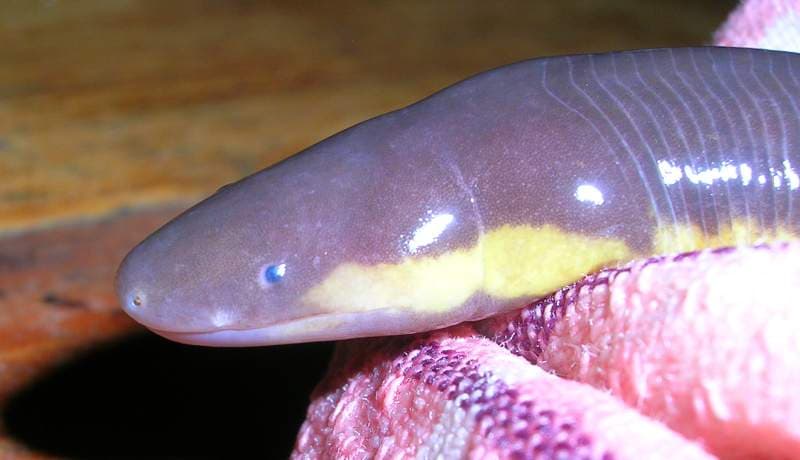
This species is characterized by its moderately slender body. The holotype specimen recorded a length of 232 mm (9.1 inches) and a width of approximately 10 mm (0.39 inches). It possesses a distinct, short tail and visible eyes on its head. The skin of the Black caecilian is notably glandular and features a significant number of ring-shaped folds, numbering around 247. When alive, specimens have been observed to have a violet-brown coloration.
The Black caecilian is presumed to inhabit tropical moist forests. As adults, they are believed to lead a subterranean existence, spending much of their time burrowed beneath the surface. Due to its elusive nature and limited specimens documented, it remains a little-known species within its habitat.
Source: Wikipedia ↗
Frequently Asked Questions
What is the scientific name of the Black caecilian?
The scientific name of the Black caecilian is Ichthyophis monochrous. This binomial nomenclature helps identify it specifically within the scientific classification of amphibians.
Where is the Black caecilian found?
The Black caecilian is endemic to northern Borneo. Its known distribution includes western Kalimantan in Indonesia and Sarawak in Malaysia, with a likely presence also in Brunei.
What does the Black caecilian look like?
It is described as a moderately slender caecilian with visible eyes and a distinct, short tail. Its skin is strongly glandular and features approximately 247 ring-shaped folds. The holotype was violet-brown in color when alive.
What is the habitat of the Black caecilian?
The Black caecilian is presumed to inhabit tropical moist forests. Adults are believed to be subterranean, suggesting a life spent largely underground.
Related Caecilian species
Ichthyophiidae
The Ichthyophiidae, also known as Asiatic tailed caecilians or fish caecilians, are a primitive family of caecilians found across South and Southeast Asia and in southernmost China. They are distinguished by their tails, numerous body scales, and mouths that are not recessed, setting them apart from more derived caecilian families. Ichthyophiidae reproduce by laying eggs in moist soil, with larvae that develop in water before metamorphosing into terrestrial adults, and females may exhibit parental care.

Ichthyophis beddomei
Ichthyophis beddomei, also known as the yellow-striped caecilian, is a species of caecilian found in the Western Ghats of southern India. This fossorial amphibian is characterized by its dark violet-brown body contrasted with a distinctive yellow lateral stripe that runs from its head to the tail tip.

Ichthyophis dulitensis
Ichthyophis dulitensis is a caecilian species endemic to Borneo, specifically known from the vicinity of Mount Dulit in Sarawak, Malaysia. Described in 1960, it is a poorly understood species with an uncertain taxonomic status. Its common name, the Mount Dulit caecilian, reflects its limited known geographic range.