
Ichthyophis glutinosus
Asia·Oviparous·Vulnerable·Southwestern and central Sri Lanka
The Ichthyophis glutinosus, commonly known as the Ceylon caecilian or common yellow-banded caecilian, is a species of caecilian native to Sri Lanka. It is characterized by its long, segmented appearance, steely blue and yellow coloration, and its habitat in moist tropical and subtropical forests and pastures.
Key Facts
- ›Endemic to Sri Lanka, with potential historical sightings in northeastern India.
- ›Resembles a large earthworm with over 300 transverse skin folds.
- ›Possesses a steely blue dorsal side and a pale yellow ventral side, with a distinct yellow lateral band.
- ›Feeds on earthworms and other small invertebrates, employing a unique subduing technique.
- ›Reproduction involves the female laying eggs in hidden locations and brooding them until hatching.
- ›Listed as 'Vulnerable' by the IUCN due to its restricted range, though locally common and adaptable.
Moist Tropical and Subtropical Forests, Pastures, Subtropical Or Tropical Moist Lowland Forests, Subtropical Or Tropical Moist Montane Forests, Subtropical Or Tropical Swamps, Cleared Forested Areas
Earthworms, Small Invertebrates
Ceylon Caecilian, Common Yellow-Banded Caecilian
About Ichthyophis glutinosus
The Ichthyophis glutinosus, more commonly recognized as the Ceylon caecilian or the common yellow-banded caecilian, is a unique amphibian species endemic to the island of Sri Lanka. This creature belongs to the family Ichthyophiidae and is adapted to life in moist tropical and subtropical environments.
Description and Habitat
Resembling a large earthworm, the Ceylon caecilian typically measures between 23 and 40 centimeters in length. Its body is distinguished by more than 300 transverse folds in its skin, which give it a distinctly segmented appearance. The head is characterized by a rounded snout and a pair of extensible tentacles located near the mouth. Its coloration is a striking steely blue on its upper side, contrasting with a pale yellow underside, and is further accentuated by a prominent yellow band that runs along each side of its body. These caecilians inhabit burrows dug into damp earth or leaf litter within various moist forest types, including lowland and montane forests, as well as swamps, cleared forest areas, and pastures, often found at elevations up to 1,355 meters.
Biology and Reproduction
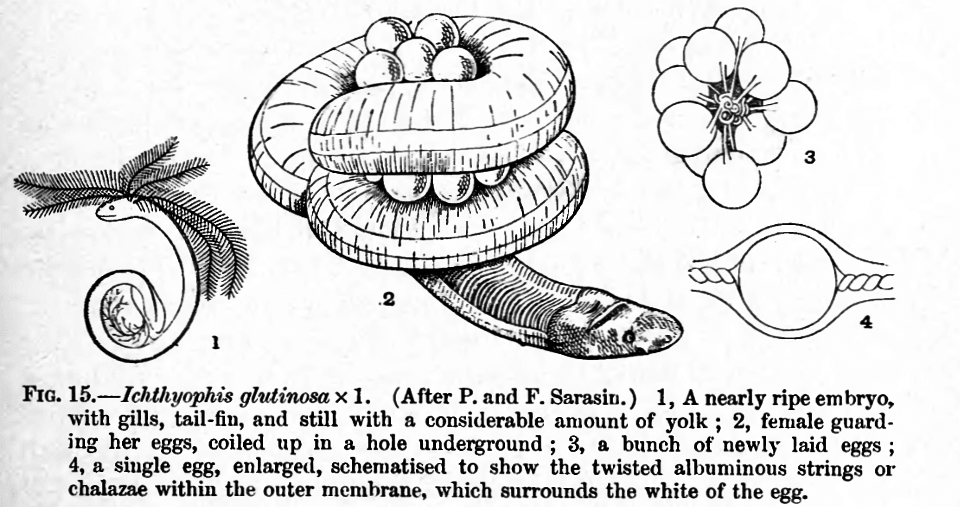
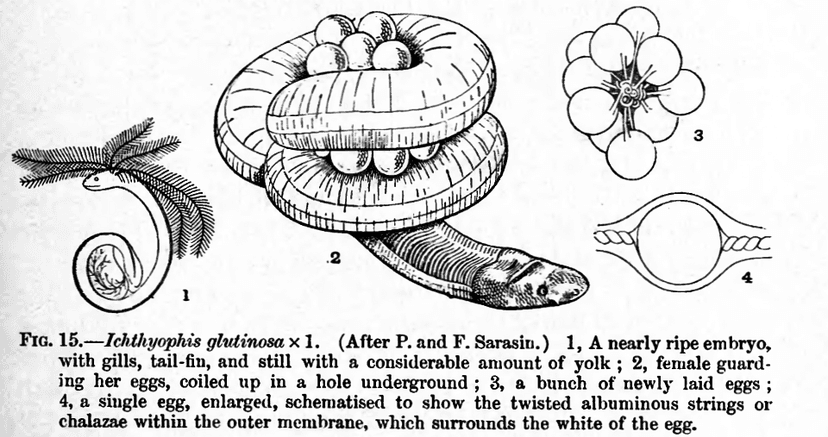
The diet of Ichthyophis glutinosus primarily consists of earthworms and other small invertebrates. When it successfully captures prey, such as an earthworm, it has been observed to retreat into its burrow and employ a unique method of subduing its meal, sometimes involving head or whole-body twisting. Reproduction occurs in hidden underground chambers or other secluded spots. The female lays clutches of approximately 30 white eggs, each coated in jelly, and then coils her body around them to brood until they hatch. The resulting larvae, measuring about 7 to 11 centimeters, possess three pairs of external feathery gills and a tail fin, enabling them to swim. These larval features are gradually lost during a metamorphosis that takes about nine months.
Conservation Status
The International Union for Conservation of Nature (IUCN) lists the Ceylon caecilian as 'Vulnerable'. This classification is based on its relatively restricted range, estimated to be less than 20,000 square kilometers. However, the species is locally common within its habitat and appears to be highly adaptable, capable of coping with environmental changes. A significant portion of its range is situated within well-protected national parks, such as the Sinharaja World Heritage Site and the Knuckles Range Forest Reserve, which likely contribute to its continued survival.
Source: Wikipedia ↗
Frequently Asked Questions
What does the Ceylon caecilian look like?
The Ceylon caecilian resembles a large earthworm, growing to about 23 to 40 cm in length. Its skin is marked by over 300 transverse folds, giving it a segmented appearance. It is steely blue on its upper side and pale yellow underneath, with a distinctive yellow band running along each side of its body.
Where can the Ichthyophis glutinosus be found?
This species is endemic to southwestern and central Sri Lanka. It inhabits burrows in damp earth or leaf litter within subtropical or tropical moist lowland and montane forests, swamps, cleared forested areas, and pastures.
What does the Ceylon caecilian eat?
The diet of the Ceylon caecilian consists primarily of earthworms and other small invertebrates. When it captures prey, it often reverses into its burrow and may twist its head or body to subdue its meal.
How does the Ichthyophis glutinosus reproduce?
Reproduction occurs in concealed underground chambers or hidden spots. The female lays strings of approximately 30 white, jelly-coated eggs and then coils her body around them, brooding until they hatch into larvae.
What is the conservation status of the Ceylon caecilian?
The Ceylon caecilian is classified as 'Vulnerable' by the IUCN Red List. While its range is relatively small, it is locally common and adaptable, with significant portions of its habitat protected within national parks.
Related Caecilian species
Common yellow-banded caecilian
The Common yellow-banded caecilian, also known as the Ceylon caecilian, is a species of caecilian endemic to Sri Lanka. It is characterized by its earthworm-like appearance, with steely blue and pale yellow coloration and a distinctive yellow band along its sides. This adaptable species inhabits moist tropical and subtropical forests and pastures, where it burrows in damp earth or leaf litter.

Ichthyophis sumatranus
Ichthyophis sumatranus, commonly known as the Sumatra caecilian, is a species of amphibian endemic to Sumatra, Indonesia. This species is characterized by its dark brown coloration, distinct eyes with a white spot, and a subterranean lifestyle as an adult. Its primary threat is habitat loss due to the expansion of palm oil plantations.

Ichthyophis tricolor
Ichthyophis tricolor, also known as the three-colored caecilian or Maddatorai caecilian, is an amphibian species native to the Western Ghats of India. This burrowing caecilian is characterized by its distinctive violet-brown body marked with a yellow lateral stripe and a broad, white ventral stripe. Its exact taxonomic status remains a subject of ongoing research.