
Ichthyophis tricolor
Ichthyophis tricolor, also known as the three-colored caecilian or Maddatorai caecilian, is an amphibian species native to the Western Ghats of India. This burrowing caecilian is characterized by its distinctive violet-brown body marked with a yellow lateral stripe and a broad, white ventral stripe. Its exact taxonomic status remains a subject of ongoing research.
Key Facts
- ›Native to the Western Ghats of India.
- ›Possesses a violet-brown body with yellow lateral and white ventral stripes.
- ›An oviparous species that lays terrestrial eggs and has aquatic larvae.
- ›Inhabits subterranean environments within wet, semi-evergreen tropical forests, as well as agricultural areas.
- ›Occurs at elevations ranging from near sea level up to 1,200 meters.
- ›Its taxonomic relationship with other Ichthyophis species is not fully resolved.

Wet, Semi-Evergreen Tropical Forests, Agricultural Areas, Rubber Plantations
Three-Colored Caecilian, Maddatorai Caecilian
About Ichthyophis tricolor
Ichthyophis tricolor: The Three-Colored Caecilian
Ichthyophis tricolor, commonly known as the three-colored caecilian or Maddatorai caecilian, is an amphibian species native to the Western Ghats region of India. This caecilian is characterized by its distinctive coloration, which includes a violet-brown body adorned with a yellow lateral stripe and a prominent white ventral stripe. Its taxonomic status is currently a subject of ongoing scientific inquiry, with questions surrounding its precise relationship to other species within the Ichthyophis genus.
Habitat and Distribution
This species is primarily subterranean, inhabiting environments within wet, semi-evergreen tropical forests. It has also been observed adapting to agricultural areas and rubber plantations, indicating a degree of resilience. Ichthyophis tricolor can be found at elevations ranging from near sea level up to 1,200 meters (3,900 ft) above sea level. While its exact distribution is tied to the Western Ghats, it is not considered uncommon in parts of its range and is present in several protected areas.
Physical Characteristics and Reproduction
Adult individuals typically measure between 226 and 330 mm in total length, with a short tail of 3 to 6 mm. The body's violet-brown hue is broken by a distinct yellow stripe along the sides, which broadens and remains unbroken at the neck. The underside of the caecilian features a broad white stripe. Ichthyophis tricolor reproduces using an oviparous strategy, laying terrestrial eggs from which aquatic larvae hatch. The species exhibits a slightly projecting snout and visible eyes, with its tentacles positioned close to the edge of the upper lip.
Source: Wikipedia ↗
Frequently Asked Questions
What is the common name for Ichthyophis tricolor?
Ichthyophis tricolor is commonly known as the three-colored caecilian or the Maddatorai caecilian. These names refer to its distinctive coloration.
Where is Ichthyophis tricolor found?
This species is endemic to the Western Ghats region of India. It can be found in various habitats within this area.
What does Ichthyophis tricolor look like?
It has a violet-brown body, distinguished by a yellow lateral stripe running from its lips to its tail, and a broad, white stripe on its underside. Its snout is slightly projecting, and its eyes are visible.
What is the habitat of the three-colored caecilian?
Ichthyophis tricolor is a subterranean species found in wet, semi-evergreen tropical forests. It also adapts to agricultural areas and rubber plantations.
How does Ichthyophis tricolor reproduce?
It is an oviparous species, meaning it lays eggs. These eggs are terrestrial, and the species has aquatic larvae.
Related Caecilian species
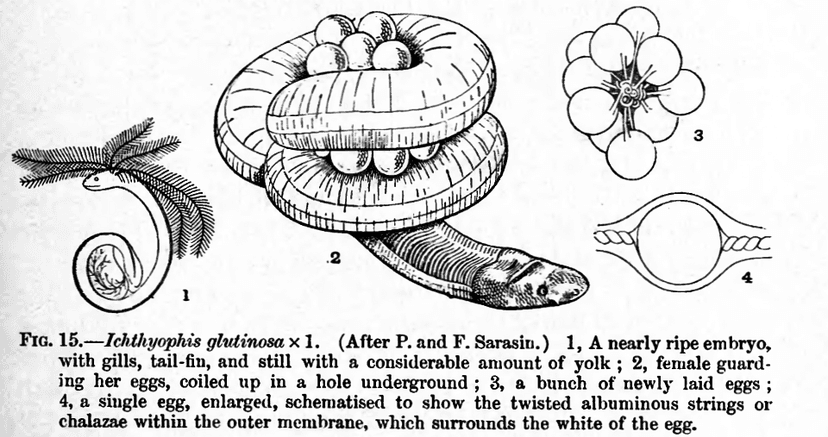
Common yellow-banded caecilian
The Common yellow-banded caecilian, also known as the Ceylon caecilian, is a species of caecilian endemic to Sri Lanka. It is characterized by its earthworm-like appearance, with steely blue and pale yellow coloration and a distinctive yellow band along its sides. This adaptable species inhabits moist tropical and subtropical forests and pastures, where it burrows in damp earth or leaf litter.
Ichthyophis glutinosus
The Ichthyophis glutinosus, commonly known as the Ceylon caecilian or common yellow-banded caecilian, is a species of caecilian native to Sri Lanka. It is characterized by its long, segmented appearance, steely blue and yellow coloration, and its habitat in moist tropical and subtropical forests and pastures.

Ichthyophis sumatranus
Ichthyophis sumatranus, commonly known as the Sumatra caecilian, is a species of amphibian endemic to Sumatra, Indonesia. This species is characterized by its dark brown coloration, distinct eyes with a white spot, and a subterranean lifestyle as an adult. Its primary threat is habitat loss due to the expansion of palm oil plantations.