
Ichthyophis longicephalus
Asia·Kerala (Silent Valley National Park), India
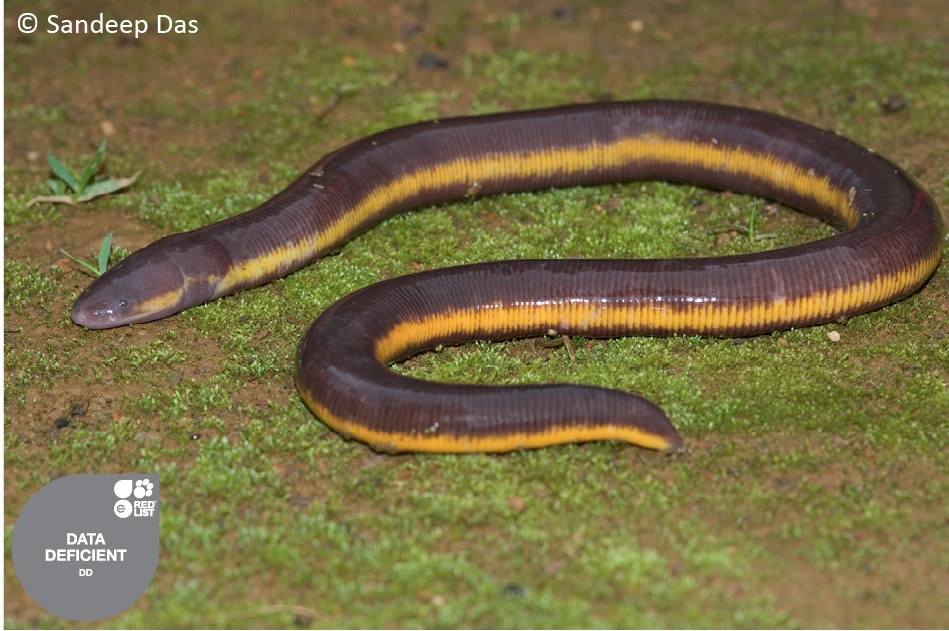
Ichthyophis longicephalus, the long-headed caecilian, is a species of amphibian found in the Western Ghats of India, specifically documented in Kerala's Silent Valley National Park. It is distinguished by its dark violet-brown body, a prominent yellow lateral stripe running from neck to tail, and distinctive head features including visible nostrils and an overhanging upper jaw.
Key Facts
- ›Body color is dark violet-brown, lighter on the underside.
- ›Features a distinct yellow stripe along its sides from neck to tail.
- ›Possesses small, yellow patches on the sides of its neck.
- ›Has a long head with visible eyes and nostrils at the snout tip.
- ›Found in Silent Valley National Park, Kerala, India.
Forests
Long-Headed Caecilian
About Ichthyophis longicephalus
Ichthyophis longicephalus, commonly known as the long-headed caecilian, is a species of caecilian native to India. This amphibian belongs to the family Ichthyophiidae and is primarily found in the Western Ghats region, with documented sightings in Silent Valley National Park in Kerala.
Physical Characteristics
The long-headed caecilian possesses a distinctive appearance. Its body is typically a dark violet-brown, which is lighter on the ventral side. A prominent yellow lateral stripe runs along its body, starting from the neck and extending all the way to the tip of its tail. Additional small yellow patches are observed on the sides of its neck. A unique characteristic is a midventral line formed by the breaking of its ventral annuli, extending from the neck to the vent. The head is notably long, featuring distinct eyes and tentacles positioned close to both the lip and the eye. Its nostrils are situated at the tip of the snout and are visible from a dorsal view. The upper jaw of Ichthyophis longicephalus noticeably overhangs the lower jaw.
Source: Wikipedia ↗
Frequently Asked Questions
What does Ichthyophis longicephalus look like?
Ichthyophis longicephalus has a dark violet-brown body that is lighter on its underside. It is characterized by a prominent yellow lateral stripe that extends from its neck to the tip of its tail, and also has small yellow patches on the sides of its neck.
Where is the long-headed caecilian found?
The long-headed caecilian is found in India, specifically within the state of Kerala. It has been documented in Silent Valley National Park, which is part of the Western Ghats region.
What are the distinctive physical features of Ichthyophis longicephalus?
This caecilian has a long head with clearly visible eyes. Its nostrils are located at the tip of its snout and are visible when viewed from above. The upper jaw also notably overhangs the lower jaw.
Related Caecilian species

Banna caecilian
The Banna caecilian (Ichthyophis kohtaoensis), also known as the Koh Tao Island caecilian, is an amphibian species found across Southeast Asia and southern China. This species inhabits a wide range of moist tropical and subtropical environments, from lowland forests to urban gardens and agricultural lands. It is primarily threatened by the loss of its diverse natural habitats.

Black caecilian
The Black caecilian (Ichthyophis monochrous) is a species of amphibian found in the tropical moist forests of northern Borneo, specifically in western Kalimantan (Indonesia) and Sarawak (Malaysia), and likely Brunei. It is a relatively unknown species, with only a few specimens documented, and is characterized by its moderately slender body, distinct tail, and glandular skin with numerous annuli.

Caudacaecilia larutensis
Caudacaecilia larutensis, also known as the Larut Hills caecilian, is a species of amphibian native to Malaysia and Thailand. It inhabits a variety of forest types, as well as rivers and agricultural lands. This caecilian is distinguished by its specific geographic distribution within Southeast Asia.