
Chakisaurus
Herbivore·Late Cretaceous·Huincul Formation, Argentina·Bipedal (inferred)
Chakisaurus is an extinct genus of elasmarian ornithopod dinosaur that lived during the Late Cretaceous period in what is now Argentina. Named for its elder guanaco lizard meaning, this medium-sized dinosaur is known from multiple partial skeletons representing individuals of various ages. It holds the distinction of being the first ornithischian species identified from the Huincul Formation.
Key Facts
- ›Chakisaurus lived during the Late Cretaceous period.
- ›Fossils were discovered in the Huincul Formation of Argentina.
- ›It is classified as an elasmarian ornithopod within the iguanodontian clade Dryomorpha.
- ›The name "Chakisaurus" means "elder guanaco lizard".
- ›The specific name "nekul" means "swift" in Mapudungun.
- ›It is known from multiple partial skeletons of different ages.

- Medium-sized elasmarian ornithopod.
- Similar in size to Anabisetia, Notohypsilophodon, and Trinisaura.
- Smaller than Talenkauen, Mahuidacursor, and Isasicursor.
- Forelimb bones show no adaptations for significant quadrupedal locomotion.
- Anterior caudal vertebrae suggest a protonic posture with the tail base curving downward.
- Tail adaptations are similar to cursorial adaptations in some coelurosaur theropods.
Anabisetia, Notohypsilophodon, Trinisaura, Talenkauen, Mahuidacursor, Isasicursor
Argentina
About Chakisaurus
Chakisaurus is an extinct genus of elasmarian ornithopod dinosaur that roamed the Earth during the Late Cretaceous period. Its fossils have been unearthed in the Huincul Formation of Argentina, a region known for its rich dinosaur fauna. The genus name, "Chakisaurus," translates to "elder guanaco lizard," a nod to the indigenous Aonikenk word "Chaki" for elder guanaco and the Greek "sauros" for lizard. The species name, "nekul," is derived from a Mapudungun word meaning "swift."
Discovery and Naming
The fossil material of Chakisaurus was discovered in the Pueblo Blanco Natural Reserve, within the Huincul Formation of Río Negro Province, Argentina. The initial holotype specimen, along with several paratype specimens from individuals of varying ages, were described in 2024 by Alvarez Nogueira and colleagues. These discoveries marked Chakisaurus as the first ornithischian species to be scientifically named from the Huincul Formation and the tenth basal ornithopod identified from South America.
Physical Characteristics and Classification
Chakisaurus is characterized as a medium-sized ornithopod, comparable in size to other elasmarian dinosaurs like Anabisetia and Notohypsilophodon, though smaller than genera such as Talenkauen. Analysis of its preserved forelimb bones suggests no significant adaptations for quadrupedal locomotion, indicating that such traits may have evolved independently in other elasmarian species. The structure of its anterior caudal vertebrae suggests a protonic posture, where the base of the tail curved downwards, a feature also observed in some titanosaurs. Its tail also exhibits adaptations for cursoriality, similar to those found in some coelurosaur theropods.
Phylogenetic analyses have placed Chakisaurus within the elasmarian ornithopod group, specifically within the iguanodontian clade Dryomorpha. However, the fragmentary nature of the fossil material means that its precise phylogenetic placement was not definitively established.
Palaeoenvironment
Chakisaurus inhabited the environment of the Huincul Formation during the Late Cretaceous. This formation has yielded fossils of a diverse array of saurischian dinosaurs, including rebbachisaurids, titanosaurs, carcharodontosaurids, megaraptorans, abelisaurids, and various other theropods. The non-dinosaurian fauna found in the formation includes fossil fish, sphenodonts, squamates, turtles, and crocodilians, painting a picture of a complex ecosystem.
Source: Wikipedia ↗
Frequently Asked Questions
What does the name Chakisaurus mean?
The genus name Chakisaurus combines 'Chaki,' an Aonikenk word for 'elder guanaco,' with the Greek 'sauros,' meaning 'lizard.' The specific name 'nekul' is a Mapudungun word meaning 'swift.'
Where were Chakisaurus fossils found?
Fossil material for Chakisaurus was discovered in the sediments of the Huincul Formation, located in the Pueblo Blanco Natural Reserve near Ezequiel Ramos-Mexía Lake in Río Negro Province, Argentina.
What period did Chakisaurus live in?
Chakisaurus lived during the Late Cretaceous period.
What group of dinosaurs does Chakisaurus belong to?
Chakisaurus is classified as an elasmarian ornithopod, belonging to the iguanodontian clade Dryomorpha.
What was the estimated size of Chakisaurus?
Chakisaurus has been described as a medium-sized elasmarian ornithopod, comparable in size to taxa like Anabisetia and Notohypsilophodon, but smaller than dinosaurs such as Talenkauen and Mahuidacursor.
Related Dinosaur species

Conchoraptor
Conchoraptor was a small oviraptorid dinosaur that lived in Asia during the Late Cretaceous period, approximately 70 million years ago. Notable for its lack of a prominent head crest and its specialized beak, Conchoraptor's diet and feeding habits have been a subject of scientific study, with evidence suggesting it was a powerful-biting generalist or specialist.
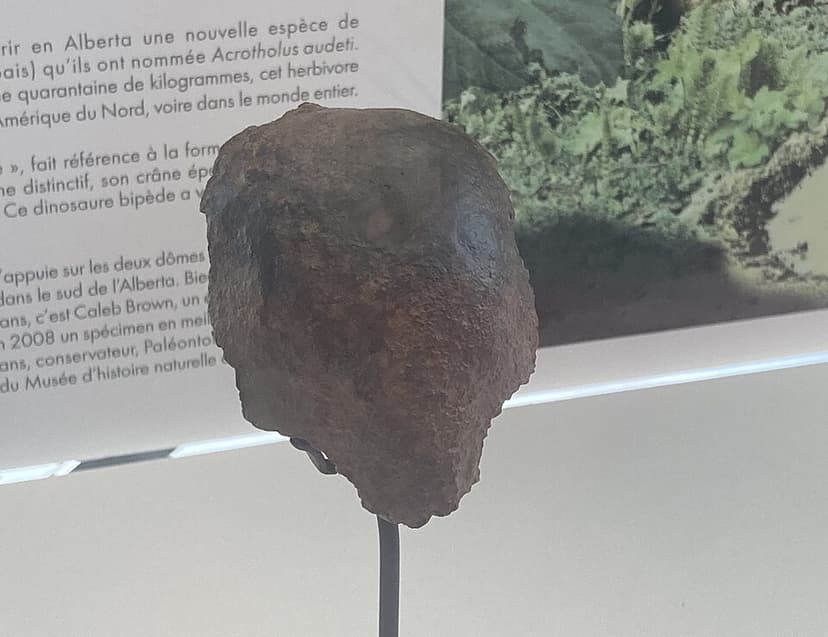
Acrotholus
Acrotholus is an extinct genus of pachycephalosaurian dinosaur that lived during the Santonian stage of the Late Cretaceous period in what is now Canada. It is notable for being one of the earliest known members of the pachycephalosaur family with a well-developed, dome-shaped skull. Acrotholus was a bipedal herbivore whose cranial dome has been theorized to have been used for intraspecies combat or display.

Adelolophus
Adelolophus is a genus of lambeosaurine dinosaur, a type of "duck-bill" known for its cranial crests, that lived during the Late Cretaceous period in what is now Utah, USA. The only known species, *Adelolophus hutchisoni*, is represented by a partial maxilla (upper jaw bone). It is significant as the oldest known lambeosaur remains from North America and a member of the Parasaurolophini tribe, indicating a close relationship with dinosaurs like Parasaurolophus.