
Chalcides striatus
The western three-toed skink (Chalcides striatus) is a lizard found in the Iberian Peninsula, southern France, and northwestern Italy. It superficially resembles a snake due to its tiny limbs, but possesses smooth, glossy skin with a silvery or bronze coloration marked by longitudinal dark lines. This secretive species inhabits damp, sunny areas with dense low vegetation and feeds on invertebrates.
Key Facts
- ›Superficially resembles a snake with two pairs of tiny, three-toed limbs.
- ›Found in the Iberian Peninsula, southern France, and northwestern Italy.
- ›Inhabits temperate forests, shrublands, grasslands, and sandy shores.
- ›Feeds on a wide range of invertebrate prey.
- ›Gives birth to up to fifteen live young after a gestation period of two to three months.
- ›Listed as 'Least Concern' by the IUCN, but threatened by habitat degradation.

Western Three-Toed Skink
Iberian Peninsula, Southern France, Northwestern Italy
- Superficially Looks Like A Snake With Tiny, Two-Paired, Three-Toed Limbs.
- Small Head and Thick Neck.
- Grows To A Length of About 43 cm .
- Smooth and Glossy Skin.
- Silvery Or Bronze Coloration.
- Approximately Ten Slender Longitudinal Dark Lines Running Along the Body.
- Head Is Usually Darker Than the Body.
- Hind Feet Have Three Toes of Equal Length, Distinguishing It From the Italian Three-Toed Skink.
Invertebrate Prey
- Moves Slowly Using Tiny Limbs, But Can Also Undulate Body For Faster Movement.
- Hibernates Deep Underground In Winter and Emerges In Late Spring.
- Very Secretive, Hiding In Dense Vegetation, Under Stones, Or In Pre-Existing Burrows When Disturbed.
- Males May Fight Or Eat Each Other During the Breeding Season.
- Habitat Degradation Due To Changes In Agricultural Practices
About Chalcides striatus
The Western Three-toed Skink
The western three-toed skink, scientifically known as Chalcides striatus, is a distinctive lizard species native to southwestern Europe. Its range encompasses the Iberian Peninsula (Spain and Portugal), southern France, and the northwestern Italian region of Liguria. This reptile is characterized by its serpentine appearance, a result of its extremely small, underdeveloped limbs, each bearing three toes. Despite these tiny appendages, it can move surprisingly fast by undulating its body.
Physical Characteristics and Habitat
Adult western three-toed skinks typically reach lengths of up to 43 cm (17 inches). Their bodies are covered in smooth, glossy scales, often exhibiting a silvery or bronze sheen. A prominent feature is the presence of approximately ten slender, longitudinal dark lines that run the length of the body, with the head usually being darker than the rest of the body. They are distinguished from similar species, like the Italian three-toed skink, by their slightly larger limbs and the equal length of the three toes on their hind feet.
These lizards favor damp yet sunny environments with dense, low-lying vegetation. Their preferred habitats include meadows, grassy slopes, stream verges, marshes, hedges, and even arable land and rural gardens. In areas closer to the Atlantic coast, they may also inhabit drier heathlands with low scrub.
Behavior and Diet
The western three-toed skink is a secretive creature. When threatened, it will quickly retreat into dense vegetation, hide under stones, or seek refuge in existing burrows. During the winter months, it hibernates deep underground, emerging in the late spring. Its diet primarily consists of a variety of invertebrate prey, which it actively hunts within its habitat.
Reproduction and Conservation
This species is viviparous, meaning females give birth to live young. Following a gestation period that can range from two to three months, a female may produce up to fifteen offspring, each approximately 10 cm (4 inches) long at birth. In some instances, the female may not survive this birthing process. The young reach maturity at around three to four years of age.
Globally, the western three-toed skink is classified as 'Least Concern' by the IUCN, owing to its extensive distribution and population density in certain regions. However, the species faces threats from the degradation of its habitat, largely driven by changes in agricultural practices. Despite being harmless, they are sometimes persecuted due to a mistaken belief that they are venomous.
Source: Wikipedia ↗
Frequently Asked Questions
What does the western three-toed skink look like?
The western three-toed skink has a snake-like appearance due to its tiny limbs, but it is a lizard. It has a small head, thick neck, and smooth, glossy skin that is silvery or bronze with dark longitudinal lines. It grows to about 43 cm (17 inches) in length.
Where can I find the western three-toed skink?
This species is native to southwestern Europe, specifically the Iberian Peninsula (Spain and Portugal), southern France, and the Liguria region of northwestern Italy. It can be found at elevations up to 1,800 meters.
What kind of habitat does the western three-toed skink prefer?
It prefers damp but sunny areas with dense low vegetation. Typical habitats include meadows, stream verges, marshes, grassy slopes, hedges, and sometimes drier heathland near the Atlantic coast.
What does the western three-toed skink eat?
The western three-toed skink has a varied diet consisting of a wide range of invertebrate prey. They are active hunters within their preferred habitats.
How does the western three-toed skink reproduce?
This species is viviparous, meaning it gives birth to live young. After a gestation period of two to three months, females can produce up to fifteen offspring, each measuring about 10 cm (4 inches) at birth.
Is the western three-toed skink endangered?
No, the IUCN has listed the western three-toed skink as 'Least Concern' due to its wide distribution and common presence in some areas. However, changes in agricultural practices that degrade its habitat pose a threat.
Why do some people mistakenly think western three-toed skinks are venomous?
In some areas, people mistakenly believe the western three-toed skink is venomous. This misconception can lead to persecution, despite the species being harmless to humans.
Related Lizards

Chalcides chalcides
The Italian three-toed skink (Chalcides chalcides), also known as the cylindrical skink, is a lizard species characterized by its long, snake-like body, reduced limbs with three-toed feet, and a length of up to 48 cm. It inhabits sunny areas with dense, low vegetation across Italy and North Africa. This diurnal species primarily feeds on insects and gives birth to live young.
Peloponnese slowworm
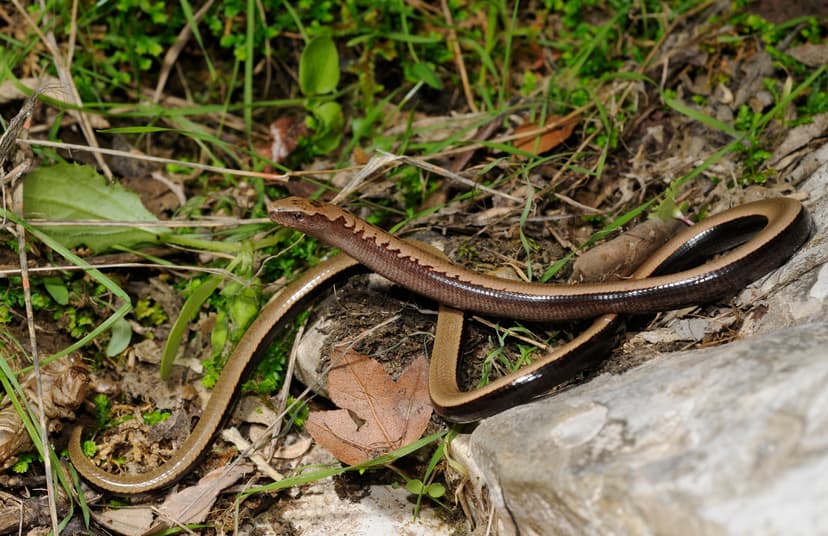
The Peloponnese slow worm (Anguis cephallonica) is a legless lizard endemic to specific regions of Greece, including the Peloponnese peninsula and the Ionian islands of Cephalonia, Ithaca, and Zakynthos. This species is distinguished by a higher number of scale rows around its body and a unique chocolate-brown lateral stripe, and it gives birth to live young.
Eumeces algeriensis
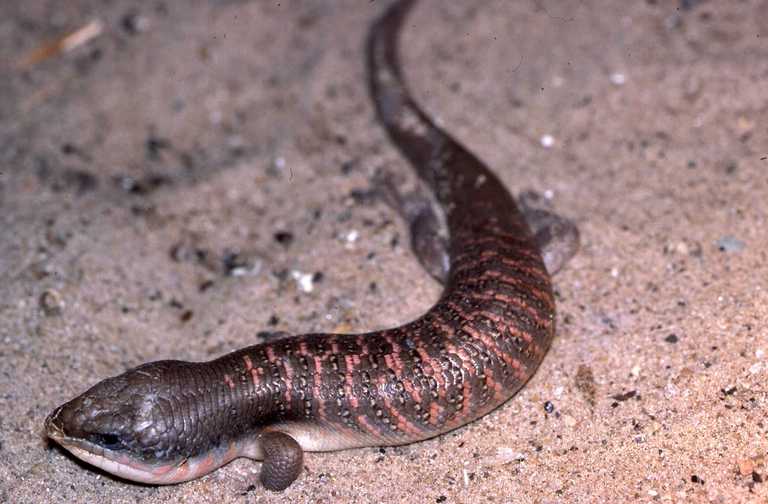
Eumeces algeriensis, also known as the Algerian skink or Algerian orange-tailed skink, is a species of skink native to the Maghreb region of North Africa. It inhabits a variety of environments including temperate forests, shrublands, grasslands, and even rural gardens. This oviparous lizard is characterized by its endemic distribution within Algeria and Morocco.