
Darevskia rudis
Darevskia rudis·Lacertidae
Darevskia rudis is a lizard species belonging to the family Lacertidae, commonly found in the Caucasus region of Georgia, Russia, and Azerbaijan, as well as in northern coastal Turkey. This species typically inhabits rocky areas within temperate forests and can also be found in montane steppes at considerable altitudes.
Key Facts
- ›Native to the Caucasus region and northern coastal Turkey.
- ›Inhabits rocky areas in temperate forests and montane steppes.
- ›Found at elevations up to 2,400 meters (7,900 feet).
- ›Belongs to the family Lacertidae.

Georgia, Russia, Azerbaijan, Turkey
Rocky Areas, Temperate Forests, Montane Steppe
About Darevskia rudis
Darevskia rudis is a lizard species recognized within the Lacertidae family. This species has a notable geographic distribution, being found across the Caucasus region, encompassing Georgia, Russia, and Azerbaijan, and extending into the northern coastal areas of Turkey.
Habitat and Distribution
The preferred habitat for Darevskia rudis consists of rocky terrains. It is commonly observed in temperate forests, but its adaptability is further demonstrated by its presence in montane steppes. This species can be found at significant altitudes, inhabiting areas up to 2,400 meters (7,900 feet) above sea level, indicating a tolerance for varied environmental conditions within its range.
Source: Wikipedia ↗
Frequently Asked Questions
Where is Darevskia rudis found?
Darevskia rudis is found in the Caucasus region, specifically in Georgia, Russia, and Azerbaijan. It is also present in northern coastal Turkey.
What kind of habitat does Darevskia rudis prefer?
This lizard species prefers rocky areas. It is commonly found in temperate forests and can also inhabit montane steppes.
At what elevations can Darevskia rudis be found?
Darevskia rudis can be found at elevations up to 2,400 meters (7,900 feet) above sea level.
What family does Darevskia rudis belong to?
Darevskia rudis is a member of the Lacertidae family, which are commonly known as wall lizards or true lizards.
Related Lizards

Algyroides marchi
The Spanish algyroides, also known as Valverde's lizard, is a species of lizard endemic to southeastern Spain. It inhabits temperate forests, riverbanks, and rocky areas at moderate to high altitudes. This oviparous lizard faces threats primarily from habitat loss.
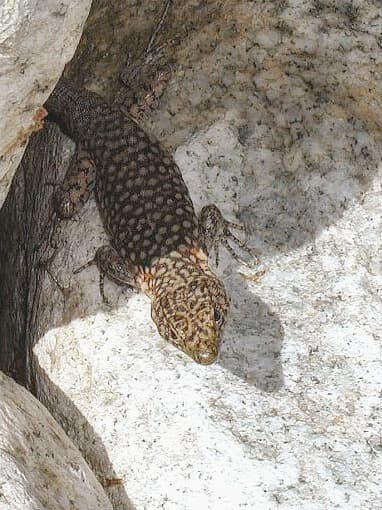
Archaeolacerta bedriagae
Bedriaga's rock lizard, scientifically known as Archaeolacterta bedriagae, is a species endemic to the islands of Corsica and Sardinia. This lizard is characterized by its brownish-grey coloration with a net pattern, which changes during the mating season, and juveniles are identifiable by their bright blue tails. It inhabits a variety of environments, including rocky areas, Mediterranean shrubland, and rural gardens, and is known for its ability to climb vertical surfaces and jump to catch flying insects.
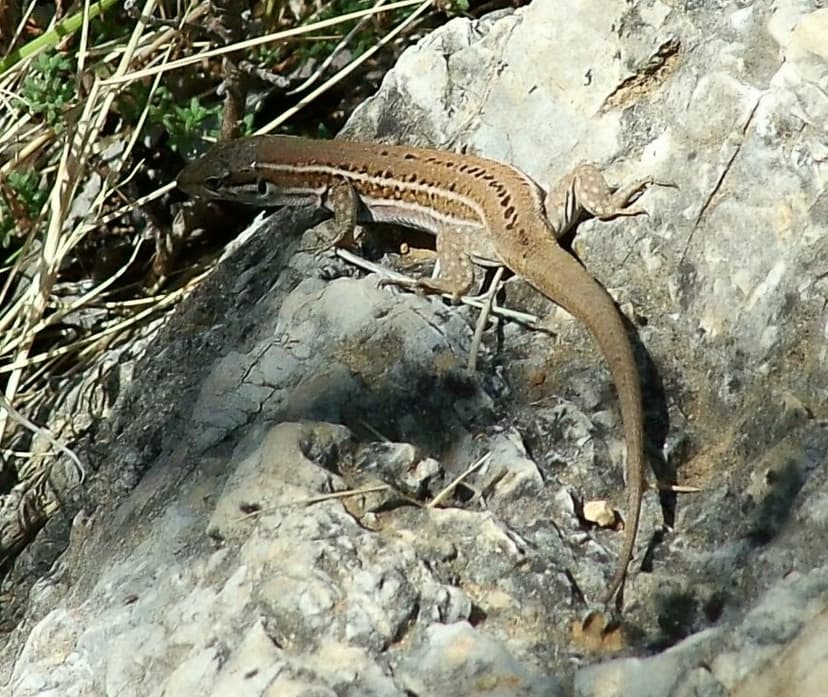
Dalmatian wall lizard
The Dalmatian wall lizard is a species of lizard found across parts of Southern Europe, inhabiting temperate forests, shrublands, rocky areas, and pastures. These lizards are characterized by their size, growing up to 65 mm in snout-vent length with a tail twice that of their body. A distinctive feature is their three ventral color morphs: yellow, orange, and white, with orange males exhibiting more dominant and aggressive behaviors.