
Dopasia gracilis
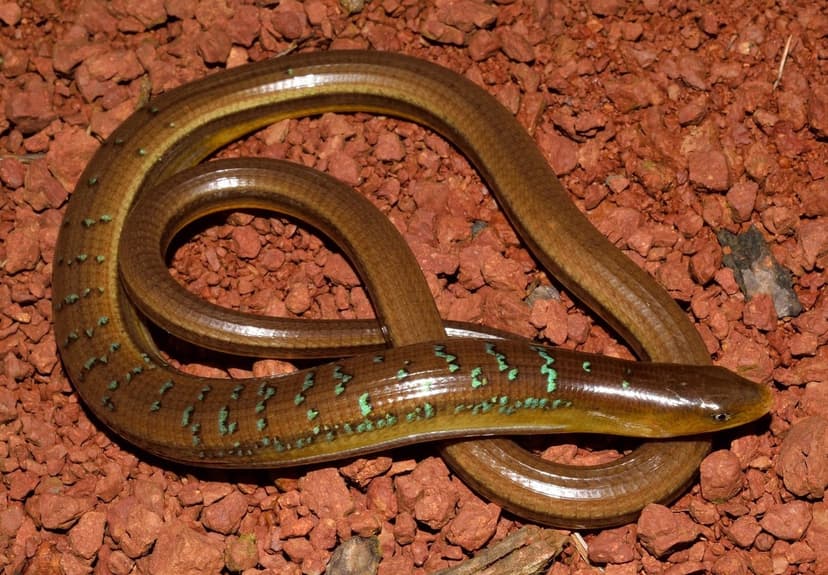
Dopasia gracilis, commonly known as the Asian glass lizard or Indian glass snake, is a legless lizard species native to Asia. It is characterized by its absence of hind limbs and a distinct lateral fold of skin along its trunk, which aids in body expansion. This species inhabits dry areas and is likely an insectivore or feeds on small vertebrates.
Key Facts
- ›A legless lizard belonging to the Anguidae family.
- ›Found in various Asian countries including China, India, Myanmar, Nepal, Thailand, and Vietnam.
- ›Distinguished by the complete absence of hind limbs, unlike some related species.
- ›Possesses a prominent lateral fold of skin extending along its body.
- ›The dorsal scales have a slight keel, while ventral scales are smooth.
- ›It is an oviparous species, meaning it reproduces by laying eggs.

Asian Glass Lizard, Burmese Glass Lizard, Indian Glass Snake
China, India, Myanmar, Nepal, Thailand, Vietnam, Bangladesh, Laos
- Legless Lizard With A Total Absence of Rudimentary Hind Limbs.
- Scaly Covering Is Tight, With Smooth Ventral Scales Arranged In Ten Series.
- Dorsal Scales Form Fourteen Longitudinal Series, Each With A Slight Continuous Keel.
- Upper Parts Are Brown With Some Irregular Black Spots Across the Back.
- Possesses An Extensible Fold of Skin Running Along Each Side of Its Trunk.
- Head Covered With A Large Vertical Plate and Three Smaller Occipitals; Frontals Are Irregular and of Unequal Size; Superciliaries In Two Series.
Small Lizards, Mice, Other Small Vertebrates
- Inferred To Live In Dry Places and Under Stones.
- Possesses An Extensible Fold of Skin Along Its Trunk To Accommodate Food Intake, Similar To Snakes.
About Dopasia gracilis
Dopasia gracilis, commonly referred to as the Asian glass lizard, Burmese glass lizard, or Indian glass snake, is a species of legless lizard belonging to the Anguidae family. This unique reptile is endemic to the Asian continent, with its natural range spanning across southern China, northern India, northern Myanmar, Nepal, Thailand, and Vietnam, and potentially extending into northern Bangladesh and Laos.
Physical Characteristics and Habitat
The most striking feature of Dopasia gracilis is its complete lack of hind limbs, setting it apart from some of its relatives. Its body is covered in tight-fitting scales, with smooth ventral scales arranged in ten longitudinal series and keeled dorsal scales forming fourteen longitudinal series. The upper body is typically brown, marked with irregular black spots along the back. A distinctive anatomical adaptation is the presence of an extensible fold of skin along each side of its trunk, which allows for significant expansion of the body, enabling it to consume larger prey than its relatively slender form might suggest.
Historically, it has been inferred that Dopasia gracilis likely inhabits dry environments, seeking shelter under stones. Its coloration and body structure suggest a cryptic lifestyle, aiding in camouflage within its terrestrial habitat.
Diet and Reproduction
While specific dietary studies are limited, based on its morphology and inferred habits similar to related species like Pseudopus pallasii, Dopasia gracilis is believed to prey on small lizards, mice, and other small vertebrates. This places it as a carnivore within its ecosystem.
Reproductively, Dopasia gracilis is oviparous, meaning it reproduces by laying eggs. The specifics of its reproductive cycle, such as clutch size or incubation periods, are not detailed in available records, but this method of reproduction is characteristic of many lizard species.
Size
A specimen measured by A. C. L. G. Günther in 1864 was recorded at 15 inches in total length, with the tail comprising approximately 10 inches of this length. This indicates that the tail is a substantial proportion of the lizard's overall body size.
Source: Wikipedia ↗
Frequently Asked Questions
What are the common names for Dopasia gracilis?
Dopasia gracilis is known by several common names, including the Asian glass lizard, the Burmese glass lizard, and the Indian glass snake. These names reflect its geographic distribution and its legless appearance, which can resemble a snake.
Where is Dopasia gracilis found?
This species is endemic to Asia and has been recorded in southern China, northern India, northern Myanmar, Nepal, Thailand, and Vietnam. It may also be found in northern Bangladesh and Laos.
What are the physical characteristics of the Asian glass lizard?
Dopasia gracilis is a legless lizard, lacking any hind limbs. It features a tight scaly covering with smooth ventral scales and dorsally keeled scales arranged in longitudinal series. A notable anatomical feature is an extensible fold of skin running along each side of its trunk.
What does Dopasia gracilis eat?
Based on its resemblance to other species and typical habits, it is inferred that Dopasia gracilis likely lives in dry places and feeds on small lizards, mice, and other small vertebrates. Its diet is primarily carnivorous.
How does Dopasia gracilis reproduce?
Dopasia gracilis is an oviparous species, which means it reproduces by laying eggs. While specific details about its nesting or egg-laying habits are not provided, this reproductive strategy is common among lizards.
What is the size of Dopasia gracilis?
A typical specimen measured 15 inches in total length, with the tail accounting for 10 inches of that length. This suggests a significant portion of its body is tail.
Related Lizards
Burmese glass lizard
The Burmese glass lizard, also known as the Asian glass lizard or Indian glass snake, is a legless lizard species found across Southeast Asia and parts of South Asia. It is characterized by its smooth ventral scales, a slight keel on its dorsal scales, and a distinct lateral fold of skin that allows for expansion. This oviparous species likely inhabits dry areas and preys on small vertebrates.

European copper skink
The European copper skink, also known as the European snake-eyed skink, is a small, slender lizard native to Eastern Europe and Southwestern Asia. It is characterized by its bronze coloration with dark sides and immovable eyelids. This shy species prefers dry, open habitats and is primarily active during twilight hours, feeding on insects and small snails.
Ablepharus
Ablepharus, commonly known as snake-eyed skinks, are small lizards distinguished by fused eyelids that prevent blinking, similar to snakes. They inhabit dry fields, hills, and rocky areas, often concealed within leaf litter. These skinks possess shiny, bronze scales and a characteristic dark stripe along their sides, feeding primarily on small insects and mollusks.