
Gehyra variegata
Gehyra variegata, also known as the tree dtella, is a gecko species native to inland Australia. This lizard is characterized by its highly variable dorsal coloration, ranging from grey to brown with blotches or spots, and its ability to climb using specialized toe pads. It inhabits arid to sub-humid woodlands, shrublands, and rocky areas, demonstrating adaptability to disturbed land.
Key Facts
- ›Native to inland Australia, excluding the far northwest and southeast.
- ›Possesses highly variable dorsal coloration, from grey to brown with blotches or spots.
- ›Inhabits arid to sub-humid woodland, shrubland, and rocky environments.
- ›Climbs using clawed fingers and toes with large adhesive pads.
- ›Feeds on insects such as beetles, termites, grasshoppers, cockroaches, and spiders.
- ›Reproduces by laying one hard-shelled egg at a time, typically twice per breeding season.
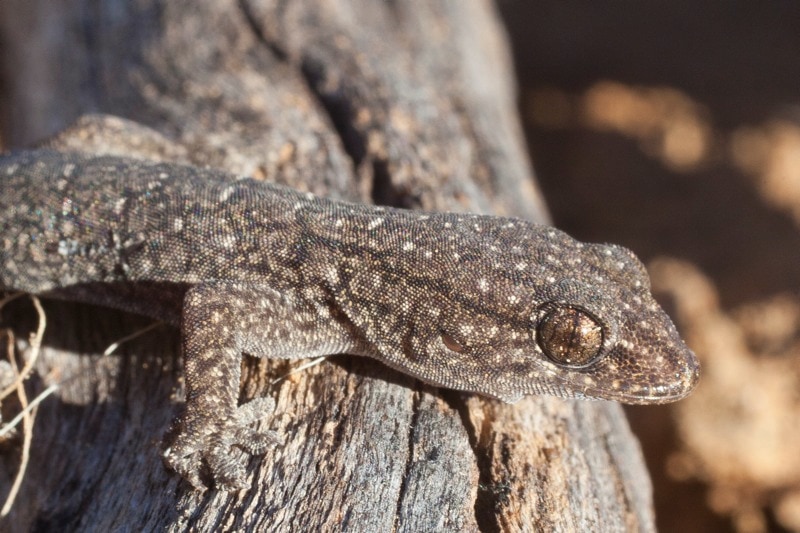
Tree Dtella, Variegated Dtella, Varied Dtella
Inland Australia
Woodland, Shrubland, Rocky Environments, Under Loose Bark, Tree Hollows, Crevices, Under Exfoliating Rock, Ground Debris, Human Dwellings
- Snout-Vent Length Up To 55mm.
- Tail Length Up To 70mm, Approximately 55% of Snout-Vent Length.
- Highly Variable Dorsal Coloration: Grey To Brown With Chequered Dark and Pale Blotches and Marbling Or White To Pale Brown Spots With Dark Bars .
- Irregular Reticulate Pattern Over the Entire Dorsal Surface.
- Small and Uniform Body Scales.
- Inter-Orbital Scales On Head Are Much Smaller Than Loreal Scales.
- Rostral Scale On Nose Has Steeply Sloping Upper Edges.
- Several Dark Lines On the Sides of the Head.
- Whitish Underside of the Body.
- Long Tail Tapers To A Point.
- Clawed Fingers and Toes With Large Pads At the Tips For Climbing.
- All Inner Digits Are Claw-Free.
- Fingers and Toes Have Divided Subdigital Lamellae.
- Third and Fourth Toes Do Not Feature Webbing.
Beetles, Termite, Grasshoppers, Cockroaches, Spiders
- Nocturnal, But Basks In the Sun and Is Active Under Cover During the Day In Cooler Months.
- Males Are Territorial.
- Several Females and One Male Often Share A Site.
- Forages In the First 3 Hours After Dark, Staying Within 10 Metres of Its Home.
- Can Live In Human Dwellings and Hunt Insects Around Street Lights.
- Can Emit A Shrill Squeak.
- Exhibits Behavioral Thermoregulation By Changing Location Under Bark To Optimize Body Temperature.
- Able To Alter Habitat Use In Response To Environmental Changes.
About Gehyra variegata
Gehyra variegata: The Tree Dtella
Gehyra variegata, commonly known as the tree dtella, variegated dtella, or varied dtella, is a species of gecko native to the inland regions of Australia. It belongs to the family Gekkonidae, which has evolutionary roots tracing back to the ancient landmass of Gondwana.
Description and Habitat
This gecko is characterized by its highly variable dorsal coloration, which can range from grey to brown with chequered blotches and marbling in eastern populations, and white to pale brown spots with dark bars in western populations. These patterns form an irregular, reticulate design across its back. The tree dtella's body reaches a snout-vent length of up to 55mm, with a tail that tapers to a point and measures up to 70mm. Its fingers and toes are equipped with clawed tips and large pads, enabling it to climb with ease.
Gehyra variegata thrives in arid to sub-humid environments, including woodlands, shrublands, and rocky areas. It is both arboreal and saxicolous, meaning it can be found under loose bark and in hollows on trees, as well as in crevices and under exfoliating rock. It prefers sheltered sites on trees, typically more than a meter above the ground, and can also be found under ground debris.
Behavior and Diet
Although primarily nocturnal, the tree dtella may bask in the sun and exhibit daytime activity under cover during cooler months. Males are territorial, and it is common for several females and one male to share a territory. This species is known to inhabit human dwellings and can be observed hunting insects around street lights at night. Gehyra variegata can also emit a shrill squeak.
Its diet consists of various invertebrates, including beetles, termites, grasshoppers, cockroaches, and spiders. The gecko typically forages within 10 meters of its home base during the first three hours after dark.
Reproduction and Lifespan
The tree dtella has a lifespan of at least five years and reaches sexual maturity around three years of age. It is oviparous, laying one hard-shelled egg at a time beneath cover, usually twice within a breeding season, often about a month apart. The incubation period for these eggs is slightly longer than two months, with hatching occurring between 61 and 79 days. Hatchlings measure approximately 45mm in total length. Nests can be communal, with instances of up to 35 eggs found in a single nest.
Evolutionary Context
The family Gekkonidae, to which Gehyra variegata belongs, is considered to be of Gondwanan origin. This lineage includes early diplodactylids, which were present in Australia when it separated from the Gondwanan supercontinent. The Scleroglossa group, characterized by using their jaws rather than tongues for eating, includes the gecko family Gekkonidae and the subfamily Gekkoninae.
Source: Wikipedia ↗
Frequently Asked Questions
What is the scientific name for the tree dtella?
The scientific name for the tree dtella is Gehyra variegata. This binomial nomenclature identifies it as a distinct species within the genus Gehyra.
What does Gehyra variegata eat?
Gehyra variegata has a diet consisting of various invertebrates. This includes beetles, termites, grasshoppers, cockroaches, and spiders, which it forages for shortly after dark.
Where can Gehyra variegata be found?
This gecko species is found in inland Australia, specifically in arid to sub-humid regions. Its preferred habitats include woodlands, shrublands, and rocky areas.
What are the physical characteristics of Gehyra variegata?
Gehyra variegata has a snout-vent length of up to 55mm and a tail length of up to 70mm. Its dorsal coloration is highly variable, ranging from grey to brown with distinctive blotches or spots, and its underside is whitish. It has specialized toe pads for climbing.
How does Gehyra variegata thermoregulate?
As an ectotherm, Gehyra variegata relies on heat exchange with its environment. It exhibits behavioral thermoregulation by moving to different locations under tree bark as the sun warms various parts of the tree throughout the day.
What is the reproductive cycle of Gehyra variegata?
Gehyra variegata is oviparous, laying one hard-shelled egg at a time, usually twice per breeding season. The eggs are typically laid beneath cover such as bark or in rock crevices, with hatching occurring after 61–79 days.
Is Gehyra variegata social?
Males of the species are territorial. It has been observed that several females and one male may share a particular site, indicating a degree of social organization within territories.
Related Lizards
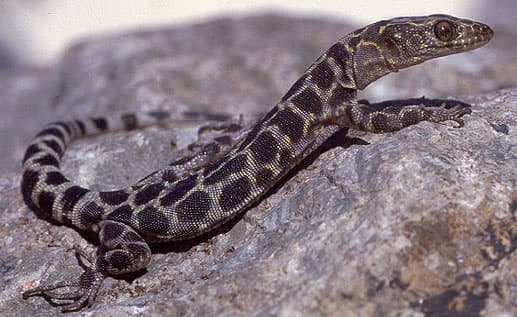
Xantusia henshawi
The granite night lizard (Xantusia henshawi) is a flat-bodied lizard endemic to North America, found in Baja California, Mexico, and southern California, USA. It is characterized by its soft skin, rounded dark dorsal spots on a pale background, large eyes with vertical pupils, and lack of eyelids. This species is often found in rocky slopes with boulders and crevices, and exhibits crepuscular and nocturnal activity.

Cordylidae
Cordylidae, commonly known as girdled lizards, spinytail lizards, or girdle-tail lizards, are a family of small to medium-sized lizards native to southern and eastern Africa. They are characterized by their flattened bodies, armored scales, and often spiny tails, which aid in defense and securing themselves in crevices. These diurnal and insectivorous lizards are primarily terrestrial, inhabiting rocky terrain, though some species may burrow or live in trees.

Sceloporus poinsettii
The crevice spiny lizard (Sceloporus poinsettii) is a small, phrynosomatid lizard characterized by its distinctly spiny scales and a typically gray or ruddy red-brown coloration. Found in the semi-arid regions of the Chihuahua Desert and Edwards Plateau, as well as parts of Mexico, it prefers rocky habitats with numerous crevices for shelter. This species is ovoviviparous, giving birth to live young in midsummer.