
Middle Eastern short-fingered gecko
The Middle Eastern short-fingered gecko (Stenodactylus doriae) is a lizard species native to Western Asia, known for its desert habitat and sand-protecting eye scales. It is oviparous, laying one to two eggs per clutch.
Key Facts
- ›Native to Western Asia, including Iran, Iraq, Israel, Jordan, Kuwait, Oman, Saudi Arabia, and the UAE.
- ›Prefers desert environments at altitudes from sea level to 1,000 meters.
- ›Reaches a snout-to-vent length of approximately 8.3 cm.
- ›Possesses large scales around its eyes to shield them from sand during burrowing.
- ›Reproduces by laying eggs (oviparous).
- ›Typically lays one or two eggs per clutch.

Doria's Comb-Fingered Gecko, Middle Eastern Short-Fingered Gecko
Iran, Iraq, Israel, Jordan, Kuwait, Oman, Saudi Arabia, United Arab Emirates
- Reaches A Snout-To-Vent Length of About 8.3 cm .
- Eyes Are Bordered By Large Scales To Protect Them From the Sand During Burrowing.
- Burrowing Behavior, Indicated By Eye Protection For Sand.
About Middle Eastern short-fingered gecko
The Middle Eastern short-fingered gecko, scientifically known as Stenodactylus doriae, is a species of lizard belonging to the Gekkonidae family. This gecko is a native inhabitant of Western Asia, with its range extending across several countries including Iran, Iraq, Israel, Jordan, Kuwait, Oman, Saudi Arabia, and the United Arab Emirates.
Habitat and Description
This species is adapted to arid environments, with its preferred natural habitat being the desert. It can be found at elevations ranging from sea level up to approximately 1,000 meters (3,300 feet). Physically, the Middle Eastern short-fingered gecko is characterized by its relatively small size, reaching a snout-to-vent length of about 8.3 centimeters (3.3 inches). A distinctive adaptation for life in sandy environments is the presence of large scales surrounding its eyes, which serve to protect them from abrasive sand particles during burrowing activities.
Reproduction
The Middle Eastern short-fingered gecko reproduces oviparously, meaning it lays eggs. Each reproductive event typically results in a clutch of one to two eggs. Further details regarding its reproductive cycle, such as gestation or incubation periods, are not extensively documented in available records.
Source: Wikipedia ↗
Frequently Asked Questions
What is the scientific name for the Middle Eastern short-fingered gecko?
The scientific name for the Middle Eastern short-fingered gecko is Stenodactylus doriae. It is also sometimes referred to as Doria's comb-fingered gecko.
Where can the Middle Eastern short-fingered gecko be found?
This species is found across Western Asia, with its geographic range including Iran, Iraq, Israel, Jordan, Kuwait, Oman, Saudi Arabia, and the United Arab Emirates.
What kind of habitat does the Middle Eastern short-fingered gecko prefer?
The preferred natural habitat for S. doriae is the desert. They can be found at altitudes ranging from sea level up to 1,000 meters (3,300 ft).
What are the distinctive physical features of this gecko?
The Middle Eastern short-fingered gecko reaches a snout-to-vent length of about 8.3 cm. A notable feature is the presence of large scales around its eyes, which help protect them from sand when the gecko burrows.
How does the Middle Eastern short-fingered gecko reproduce?
This species is oviparous, meaning it reproduces by laying eggs. Each clutch typically contains one or two eggs.
Related Lizards
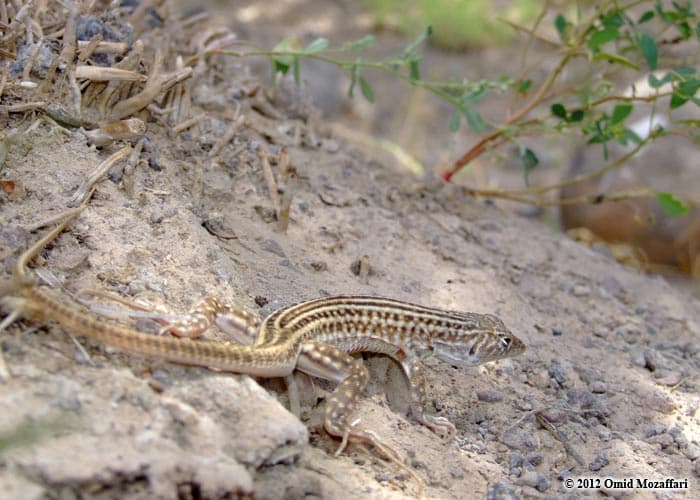
Acanthodactylus cantoris
The Indian fringe-fingered lizard (Acanthodactylus cantoris) is a terrestrial species endemic to Asia, primarily found in sandy desert and shrubland habitats. It is characterized by its acutely pointed snout, keeled dorsal scales, and strong digital denticulations. This oviparous lizard burrows in the sand for protection and its young have distinctive white longitudinal lines on a blackish background.
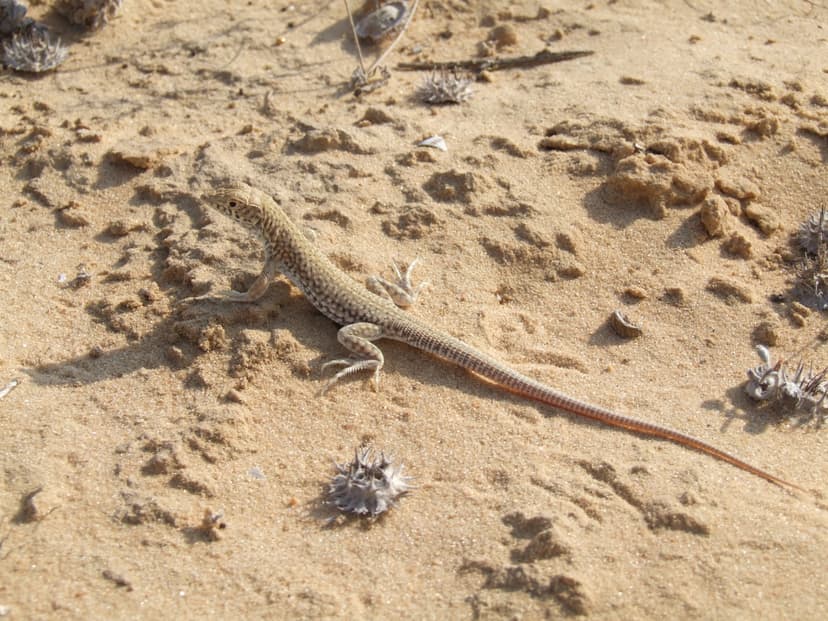
Acanthodactylus scutellatus
The Acanthodactylus scutellatus, commonly known as the Nidua fringe-fingered lizard, is a small lizard species endemic to northern Africa and the Middle East. It is recognized by its unique ventral scale arrangement and its adeptness at burrowing in loose sand for shelter. This diurnal species breeds in late winter, with females laying clutches of 3-6 eggs in the spring.

Agama anchietae
Agama anchietae, commonly known as Anchieta's agama or the western rock agama, is a species of lizard native to southern Africa. It is characterized by its cryptic coloration, a wider head and longer tail in males due to sexual dimorphism, and a diet primarily consisting of insects, particularly ants. This species inhabits diverse environments including deserts, shrublands, and grasslands, and it reproduces by laying eggs.