
Sceloporus bimaculosus
Sceloporus bimaculosus, commonly known as the twin-spotted spiny lizard, is a species of lizard found in the southwestern United States and Mexico. This lizard belongs to the Phrynosomatidae family and is characterized by its distinctive markings.
Key Facts
- ›Found in New Mexico, Texas, and Mexico.
- ›Belongs to the family Phrynosomatidae.
- ›Its common name is the twin-spotted spiny lizard.
- ›Primarily inhabits arid and semi-arid environments.

Twin-Spotted Spiny Lizard
New Mexico, Texas, Mexico
Characterized By Twin Spots.
About Sceloporus bimaculosus
Sceloporus bimaculosus: The Twin-Spotted Spiny Lizard
Sceloporus bimaculosus, commonly referred to as the twin-spotted spiny lizard, is a species of reptile native to arid and semi-arid regions of southwestern North America. Its range encompasses parts of New Mexico and Texas in the United States, as well as areas within Mexico.
This lizard belongs to the family Phrynosomatidae, a diverse group of lizards known for their adaptations to various terrestrial environments. While specific details about its physical characteristics beyond its namesake "twin spots" are not extensively documented in general references, its common name highlights a distinctive visual feature.
Information regarding the diet, lifespan, reproductive methods, and conservation status of Sceloporus bimaculosus is limited in readily available summaries. Further research would be required to fully understand its ecological role and specific needs within its natural habitat.
Source: Wikipedia ↗
Frequently Asked Questions
What is the scientific name for the twin-spotted spiny lizard?
The scientific name for the twin-spotted spiny lizard is Sceloporus bimaculosus.
Where can Sceloporus bimaculosus be found?
Sceloporus bimaculosus is found in New Mexico and Texas in the United States, as well as in Mexico.
What family does the twin-spotted spiny lizard belong to?
The twin-spotted spiny lizard belongs to the family Phrynosomatidae.
Related Lizards

Ctenophorus fordi
The Mallee dragon (Ctenophorus fordi) is a small lizard native to the arid regions of southern Australia, characterized by its reddish-orange coloration and pale, black-bordered stripes. It inhabits shrubland and hummock grass environments, particularly in Mallee woodlands and spinifex areas, often near vegetated sand dunes. This species is primarily an ant specialist, employing a sit-and-wait strategy to ambush its prey.

Eurylepis taeniolatus
Eurylepis taeniolata, also known as the ribbon-sided skink, is a species found across Central, South, and West Asia. This skink is characterized by its elongated body, slender limbs, and a distinctive color pattern of gray-brown with pale dorsolateral stripes that become more prominent anteriorly, and brown rectangular spots posteriorly. It inhabits a variety of arid and semi-arid environments.
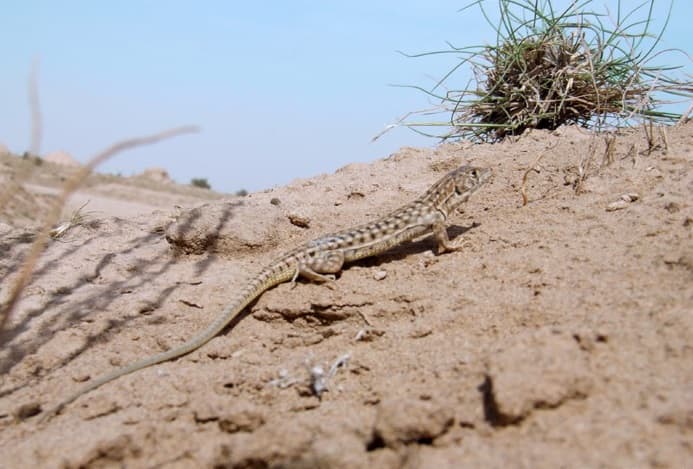
Giant fringe-fingered lizard
The giant fringe-fingered lizard (Acanthodactylus grandis) is a species of lizard belonging to the family Lacertidae, native to Western Asia. This oviparous species is found across several countries in the region, inhabiting arid and semi-arid environments.