
Slevin's bunchgrass lizard
Slevin's bunchgrass lizard (Sceloporus slevini) is a lizard species native to grasslands and forests in the southwestern United States and northern Mexico. Adults typically measure between 4 to 7 cm in snout-to-vent length and are distinguished by their scale patterns. This oviparous species was named in honor of the specimen collector, Joseph R. Slevin.
Key Facts
- ›Found in southeastern Arizona, Chihuahua, Durango, Sinaloa, and Sonora.
- ›Prefers grassland and forest habitats.
- ›Adults have a snout-to-vent length of 4–7 cm.
- ›Lateral scale rows are parallel to dorsal scale rows.
- ›Femoral pores are separated by no more than two scales at the midline.
- ›Reproduces by laying eggs (oviparous).

United States, Mexico
- Adult Snout-To-Vent Length of 4–7 cm.
- Lateral Scale Rows Are Parallel To Dorsal Scale Rows.
- Rows of Femoral Pores Are Separated At the Midline By Not More Than Two Scales.
About Slevin's bunchgrass lizard
Slevin's bunchgrass lizard, scientifically known as Sceloporus slevini, is a species of lizard native to the arid and semi-arid regions of the southwestern United States and adjacent northern Mexico. This reptile is a member of the Phrynosomatidae family, a diverse group of spiny lizards.
Description and Habitat
Adult Slevin's bunchgrass lizards are relatively small, typically measuring between 4 to 7 centimeters (1.6 to 2.8 inches) in snout-to-vent length. A distinguishing characteristic of this species is the arrangement of its scales; the lateral rows of scales along the sides of its body are parallel to the dorsal scale rows. Furthermore, the femoral pores, which are small openings on the underside of the thigh, are separated at the midline by no more than two scales. The preferred natural habitats for Slevin's bunchgrass lizard include grasslands and forest environments, indicating an adaptation to a variety of vegetated landscapes.
Distribution and Taxonomy
The geographic range of Sceloporus slevini extends across southeastern Arizona in the United States. In Mexico, it is found in the states of Chihuahua, northern Durango, northeastern Sinaloa, and eastern Sonora. The species was formally described in 1937 by Hobart M. Smith. It bears the name of Joseph R. Slevin, who was the collector of the holotype specimen, the original example used to describe the species.
Reproduction
Slevin's bunchgrass lizard reproduces oviparously, meaning it lays eggs. Further details regarding its reproductive cycle, such as clutch size or incubation periods, are not extensively documented in the primary accounts of the species.
Source: Wikipedia ↗
Frequently Asked Questions
Where is Slevin's bunchgrass lizard found?
Slevin's bunchgrass lizard is indigenous to the southwestern United States, specifically southeastern Arizona. It is also found in adjacent northern Mexico, including the states of Chihuahua, northern Durango, northeastern Sinaloa, and eastern Sonora.
What kind of habitat does Slevin's bunchgrass lizard prefer?
The preferred natural habitats for Slevin's bunchgrass lizard are grassland and forest environments. These areas provide the necessary cover and resources for the species to thrive.
What are the physical characteristics of Slevin's bunchgrass lizard?
Adult Slevin's bunchgrass lizards typically have a snout-to-vent length ranging from 4 to 7 cm. A notable feature is that the rows of lateral scales on the sides of the body run parallel to the rows of dorsal scales.
How does Slevin's bunchgrass lizard reproduce?
Slevin's bunchgrass lizard is oviparous, meaning it reproduces by laying eggs. The specific details regarding clutch size or incubation period are not provided in the available information.
What is the significance of the femoral pores in Slevin's bunchgrass lizard?
In Slevin's bunchgrass lizard, the rows of femoral pores are separated at the midline by not more than two scales. This anatomical detail is a characteristic used in its identification.
Related Lizards

Anisolepis grilli
Anisolepis grilli, also known as Boulenger's tree lizard, is a species of lizard endemic to South America, found in parts of Argentina, Brazil, and Uruguay. It inhabits forests and grasslands and is oviparous, meaning it reproduces by laying eggs. The species is named in honor of Giuseppe Franco Grillo.

Calumma hilleniusi
Calumma hilleniusi is a chameleon species native to Madagascar. This lizard inhabits forest and grassland environments at significant altitudes. It is known for being oviparous, with females laying clutches of eggs.
Chernov's skink
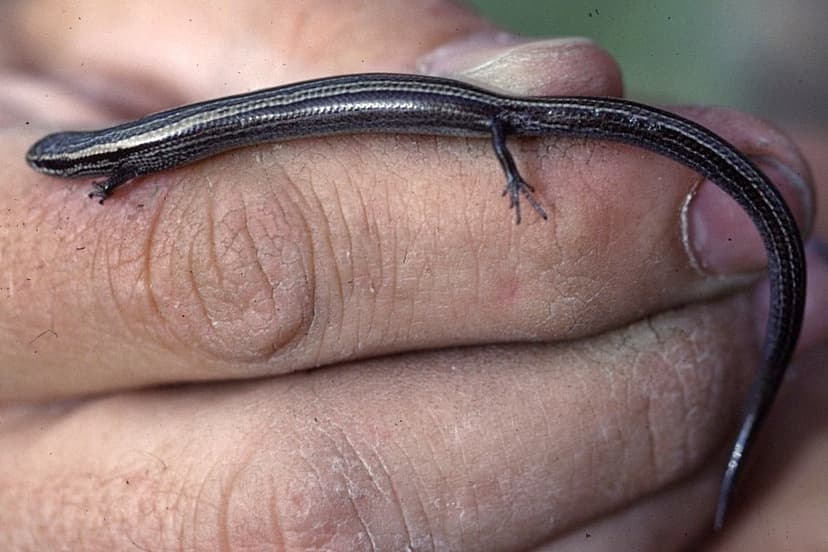
Chernov's skink, scientifically known as *Ablepharus chernovi*, is a species of skink found in northern Eurasia. This lizard inhabits grasslands, shrublands, and forests at moderate to high altitudes. It is characterized by being oviparous, with females laying clutches of up to four eggs.