
Black-legged parrot
The black-legged parrot, also known as the western white-bellied parrot, is a species of parrot found in the Amazon basin of South America. It is distinguished by its primarily white underparts and, as its name suggests, dark legs. While facing population declines due to habitat loss, its large range and slow rate of decline have led to its classification as 'Least Concern' by the IUCN.
Key Facts
- ›Native to Bolivia, Brazil, and Peru.
- ›Classified as 'Least Concern' by the IUCN despite habitat loss.
- ›Often treated as a subspecies of the white-bellied parrot (Pionites leucogaster).
- ›Distinguished by its dark legs and white underparts.
- ›Found in the Arinae subfamily of the Psittacidae family.

Western White-Bellied Parrot
South America
Dark Legs, White Underparts
About Black-legged parrot
The black-legged parrot, scientifically known as Pionites leucogaster xanthomerius, is a bird species native to the Amazon basin of South America. It is also commonly referred to as the western white-bellied parrot. This species belongs to the Arinae subfamily within the Psittacidae family, which encompasses African and New World parrots.
Geographic Distribution and Taxonomy
The black-legged parrot is found in Bolivia, Brazil, and Peru. Its taxonomic classification has been a subject of discussion among ornithological bodies. While BirdLife International's Handbook of the Birds of the World (HBW) considers it a distinct species, the South American Classification Committee of the American Ornithological Society, the International Ornithological Committee, and the Clements taxonomy treat it as a subspecies of the broader white-bellied parrot (Pionites leucogaster).
Conservation Status
Despite experiencing a decline in population due to ongoing habitat loss, the black-legged parrot is currently classified as 'Least Concern' by the International Union for Conservation of Nature (IUCN). This classification is attributed to its extensive geographic range and a relatively slow decline in its overall population numbers.
Physical Characteristics
The black-legged parrot is characterized by its predominantly white underparts and, as its common name suggests, dark legs. Specific details regarding its size, weight, and plumage variations beyond its differentiating features are not extensively detailed in available records.
Source: Wikipedia ↗
Frequently Asked Questions
What is the scientific name for the black-legged parrot?
The scientific name for the black-legged parrot is Pionites leucogaster xanthomerius. It is also sometimes referred to by the scientific name Pionites xanthomerius.
Where are black-legged parrots found?
Black-legged parrots are native to South America, specifically found in the countries of Bolivia, Brazil, and Peru.
What is the conservation status of the black-legged parrot?
Despite ongoing habitat loss leading to population decline, the International Union for Conservation of Nature (IUCN) classifies the black-legged parrot as 'Least Concern'. This is due to its extensive geographical range and the relatively slow rate of its population decrease.
Is the black-legged parrot considered a separate species?
There is some taxonomic debate regarding the black-legged parrot. While BirdLife International's Handbook of the Birds of the World (HBW) recognizes it as a full species, other ornithological bodies like the South American Classification Committee and the International Ornithological Committee classify it as a subspecies of the white-bellied parrot (Pionites leucogaster).
Related Parrot species
Blue-and-yellow macaw
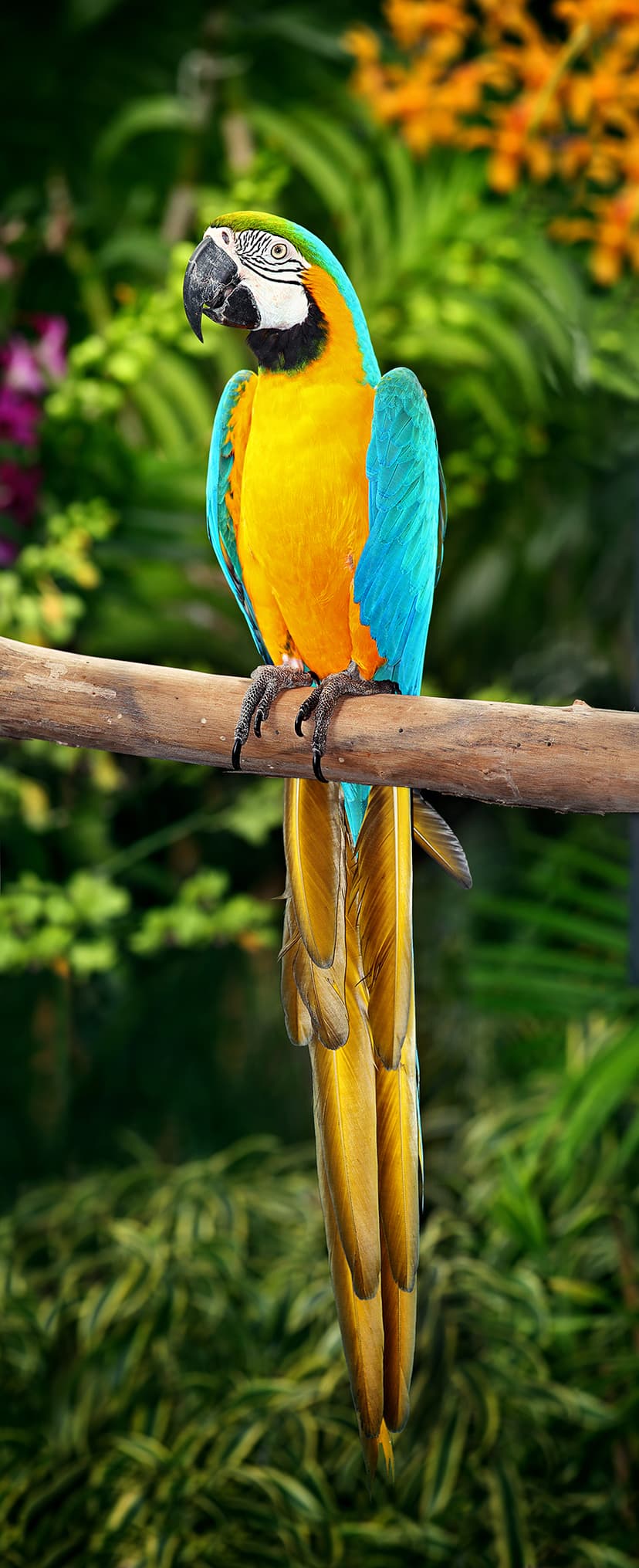
The blue-and-yellow macaw, also known as the blue-and-gold macaw, is a large Neotropical parrot native to the forests, woodlands, and savannahs of tropical Central and South America, including Trinidad. It is distinguished by its vibrant blue upperparts, yellow to orange underparts, and a green crown, making it one of the most popular and commonly kept macaw species in aviculture due to its striking appearance and ability to bond with humans.

Blue-fronted fig parrot
The blue-fronted fig parrot is a species of parrot found in the lowland forests of New Guinea, the Bird's Head Peninsula, and Salawati. It is primarily green with distinctive orange markings on the males' breasts and females' faces. This species is known for its diet of fig seeds and its nesting habits within arboreal termite mounds.

Blue-fronted parrotlet
The blue-fronted parrotlet is a small bird found in the cloud forests and mature secondary forests of Colombia, Ecuador, Panama, and Venezuela. Characterized by its predominantly green plumage, it is distinguished by a vibrant blue forehead, a white eye ring, and red markings on its wings. These birds are known for their gregarious nature and can be quite noisy in flight, though they are often overlooked due to their quiet feeding habits.