
Brown-hooded parrot
The brown-hooded parrot is a species of parrot found from Mexico to Colombia, belonging to the family Psittacidae. It is distinguished by its vibrant plumage, featuring a reddish-brown crown and throat, olive-yellow breast, and green body with blue accents on the wings and tail.
Key Facts
- ›Found in humid evergreen forests, cloud forests, and mature secondary forests.
- ›Diet primarily consists of fruits and seeds, with figs being a favored food source.
- ›Adults measure 21-23 cm (8.3-9.1 in) in length and weigh 145-150 g (5.1-5.3 oz).
- ›Plumage is predominantly green with a reddish-brown hood, blue wing edges, and blue tail tips.
- ›Has a large geographic range spanning from Mexico to Colombia.
- ›Classified as 'Least Concern' by the IUCN, with a population estimated at over 50,000 mature individuals, though declining.
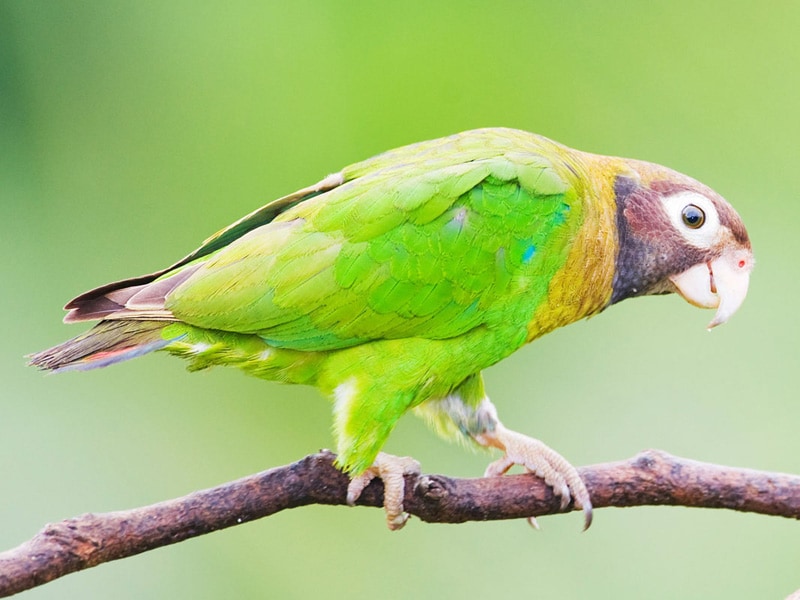
Brown-Headed Parrot
Mexico, Central America, Colombia
Humid Evergreen Forest Canopy, Cloudforest, Mature Secondary Forest Edges
Reddish-brown crown, ear coverts, and throat, Pinkish-red patch behind the eye, White nares and eye ring, Blue on wing edge and tail tips
Fruits, Seeds, Epiphytes, Mistletoe Leaves
- Flight call described as 'kee-reek' or 'curicu-reek'
- High-pitched 'chreea, cheea' in flight
- Melodious perched calls ranging from yelps to gurgling and squeaking notes
Nests In Tree Cavities
About Brown-hooded parrot
The brown-hooded parrot, scientifically known as Pyrilia haematotis, is a species of parrot found from Mexico south to Colombia. It is part of the subfamily Arinae within the family Psittacidae, which encompasses African and New World parrots.
Description and Appearance
Adult brown-hooded parrots typically measure between 21 and 23 cm (8.3 to 9.1 inches) in length and weigh approximately 145 to 150 grams (5.1 to 5.3 ounces). Their plumage is notable for a reddish-brown crown, ear coverts, and throat, complemented by a small pinkish-red patch behind the eye and distinct white nares and eye rings. The nape and breast are a dull olive-yellow, with red coloration on the flanks. The majority of their body is green, accented with blue on the wing edges, blackish-blue on the flight feathers, and blue tips on the tail feathers. Subspecies P. h. coccinicollaris may exhibit additional pinkish-red coloration below the dark throat. Immature birds are similar to adults but possess a paler head, lack the red patch behind the eye, and have a greener breast.
Distribution and Habitat
The species inhabits the canopy and edges of humid evergreen forests, cloud forests, and mature secondary forests. Its elevational range generally spans from sea level up to 1,200 meters (3,900 ft), with some occurrences as high as 1,900 meters (6,200 ft). The nominate subspecies, P. h. haematotis, is found from Veracruz and Oaxaca in southeastern Mexico, extending south through Belize, Guatemala, Honduras, and Nicaragua, and across both slopes in Costa Rica and western Panama. The subspecies P. h. coccinicollaris is found from the vicinity of the Panama Canal into the northwestern departments of Colombia, including Chocó, Antioquia, and Córdoba.
Behavior and Ecology
Brown-hooded parrots are believed to undertake seasonal elevational movements, possibly moving to lower elevations after breeding at higher altitudes, particularly noted in Costa Rica. They forage in the forest canopy and at forest edges. Their diet is primarily composed of fruits and seeds sourced from trees and epiphytes, with figs (Ficus) being a favored food item. Observations also include feeding on mistletoe leaves.
Vocalizations
Their vocalizations include a distinct flight call described as a "clear chirruping kee-reek or curicu-reek," and also as a "high-pitched chreea, cheea." When perched, they produce a variety of melodious calls, which can range from yelps to various gurgling and squeaking notes.
Reproduction
Nesting occurs in cavities within trees. The specific breeding season appears to vary geographically and is not precisely defined. Details regarding clutch size, incubation period, fledging time, and parental care practices are not well-documented.
Conservation Status
The International Union for Conservation of Nature (IUCN) has assessed the brown-hooded parrot as 'Least Concern'. The species possesses a large geographic range and an estimated population of at least 50,000 mature individuals, although this population is believed to be in decline. Habitat logging is identified as the primary threat, but it is not considered severe. The species is described as fairly common throughout much of its range and experiences very little persecution, even locally from trapping.
Source: Wikipedia ↗
Frequently Asked Questions
What is the scientific name of the brown-hooded parrot?
The scientific name of the brown-hooded parrot is Pyrilia haematotis. It belongs to the genus Pyrilia, which was formerly included within the genus Pionopsitta.
Where are brown-hooded parrots found?
Brown-hooded parrots are distributed from Mexico through Central America to Colombia. They inhabit the canopy and edges of humid evergreen forests, cloud forests, and mature secondary forests.
What do brown-hooded parrots eat?
Their diet primarily consists of fruits and seeds from trees and epiphytes. Figs are noted as a favored food, and they have also been observed feeding on mistletoe leaves.
What are the distinctive physical characteristics of a brown-hooded parrot?
Adults have a reddish-brown crown, ear coverts, and throat, a pinkish-red patch behind the eye, and white nares and eye ring. Their body is mainly green with blue accents on the wings and tail tips.
What is the conservation status of the brown-hooded parrot?
The brown-hooded parrot is listed as 'Least Concern' by the IUCN. While its population is estimated to be decreasing, it has a large range and faces minimal persecution.
Related Parrot species
Fiery-shouldered parakeet
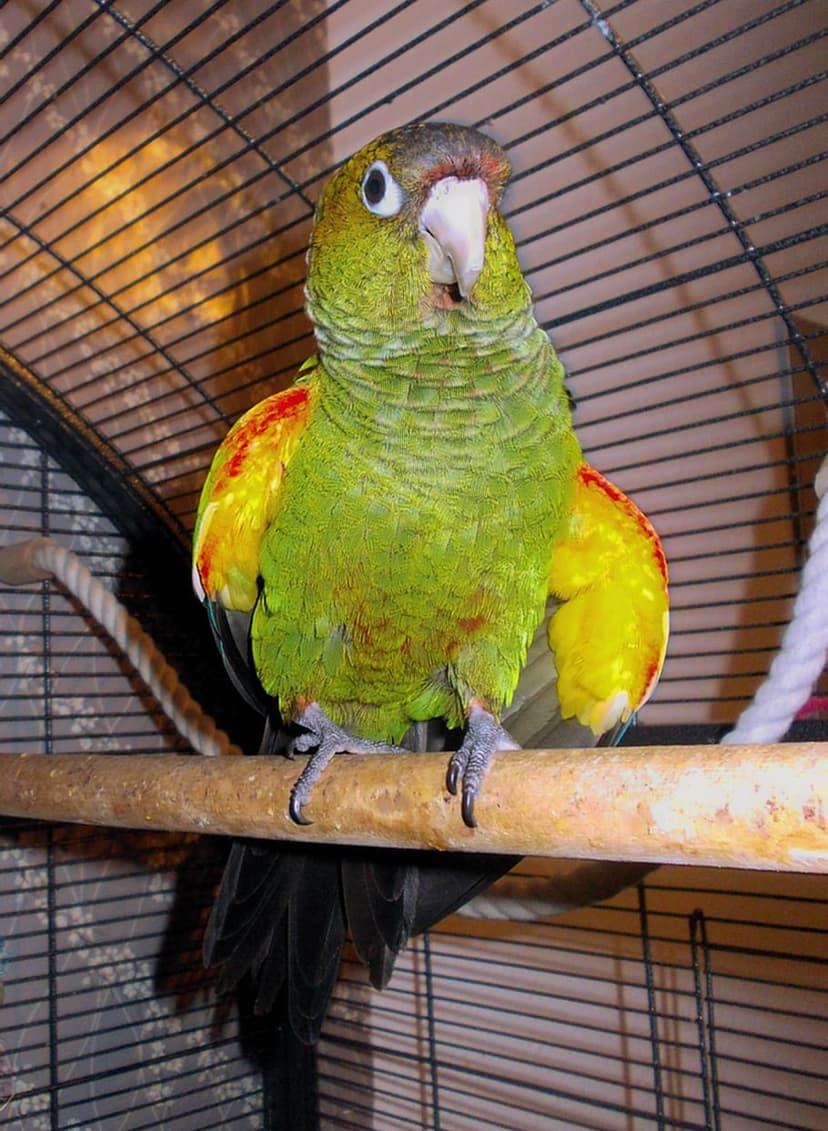
The Fiery-shouldered parakeet is a species of parrot native to the montane forests of Guyana, Brazil, and Venezuela. It is distinguished by its grey head, green body with yellow and orange markings on the wings, and a reddish-brown abdomen. This species is generally considered fairly common, though its habitat faces threats from logging.

Fuertes's parrot
Fuertes's parrot, also known as the indigo-winged parrot, is an endangered species endemic to the west slope of Colombia's Central Andes. This parrot is distinguished by its striking blue and green plumage, accented with red and violet-blue markings on its wings and tail. It inhabits wet temperate cloudforests and is known to feed in flocks, with conservation efforts focusing on nest box programs to aid its population recovery.

Painted parakeet
The painted parakeet, also known as the painted conure in aviculture, is a species of parrot native to northeastern South America. This medium-sized parrot is distinguished by its vibrant plumage, featuring a mix of green, blue, and maroon, with distinctive scalloped markings on its breast. It inhabits various forest types and is known to forage in flocks.