
Caica parrot
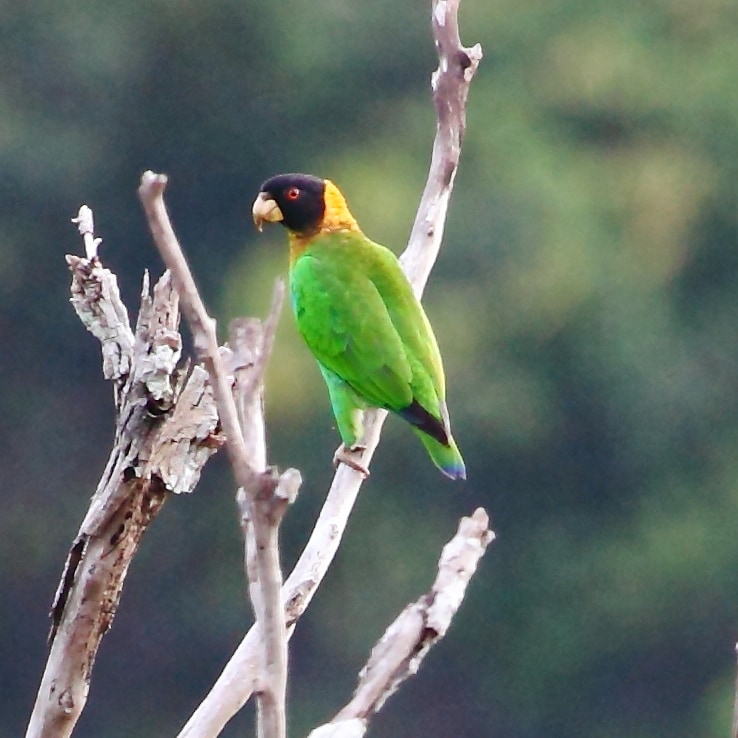
The Caica parrot is a species of parrot found in the northeastern Amazon Basin of South America, inhabiting mature terra firme forests. It is distinguished by its brownish-black head, golden collar, and green body, with specific blue and black markings on its wings and tail. While its exact movements and foraging behavior are not well-documented, it is known to feed on seeds and fruits and has a distinctive nasal flight call.
Key Facts
- ›Found in Brazil, French Guiana, Guyana, Suriname, and Venezuela.
- ›Typically measures between 23 to 25 cm in length and weighs 121 to 143 g.
- ›Adults have a brownish-black head with bare gray skin around the eyes and a fulvous or golden collar.
- ›Its body is primarily green, with dull blue primary coverts and blackish primaries.
- ›The species inhabits mature terra firme forests, generally avoiding flooded and secondary forests.
- ›Its flight call is a nasal, horn-like sound, with variations of 'kyow' and 'kra'.
South America
Mature Terra Firme Forest
Green, Brownish Black, Golden, Olive-Brown, Dull Blue, Blackish
- Bare gray skin around the eye
- Fulvous or golden collar on hindneck with a scaly appearance
Seeds, Fruits
- Nasal, Horn-Like Flight Call
- Short Nasal Yelps and Squeaking Notes When Perched
Tree Cavity
About Caica parrot
The Caica parrot (Pyrilia caica) is a species of parrot belonging to the subfamily Arinae within the family Psittacidae. It is native to the northeastern part of the Amazon Basin in South America, with its range extending across Brazil, French Guiana, Guyana, Suriname, and Venezuela.
Description and Identification
Adult Caica parrots typically measure between 23 to 25 cm (9.1 to 9.8 inches) in length and weigh between 121 to 143 grams (4.3 to 5.0 ounces). A distinctive feature is their brownish-black head, contrasted by bare gray skin surrounding the eyes. They possess a fulvous or golden collar on their hindneck, which appears scaly due to dark feather edges. The throat and upper breast are olive-brown, while the rest of the body is predominantly green. The primary wing coverts are a dull blue, the flight feathers (primaries) are blackish, and the tail feathers have dull blue tips. Immature birds are more uniformly green, with a duller collar.
Distribution and Habitat
The Caica parrot is found from eastern Venezuela eastward through the Guianas and into Brazil, specifically in the Amapá state and south along the Amazon River. Their preferred habitat is mature terra firme forest, and they generally avoid flooded or secondary forests. They have been observed at elevations up to 1,100 meters (3,600 feet).
Behavior and Ecology
Much about the Caica parrot's movements and foraging behavior remains unrecorded. However, observations indicate they feed on seeds and fruits. Their vocalizations include a distinctively nasal, horn-like flight call, which can manifest as a single "kyow," a double "kra ... kyow," or a triple "kra.kree ... kyow." When perched, they produce a variety of short, nasal yelps and squeaking notes.
Breeding
In French Guiana, the Caica parrot breeds between November and January. Information regarding their breeding season in other parts of their range is limited. The only known nest was located in a tree cavity approximately 10 meters (33 feet) above the ground.
Conservation Status
The Caica parrot's conservation status has fluctuated, but it is currently listed as Least Concern by the IUCN. Despite a fairly large geographic range and an estimated population of 250,000 mature individuals, the population is believed to be declining. The primary threat to the species is accelerating deforestation, driven by land clearing for cattle ranching and soy production, often facilitated by road network expansion. While considered common in French Guiana, they are uncommon to scarce elsewhere. They do inhabit several large, protected areas within their range.
Source: Wikipedia ↗
Frequently Asked Questions
What is the scientific name of the Caica parrot?
The scientific name of the Caica parrot is Pyrilia caica. It was formerly included in the genus Pionopsitta before being moved to Pyrilia.
Where is the Caica parrot found?
The Caica parrot is distributed from eastern Venezuela through the Guianas into Brazil's Amapá state and south in Brazil to the Amazon River. Its range covers Brazil, French Guiana, Guyana, Suriname, and Venezuela.
What does the Caica parrot look like?
Adult Caica parrots are about 23-25 cm long with a brownish-black head, a golden collar on the hindneck, and olive-brown throat and upper breast. The rest of their body is green, with dull blue primary coverts and blackish primaries.
What is the habitat of the Caica parrot?
The Caica parrot primarily inhabits mature terra firme forests, generally avoiding flooded and secondary forests. They can be found at elevations up to 1,100 meters.
What is the conservation status of the Caica parrot?
The IUCN has assessed the Caica parrot as Least Concern. Its population is estimated at 250,000 mature individuals, though this number is believed to be decreasing due to deforestation.
What are the vocalizations of the Caica parrot?
The Caica parrot's flight call is described as a nasal, horn-like sound, which can be a single 'kyow,' a double-noted 'kra ... kyow,' or a triple-noted 'kra.kree ... kyow.' When perched, they utter short nasal yelps and squeaking notes.
Related Parrot species

Aztec parakeet
The Aztec parakeet, also known as the olive-throated parakeet, is a species of bird found from Mexico to Costa Rica and in Jamaica. It is distinctive for its mainly dark green plumage with yellowish ear coverts and rump, and an olive-brown throat and breast. This species is known for its vocalizations, described as sharp, grating calls, and its adaptability to various woodland and forest habitats.
Peach-fronted parakeet
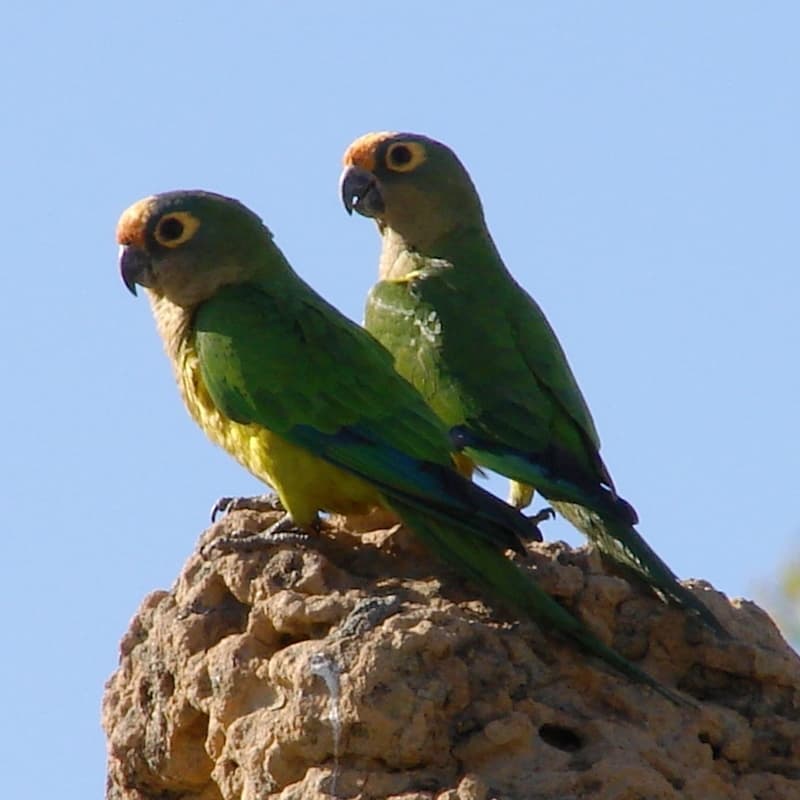
The Peach-fronted parakeet is a species of parrot found in South America, inhabiting a variety of semi-open to wooded landscapes. It is distinguished by its peachy orange forehead and hindcrown of dull blue, and is known for its varied diet and nesting habits.

Kea
The kea, a large parrot endemic to New Zealand's South Island, is distinguished by its olive-green plumage, orange underwings, and a distinctive large, curved beak. Known for exceptional intelligence and curiosity, they inhabit both forested and alpine regions and have a varied omnivorous diet that includes carrion. Historically persecuted by sheep farmers, the kea is now a protected species.