
Glossy black cockatoo
The Glossy black cockatoo is a bird species native to eastern Australia, recognized as the smallest member of the subfamily Calyptorhynchinae. This species is notable for its distinct sexual dimorphism, with males being predominantly black and females a duller brown with yellow markings. Its conservation status varies by subspecies, with some listed as vulnerable or endangered.
Key Facts
- ›Adults can reach up to 50 cm (19.5 in) in length.
- ›Males are blackish-brown with red tail bands, while females are dark brown with yellow neck markings and red-barred tails.
- ›It is the smallest member of the subfamily Calyptorhynchinae.
- ›The species is found in eastern Australia.
- ›Its diet primarily consists of seeds from she-oak trees (Casuarina spp.).
- ›Conservation status varies, with subspecies listed as vulnerable or endangered.

Glossy-Black Cockatoo
Australia
Open Forest, Woodlands
Prominent Sub-Terminal Red Tail Bands, Idiosyncratic Yellow Marking Around the Neck, Barred Tail Vs. Patched Tail
Seeds of She-Oak
Juvenile Begging Call, Vocalization When Swallowing Food
About Glossy black cockatoo
The Glossy black cockatoo (Calyptorhynchus lathami) is a distinctive bird species found in eastern Australia, representing the smallest member of the Calyptorhynchinae subfamily. This species is characterized by significant sexual dimorphism, with males displaying a predominantly black plumage accented by bold red tail bands, while females exhibit a duller dark brown coloration with notable yellow markings around the neck and barred red tail bands.
Taxonomy and Classification
First described by Dutch naturalist Coenraad Jacob Temminck in 1807, the scientific name Calyptorhynchus lathami honors the English ornithologist John Latham. The Glossy black cockatoo is closely related to the Red-tailed black cockatoo, forming the genus Calyptorhynchus. They are distinguished from other black cockatoos by differences in tail color, head patterns, pronounced sexual dimorphism, and specific juvenile vocalizations.
Historically, three subspecies were proposed: C. l. lathami (south-eastern), C. l. erebus (central Queensland), and C. l. halmaturinis (Kangaroo Island). However, recent detailed morphological analyses have challenged this subdivision, arguing that minimal genetic and plumage differences, along with no differentiation in bill morphology or diet, do not justify separate subspecies. These analyses suggest the species may be monotypic, with observed variations attributed to clinal shifts in body dimensions across its latitudinal range.
Description and Physical Characteristics
Adult Glossy black cockatoos typically measure between 46 to 50 cm (18 to 19.5 inches) in length. The males are primarily black with a chocolate-brown head and striking red patches on their tails. Females are a duller dark brown and display flecks of yellow in their tails and a distinctive yellow collar or neck marking. A key visual difference is that the female's tail is barred, while the male's tail is distinctly patched.
Distribution and Habitat
These cockatoos are found in eastern Australia, inhabiting open forests and woodlands. Their primary food source consists of the seeds from she-oak trees (Casuarina spp.). The Kangaroo Island subspecies, in particular, is known to specialize in the cones of the drooping she-oak (Allocasuarina verticillata).
Conservation Status
The conservation status of the Glossy black cockatoo varies among its recognized subspecies. The south-eastern subspecies (C. l. lathami) is listed as vulnerable under federal legislation in Australia. The Kangaroo Island subspecies (C. l. halmaturinis) faces a more critical situation, being listed as endangered due to habitat loss and predation. Efforts to protect this subspecies have included deterring predators like possums and installing nest boxes, which are now utilized by a significant portion of breeding pairs. Recovery programs also involve habitat restoration through planting she-oak seedlings.
Source: Wikipedia ↗
Frequently Asked Questions
What is the scientific name of the Glossy black cockatoo?
The scientific name of the Glossy black cockatoo is Calyptorhynchus lathami. This name honors the English ornithologist John Latham.
What are the main differences between male and female Glossy black cockatoos?
The species is sexually dimorphic. Males are predominantly black with striking red tail patches, while females are a duller dark brown with yellow flecks in the tail and a yellow collar. The female's tail is barred, whereas the male's tail is patched.
Where are Glossy black cockatoos found?
Glossy black cockatoos are found in eastern Australia. They inhabit open forests and woodlands.
What do Glossy black cockatoos eat?
Their diet primarily consists of seeds from she-oak trees (Casuarina spp.). They are known to be selective, with one subspecies specializing in the most recent cones of the drooping she-oak.
What is the conservation status of the Glossy black cockatoo subspecies?
The conservation status varies by subspecies. The south-eastern glossy black cockatoo (C. l. lathami) is listed as vulnerable under federal legislation, and the Kangaroo Island subspecies (C. l. halmaturinis) is listed as endangered.
Related Parrot species
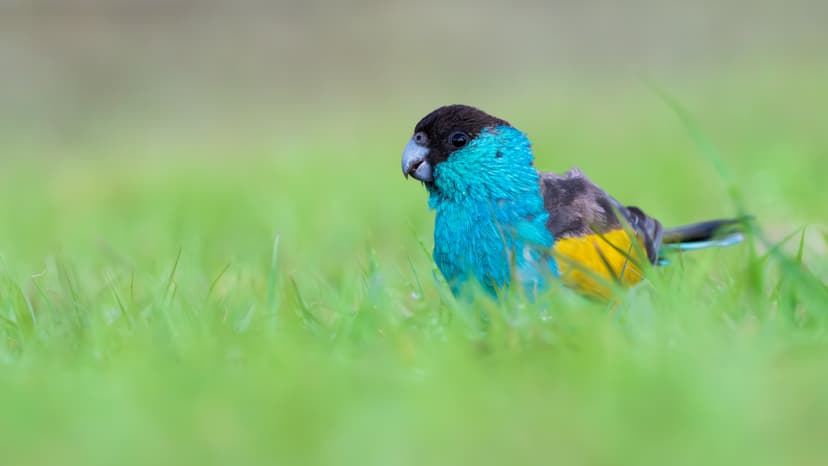
Hooded parrot
The hooded parrot is a species native to the Northern Territory in Australia, inhabiting savannah and open woodland. It is distinctive for being one of the few parrots that breed in termite mounds, and males are recognized by their black head and yellow wing patches. While once more widespread, it remains common in protected areas.

Eastern bluebonnet
The eastern bluebonnet is a medium-sized Australian parrot native to the interior of southeastern and central-southern Australia. It is characterized by its olive-grey to brown upper body, blue forehead and face, and a distinctive crest-like head feather arrangement. This species is adapted to semi-arid regions but can also thrive in areas with moderate rainfall.
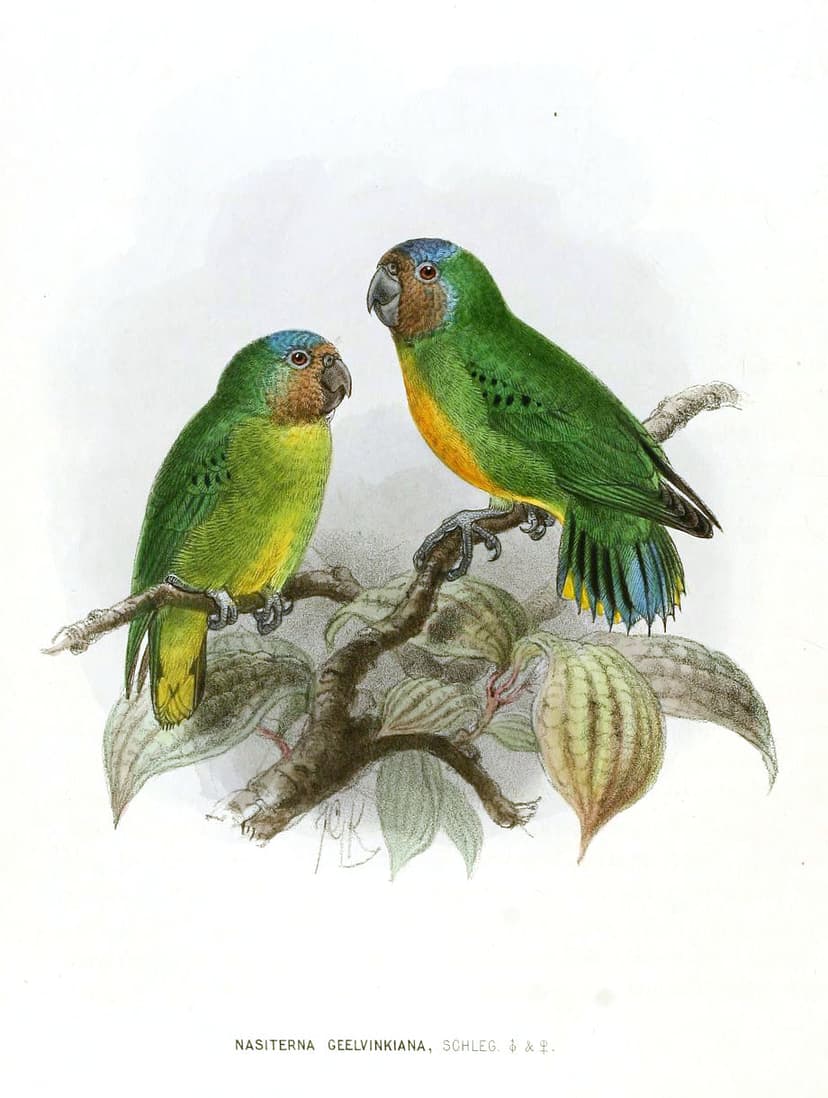
Geelvink pygmy parrot
The Geelvink pygmy parrot is a small parrot species found exclusively on Biak and Numfoor islands in Western New Guinea. Its distinctive plumage includes a brown head, blue crown, yellow breast, green body, and blue tail, with red eyes. The species is threatened by habitat loss in its natural lowland forest and garden environments.