
Red-billed parrot
The red-billed parrot, scientifically known as Pionus sordidus, is a species of parrot native to several South American countries including Bolivia, Colombia, Ecuador, Peru, and Venezuela. It is distinguished by its eponymous red bill, dull green plumage with blue and buff-olive markings, and red undertail coverts.
Key Facts
- ›The red-billed parrot measures 27 to 29 cm in length and weighs approximately 272 g.
- ›Its plumage is predominantly dull green with blue edges on head feathers, blue outer tail feathers, and red undertail coverts.
- ›This species inhabits a variety of wooded landscapes, from lowland forests to coffee plantations, typically between 500 and 1500 meters in elevation.
- ›Dietary information is limited but is known to include fruits and blossoms.
- ›Breeding seasons vary by region, with nesting occurring in tree cavities and clutches typically consisting of three eggs.

Coral-Billed Pionus, Red-Billed Pionus
South America
- Humid to wet lowland and submontane evergreen and semi-deciduous forests
- Cloud forests
- Secondary forests
- Gallery forests
- Coffee plantations
Eponymous Red Bill, Red Undertail Coverts, Bare Grayish Skin Around the Eyes
Fruits, Blossoms
Information Not Available
- Flight calls appear to differ among subspecies
- Some subspecies make a strident "Kee!-yak"
- Other subspecies make an upslurred "Crree!" and a more mellow "Crrah"
Nests In Holes In Trees
About Red-billed parrot
The red-billed parrot (Pionus sordidus), also known as the coral-billed pionus or red-billed pionus, is a species of parrot found in the diverse wooded landscapes of South America. Its range spans Bolivia, Colombia, Ecuador, Peru, and Venezuela, where it inhabits a variety of forest types, from humid lowlands to submontane regions, as well as gallery forests and coffee plantations. The species is characterized by its distinctive red bill, which gives it its common name, and its predominantly dull green plumage accented with blue on the head and tail, and red undertail coverts. Adults typically measure between 27 and 29 cm in length and weigh around 272 grams.
Taxonomy and Systematics
First illustrated and described by English naturalist George Edwards in 1751 as "The dusky parrot," the red-billed parrot was later placed in the genus Psittacus by Carl Linnaeus in 1758, who coined the binomial name Psittacus sordidus. It now resides in the genus Pionus, established by Johann Georg Wagler in 1832. The genus name originates from the Greek word for "fat," while the specific epithet "sordidus" is Latin for "shabby" or "dirty." The red-billed parrot comprises six recognized subspecies: P. s. saturatus, P. s. ponsi, P. s. sordidus, P. s. antelius, P. s. corallinus, and P. s. mindoensis. Historically, some authors have debated the status of certain subspecies, such as P. s. corallinus and P. s. mindoensis.
Description
The adult red-billed parrot is readily identified by its bright red bill. Its plumage is generally dull green, with the head feathers featuring dull blue edges. A ring of bare grayish skin encircles the eye. The back, wings, and inner tail feathers are olive green, while the outer tail feathers are blue. The upper breast displays a dull blue hue, which transitions to a buff-olive color with a pinkish tinge on the belly. The undertail coverts are notably red. Immature birds are distinguished by a green head and breast, and yellowish-green undertail coverts.
Subspecies exhibit variations in coloration and size. For instance, P. s. antelius is paler than the nominate subspecies, with less blue on the breast. P. s. saturatus is darker, and P. s. ponsi is even darker than saturatus. Subspecies P. s. corallinus is larger and greener than the nominate form, with gray and blue tinges on the mantle and back. P. s. mindoensis is similar to P. s. corallinus but tends to be yellower.
Distribution and Habitat
The red-billed parrot's distribution is disjunct across its range. Subspecies are found in specific regions: P. s. saturatus in Colombia's Sierra Nevada de Santa Marta; P. s. ponsi in the foothills of the Sierra Nevada de Santa Marta extending into the Serranía del Perijá; P. s. sordidus in northern Venezuela; P. s. antelius in northeastern Venezuelan states; P. s. corallinus from the Eastern Andes of Colombia through eastern Ecuador to central Peru and parts of central Bolivia; and P. s. mindoensis in western Ecuador.
Their preferred habitat includes a variety of wooded environments. This encompasses the interior, clearings, and edges of humid to wet lowland and submontane evergreen and semi-deciduous forests. They also inhabit cloud forests, secondary growth, gallery forests, and coffee plantations. Elevationally, they are most commonly found between 500 and 1,500 meters, but their range extends from as low as 100 meters to as high as 2,400 meters.
Behavior and Ecology
Movement
The red-billed parrot engages in some local seasonal movements within northern Venezuela. Information regarding movements in other parts of its range is limited.
Feeding
Detailed knowledge of the red-billed parrot's foraging behavior and diet is scarce. However, existing records indicate that their diet includes fruits and blossoms.
Breeding
The breeding season for the red-billed parrot is geographically variable. In Colombia, it occurs from February to April, while in Ecuador, it spans January to May. In Venezuela, the breeding season includes April, and in Bolivia, it extends into October. The parrots typically nest in holes found in trees. A clutch usually consists of three eggs. The incubation period is approximately 27 days, and fledging, the stage where young birds are capable of flight, occurs about 12 weeks after hatching.
Vocalization
The flight calls of the red-billed parrot appear to vary among its subspecies. For instance, P. s. sordidus and P. s. antelius are known to produce a "strident 'kee!-yak'" call. In contrast, P. s. corallinus and P. s. mindoensis are described as making an "upslurred 'crree!'" and a more mellow "crrah."
Conservation Status
The International Union for Conservation of Nature (IUCN) has classified the red-billed parrot as Least Concern. Despite possessing a very large range, its exact population size is unknown and is believed to be declining. Currently, no immediate threats have been identified for the species. It is generally considered fairly common throughout most of its habitat. Local population declines have been observed due to deforestation in Colombia and Venezuela. Nevertheless, the species is noted to persist in moderately disturbed habitats.
Source: Wikipedia ↗
Frequently Asked Questions
What is the scientific name of the red-billed parrot?
The scientific name of the red-billed parrot is Pionus sordidus. It was first described by Carl Linnaeus in 1758 under the binomial name Psittacus sordidus.
Where is the red-billed parrot found?
The red-billed parrot is found in Bolivia, Colombia, Ecuador, Peru, and Venezuela. Its subspecies have a disjunct distribution across these countries.
What does a red-billed parrot look like?
Adult red-billed parrots have a dull green head with blue-edged feathers and a red bill. Their bodies are mostly olive green with blue outer tail feathers and red undertail coverts. The breast is dull blue, transitioning to buff-olive with a pink tinge on the belly.
What is the habitat of the red-billed parrot?
The red-billed parrot inhabits a range of wooded environments, including interior forests, clearings, forest edges, cloud forests, secondary forests, gallery forests, and coffee plantations.
What do red-billed parrots eat?
Little is known about the specific foraging behavior and diet of the red-billed parrot. However, it is known to consume fruits and blossoms.
When do red-billed parrots breed?
The breeding season for the red-billed parrot varies by geographic location. It occurs from February to April in Colombia, January to May in Ecuador, April in Venezuela, and October in Bolivia. They nest in tree holes.
What is the conservation status of the red-billed parrot?
The IUCN has assessed the red-billed parrot as Least Concern. While its population is believed to be decreasing, no immediate threats have been identified, and it is considered fairly common across most of its range.
Related Parrot species
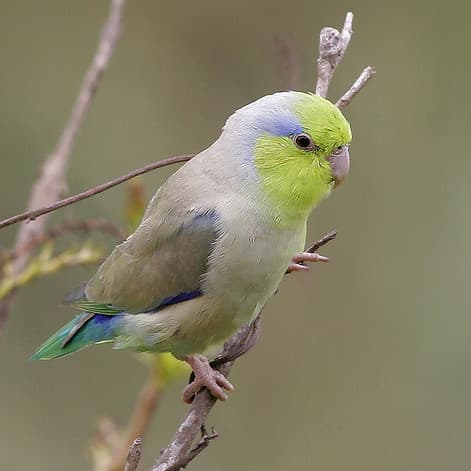
Pacific parrotlet
The Pacific parrotlet, scientifically known as Forpus coelestis, is a small parrot originating from South America, specifically western Ecuador and northwestern Peru. These birds are distinguished by their small size, often referred to as "pocket parrots," and their often feisty and curious personalities, despite their diminutive stature.

Black-winged parrot
The black-winged parrot, scientifically known as Hapalopsittaca melanotis, is a species of parrot found in Bolivia and Peru. This predominantly green bird is distinguished by its black ear coverts (in the nominate subspecies) and largely black wings with blue primaries. It inhabits humid montane forests and can be found in flocks searching for berries.

Bronze-winged parrot
The Bronze-winged parrot (Pionus chalcopterus) is a medium-sized parrot native to northwestern South America, inhabiting forest and woodland environments. It is distinguished by its predominantly dark plumage, a distinctive whitish chin patch, and bronze-green body feathers that shimmer with blue tips, along with short red undertail feathers.