
Aneides klamathensis
Aneides klamathensis·Plethodontidae
The Klamath black salamander (Aneides klamathensis) is a species of salamander found in the western United States, specifically the Klamath Mountains region of northern California and southern Oregon. It was previously considered part of the speckled black salamander species complex but was described as a distinct species in 2019. Its distinctive appearance includes a solid black base coloration with greenish-gray frosting and heavily white to cream-spotted limbs.
Key Facts
- ›Endemic to the Klamath Mountains in northern California and southern Oregon.
- ›Described as a distinct species in 2019, previously considered part of Aneides flavipunctatus.
- ›Characterized by a solid black base coloration with greenish-gray frosting.
- ›Limbs are heavily spotted with white to cream-colored spots.
- ›Occurs in southeast-central Humboldt and Trinity counties in California, and southern Josephine and Jackson counties in Oregon.

Klamath Black Salamander
Klamath Mountains
United States
- Solid Black Base Coloration Overlaid By Greenish-Gray Frosting Extending Down the Trunk.
- Limbs Are Heavily Spotted With White To Cream-Colored Spots.
- Spots Are Largely Scattered On Other Dorsal Surfaces.
About Aneides klamathensis
Klamath Black Salamander (Aneides klamathensis)
The Klamath black salamander, scientifically known as Aneides klamathensis, is a species of salamander native to the western United States. It is found exclusively within the Klamath Mountains, spanning across northern California and southern Oregon.
Taxonomy and Identification
This species was formally described as Aneides klamathensis in 2019. Prior to this, it was recognized as a distinct population within the speckled black salamander species complex (A. flavipunctatus). However, research indicated that A. flavipunctatus comprised multiple distinct species, leading to the elevation of the Klamath population to its own species status.
Geographic Distribution
The natural range of Aneides klamathensis is confined to the Klamath Mountains. In California, it is found in southeast-central Humboldt and Trinity counties. Its distribution extends northward into southern Josephine and Jackson counties in Oregon.
Physical Characteristics
The Klamath black salamander exhibits a striking appearance. Its base coloration is a solid black, which is then overlaid with a distinctive greenish-gray frosting that extends down its trunk. The limbs of this salamander are notably heavily spotted with white to cream-colored markings, though these spots are more sparsely distributed on other dorsal surfaces of the body.
Source: Wikipedia ↗
Frequently Asked Questions
What is the scientific name for the Klamath black salamander?
The scientific name for the Klamath black salamander is Aneides klamathensis. This name was established in 2019 when it was recognized as a distinct species.
Where is the Klamath black salamander found?
This species is endemic to the Klamath Mountains, inhabiting northern California and southern Oregon. Its range extends from Humboldt and Trinity counties in California north to Josephine and Jackson counties in Oregon.
How is the Klamath black salamander distinguished from other salamanders?
The Klamath black salamander has a unique appearance with a solid black base coloration overlaid by greenish-gray frosting. Its limbs are also distinctly and heavily spotted with white to cream-colored spots.
Was the Klamath black salamander always considered a separate species?
No, the Klamath black salamander was formerly considered a population of the speckled black salamander (Aneides flavipunctatus). A 2019 study led to its description as a separate species, Aneides klamathensis.
Related Salamander and Newt species

Ambystoma granulosum
The granular salamander (Ambystoma granulosum), also known as ajolote, is a species of mole salamander endemic to central Mexico. It inhabits high-altitude grasslands, marshes, and ponds, and is distinguished by its susceptibility to threats from habitat loss and skin scaling.
Ambystoma leorae
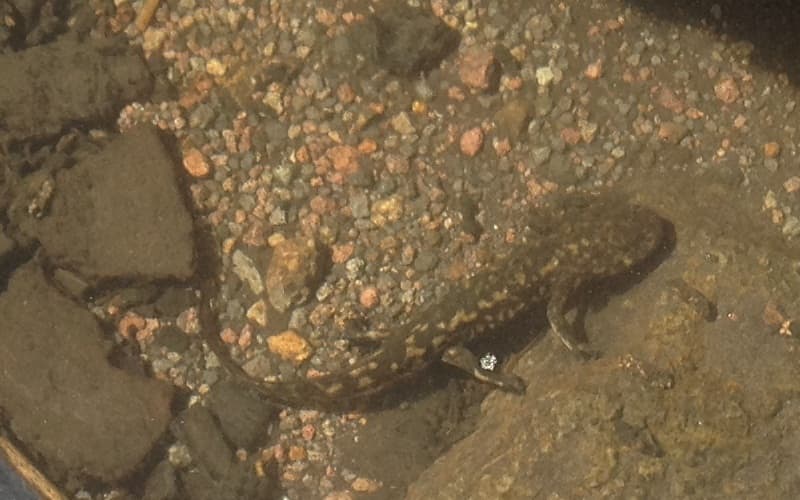
The Leora's stream salamander (Ambystoma leorae) is a critically endangered mole salamander endemic to a very small region within Mexico's Iztaccihuatl-Popocatepetl National Park. Its survival is threatened by its specific water quality requirements and human activities such as water extraction, cattle grazing, and direct consumption, leading to a single known population persisting on Mount Tlaloc.
Ambystoma lermaense
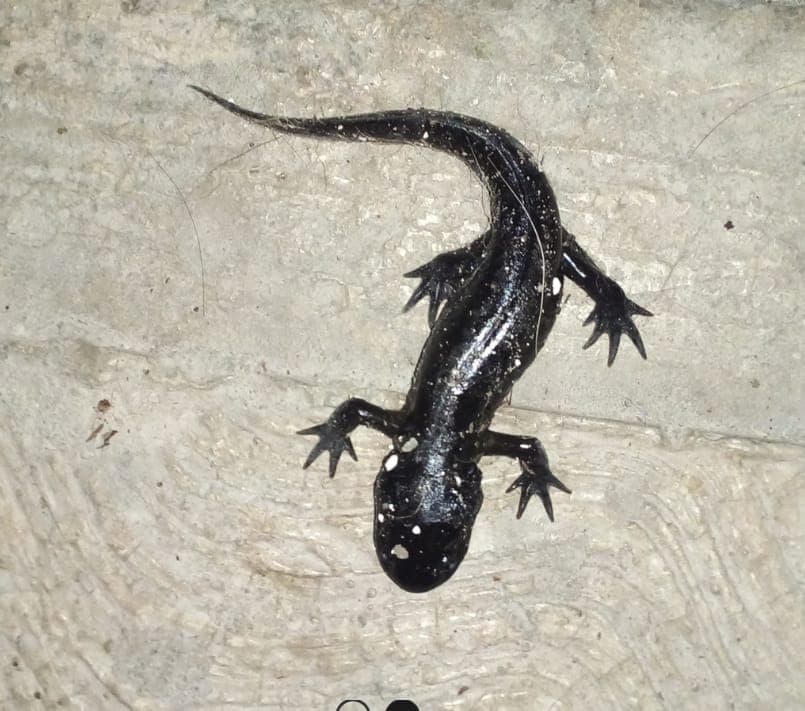
The Lake Lerma salamander (Ambystoma lermaense) is an extremely rare mole salamander species native to the Toluca Valley in central Mexico. This species is characterized by its neotenic tendencies and has faced a catastrophic decline due to habitat destruction, pollution, and dam construction in its native Lerma River and Lake Lerma wetlands.