
Filistatidae
They are web builders that construct funnel or tube webs to ensnare prey. They may also use their modified first legs to retain prey from crevices.
Filistatidae, commonly known as crevice weaver spiders, are a family of cribellate spiders recognized for certain "primitive" araneomorph features. They construct funnel or tube webs and are found worldwide, with notable genera like Kukulcania in the Americas and Filistata in Afro-Eurasia.
Key Facts
- ›Filistatidae are cribellate spiders, meaning they possess a cribellum, a sieve-like plate used to produce fine silk.
- ›They are characterized by their funnel or tube web construction.
- ›The family exhibits notable sexual dimorphism, with significant differences between males and females.
- ›A distinctive physical trait is an upward bend in the femur of the first pair of legs.
- ›Filistatidae are considered a basal group within araneomorph spiders, with several features thought to be 'primitive'.

Crevice Weaver Spiders
Worldwide, Americas, Afro-Eurasia
- Upward Bend In the Femur of the First Pair of Legs
- Cribellum Present
- M-Shaped Intestine
- Males With Palps Held Together In Front of the Carapace
- Construct Funnel Or Tube Webs
- Use Modified First Legs To Anchor and Retain Prey
- Some Species Dig Holes In Soft Ground At An Angle
About Filistatidae
Filistatidae: The Crevice Weaver Spiders
Filistatidae, commonly referred to as crevice weaver spiders, represent a family of cribellate spiders distinguished by several characteristics that have been considered "primitive" among araneomorph spiders. These spiders are adept weavers, constructing distinctive funnel or tube webs. The family is globally distributed and encompasses over 120 described species across 18 genera, with notable representatives found in both the Americas and Afro-Eurasia.
Physical Characteristics and Adaptations
A striking visual feature of Filistatidae spiders is a unique upward bend observed near the femur of their first pair of legs. This anatomical modification is not merely cosmetic; it plays a crucial role in their predatory behavior, enabling them to effectively retain prey directly from the crevices they inhabit. This adaptation also provides leverage, making it difficult for larger prey to pull the spider from its secure location. Certain species, such as those in the Kukulcania genus, further utilize these robust front legs for burrowing, creating angled holes in soft ground.
Taxonomy and Evolutionary Significance
The family Filistatidae was established by Anton Ausserer in 1867. Phylogenetically, they are often placed within the Haplogynae group, frequently considered a sister taxon to other haplogyne spiders. However, Filistatidae possess the cribellum, a feature absent in most other haplogynes, and also exhibit other traits such as an M-shaped intestine and the presence of posterior book lung leaves in juveniles, which are regarded as "primitive" araneomorph features. Recent molecular studies suggest a complex evolutionary history, placing Filistatidae alongside Hypochilidae, a position that has led to re-evaluations of what constitutes a "primitive" trait in the broader context of araneomorph spider evolution.
Diversity and Distribution
The family includes genera such as Filistatinella, whose members are described as miniature versions of Kukulcania, and the nominate genus Filistata, primarily found in Afro-Eurasia. Historically, many species now classified under Kukulcania in the Americas were previously placed in Filistata. The southern house spider, Kukulcania hibernalis, is a particularly abundant member of this family in the Americas, known for its pronounced sexual dimorphism.
Source: Wikipedia ↗
Frequently Asked Questions
What are crevice weaver spiders?
Crevice weaver spiders belong to the family Filistatidae. They are characterized by their "primitive" araneomorph features and their habit of building funnel or tube webs.
Where are Filistatidae spiders found?
Filistatidae spiders are found worldwide. The genus Filistata is distributed across Afro-Eurasia, while species of Kukulcania are common in the Americas.
What is distinctive about the legs of Filistatidae spiders?
A striking characteristic is an unusual upward bend near the femur of the first pair of legs. This modification aids in retaining prey from crevices and can be used for anchorage.
Are there differences between male and female Filistatidae spiders?
Yes, the family exhibits significant sexual dimorphism. For example, female Kukulcania hibernalis are large and dark, while males are smaller, lighter brown, and more long-legged.
What kind of webs do Filistatidae spiders build?
Filistatidae spiders are known as weavers of funnel or tube webs. These webs are typically found in crevices or other sheltered locations.
Related Spider species

Agelenidae
The Agelenidae, commonly known as funnel weavers, are a large family of spiders found globally. They are distinguished by their fast running speeds and the construction of flat sheet webs with a funnel-shaped retreat. While most species are solitary, some African species exhibit parasocial behavior, living in communal webs.
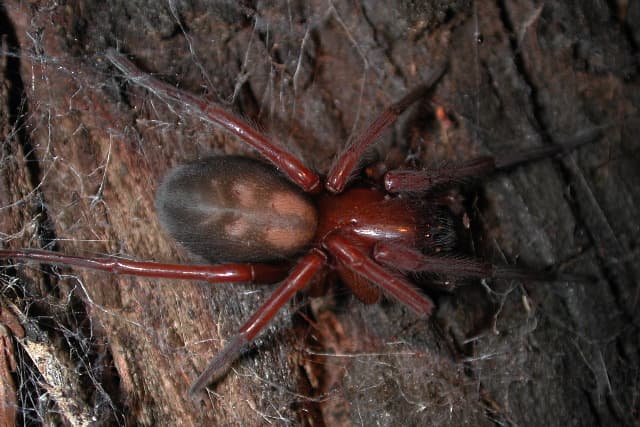
Amaurobiidae
Amaurobiidae is a family of spiders characterized by their three-clawed feet and the presence of either a cribellum or its absence. These spiders are typically found in crevices, hollows, or under stones, where they construct retreats and are often captured in pitfall traps. While widespread, they can be challenging to distinguish from closely related spider families.
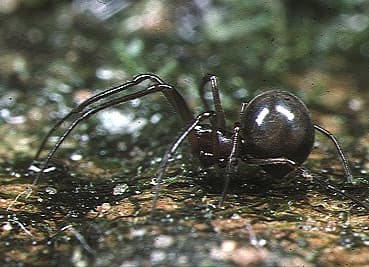
Anapidae
Anapidae is a diverse family of small spiders, with most species measuring less than two millimeters in length. These spiders are found worldwide, inhabiting leaf litter and moss in rainforest environments. A distinctive characteristic of many Anapidae species is their ability to build small orb webs, often less than three centimeters in diameter.