
Halonoproctidae
Ambush predator, utilizing burrows with trapdoors to capture unsuspecting prey.
Halonoproctidae is a family of mygalomorph spiders, recently split from Ctenizidae, characterized by their medium to large size and sombre coloration. These spiders are found across various continents, including North and Central America, Australasia, Asia, southern Europe, and North Africa, constructing burrows with distinctive trapdoors.
Key Facts
- ›They are medium to large-sized mygalomorph spiders.
- ›Species are found across North and Central America, Australasia, Asia, southern Europe, and North Africa.
- ›They construct burrows that are covered by a wafer-like or cork-like trapdoor.
- ›Coloration is typically sombre, ranging from light brown to black, with few distinctive markings.
- ›The family was elevated from a subfamily of Ctenizidae in 2018 based on molecular phylogenetic studies.
- ›Halonoproctidae includes six genera and 145 species.

North America, Central America, Caribbean, South America, Southern Europe, North Africa, Eastern Asia, Australasia
- Burrows With Wafer-Like Or Cork-Like Trapdoors
- Females Have Unique Curved, Thorn-Like Spines On the Sides of Legs I and Ii
- Males Have Scopulae On the Tarsi of At Least Some Legs
Live In Burrows, Construct Trapdoors
About Halonoproctidae
The family Halonoproctidae comprises a group of mygalomorph spiders, distinguished by their medium to large size, sombre coloration, and characteristic burrowing behavior. These spiders are known for constructing subterranean homes covered by a unique trapdoor, which can be either wafer-like or cork-like, serving as a crucial element in their hunting strategy.
Distribution and Habitat
Halonoproctidae spiders exhibit a wide geographic distribution, with species found across North and Central America, Australasia, Asia, southern Europe, and North Africa. Notably, one species has been documented in Venezuela, South America. Their habitat typically involves terrestrial environments where they can excavate their characteristic burrows.
Description and Taxonomy
Spiders within this family generally range from light brown to black, often lacking distinctive markings on their bodies. The carapace is usually hairless and sparsely spined, while the sternum is longer than it is wide. Females possess unique, curved, thorn-like spines on the sides of their first two pairs of legs, a feature not found in males, who typically have scopulae on their leg tarsi. The family Halonoproctidae was established in 2018, having been previously classified as the subfamily Halonoproctinae within the family Ctenizidae. This taxonomic revision was the result of molecular phylogenetic studies that revealed the distinctiveness of this group.
Genera and Species
As of recent classifications, the Halonoproctidae family encompasses six genera and approximately 145 species, divided into two subfamilies: Halonoproctinae and Ummidiinae. These genera include Bothriocyrtum, Cyclocosmia, Hebestatis, Conothele, Latouchia, and Ummidia, each containing various species distributed across different regions.
Source: Wikipedia ↗
Frequently Asked Questions
What are Halonoproctidae spiders?
Halonoproctidae is a family of mygalomorph spiders. They are known for their medium to large size, sombre coloration, and for living in burrows equipped with a trapdoor.
Where are Halonoproctidae spiders found?
These spiders have a wide distribution, inhabiting parts of North and Central America, Australasia, Asia, southern Europe, and North Africa. One species has also been recorded in Venezuela, South America.
What do Halonoproctidae spiders look like?
They are relatively large spiders that are sombrely colored, ranging from light brown to black, and typically lack strong body markings. Females have unique curved, thorn-like spines on the sides of their first two pairs of legs.
How do Halonoproctidae spiders catch prey?
Halonoproctidae spiders are trapdoor spiders. They construct burrows with a trapdoor and likely wait for prey to approach before ambushing them.
What is the taxonomic classification of Halonoproctidae?
Halonoproctidae was established as a distinct family in 2018, having previously been considered a subfamily (Halonoproctinae) within the family Ctenizidae. This reclassification was based on molecular phylogenetic research.
How many genera and species are in the Halonoproctidae family?
As of recent classifications, the family Halonoproctidae includes six genera and a total of 145 species. These are divided into two subfamilies: Halonoproctinae and Ummidiinae.
Related Spider species
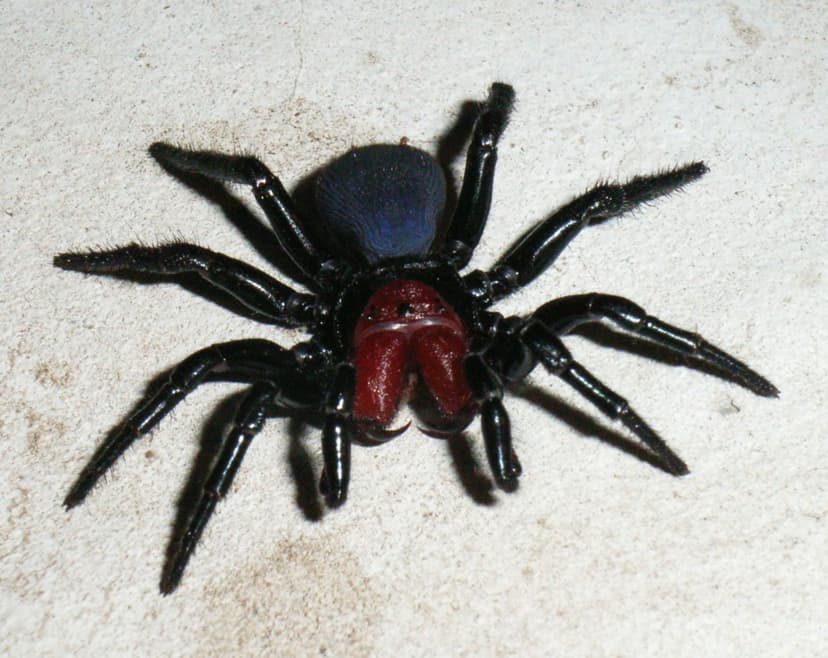
Actinopodidae
Actinopodidae is a family of mygalomorph spiders native to mainland Australia and South America, typically inhabiting open forests. This family includes the mouse spiders (Missulena species), which are notable for their medically significant and potentially dangerous bites.

Agelenidae
The Agelenidae, commonly known as funnel weavers, are a large family of spiders found globally. They are distinguished by their fast running speeds and the construction of flat sheet webs with a funnel-shaped retreat. While most species are solitary, some African species exhibit parasocial behavior, living in communal webs.
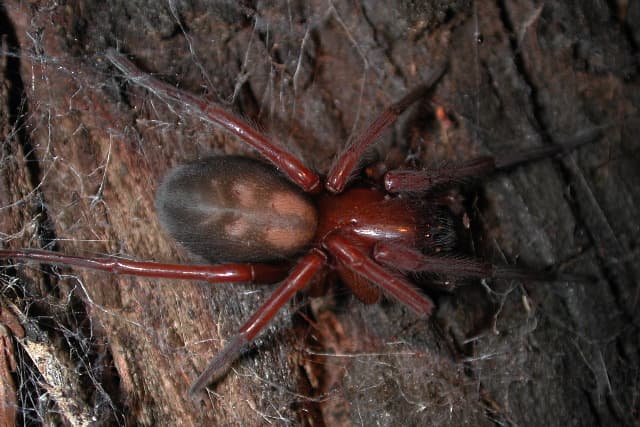
Amaurobiidae
Amaurobiidae is a family of spiders characterized by their three-clawed feet and the presence of either a cribellum or its absence. These spiders are typically found in crevices, hollows, or under stones, where they construct retreats and are often captured in pitfall traps. While widespread, they can be challenging to distinguish from closely related spider families.