
Lathyidae
As cribellate spiders, they are presumed to use silk from their cribellum to create webs or other silk structures for capturing prey.
Lathyidae is a family of small cribellate araneomorph spiders established in 2025. This taxonomic group was recognized following molecular phylogenetic studies that clarified the evolutionary relationships within the previously broadly defined Dictynidae family. Lathyidae spiders are characterized by their small size, specific eye arrangements, and unique genital structures in both males and females.
Key Facts
- ›Small cribellate araneomorph spiders.
- ›Established in 2025 as a revision of Dictynidae.
- ›Possess a low to moderately high carapace and narrow clypeus.
- ›Anterior median eyes (AME) are often narrow or absent.
- ›Males have distinctive pedipalps with a unique locking mechanism.
- ›Females have well-developed epigynes with prominent spermathecae and copulatory ducts.

Europe, Asia, Africa, North America
- Low To Moderately High Carapace
- Narrow Clypeus
- Anterior Median Eyes Usually Narrower Than Other Eyes Or Absent
- Males: Conductor Upper Arm Longer Than Lower Arm, Conductor Lower Arm Directed Dorsally, Unique Locking Mechanism On Pedipalps
- Females: Primary Spermathecae 2+ Times Wider Than Copulatory Duct Width, Well-Developed Copulatory Ducts Many Times Longer Than Primary Spermathecae Width
About Lathyidae
What is Lathyidae?
Lathyidae is a family of spiders that was formally established in 2025. These spiders are classified as small, cribellate araneomorphs. The creation of this family was a consequence of extensive molecular phylogenetic research that aimed to resolve taxonomic uncertainties previously present within the broadly defined family Dictynidae.
Taxonomy and Naming
The family Lathyidae was introduced by Cala-Riquelme, Montana, Crews, and Esposito in 2025 as part of a significant reassessment of the Dictynidae family. The name Lathyidae originates from its type genus, Lathys, which was originally named by Eugène Simon in 1885. Simon created this name as a substitute for Lethia Menge, 1869, because Lethia was already in use for a genus of moths.
Prior molecular studies had consistently indicated that certain genera classified under the umbrella of Dictynidae were not closely related to the core dictynid lineage. This evolutionary divergence prompted the recognition of several distinct families within the superfamily Dictynoidea. A proposed subfamily, Lathysinae, by Gorneau et al. (2023), was found to be unavailable under the International Code of Zoological Nomenclature.
Physical Characteristics
Spiders belonging to the Lathyidae family are characterized by their small size and the presence of a cribellum. They typically exhibit a carapace that is low to moderately high and a narrow clypeus. A notable feature is the arrangement of their eyes: the anterior median eyes (AME) are usually smaller than the other eyes or may be entirely absent. The anterior lateral eyes (ALE), posterior median eyes (PME), and posterior lateral eyes (PLE) are generally similar in size and spaced relatively evenly.
Their chelicerae are described as relatively short and moderately stout, without any basal enlargements or spurs. In males, the pedipalps are distinctive, featuring a conductor where the upper arm is typically longer than the lower arm, and the lower arm is usually directed dorsally. A specialized locking mechanism is present, comprising a longitudinal furrow, a retrolateral tibial apophysis (RTA), and a hook-shaped tibial process.
Females possess an epigyne with primary spermathecae that are at least twice as wide as the copulatory duct. The copulatory ducts are well-developed and are usually many times longer than the width of the primary spermathecae.
Distribution and Diversity
Lathyidae spiders have a broad global distribution, with species found across multiple continents including Europe, Asia, Africa, and North America. As of October 2025, the family comprises ten genera and a total of 58 species, indicating a considerable diversity within this relatively recently defined taxonomic group.
Source: Wikipedia ↗
Frequently Asked Questions
When was the family Lathyidae established?
The family Lathyidae was established in 2025 by Cala-Riquelme, Montana, Crews & Esposito. This was part of a significant revision concerning the taxonomy of spiders previously grouped under Dictynidae.
What is the origin of the family name Lathyidae?
The family name Lathyidae is derived from its type genus, Lathys. Lathys was originally described by Eugène Simon in 1885 as a replacement name for Lethia Menge, 1869, due to the latter being preoccupied by a genus of moths.
What led to the establishment of the Lathyidae family?
The family Lathyidae was established due to molecular phylogenetic studies. These studies revealed that several genera previously classified within Dictynidae were evolutionarily distant from the core dictynid lineage, necessitating the creation of new taxonomic groups.
What are some general physical characteristics of Lathyidae spiders?
Lathyidae spiders are generally small and cribellate. They typically have a low to moderately high carapace and a narrow clypeus. Their anterior median eyes are often narrower than other eyes or may be entirely absent.
How do male Lathyidae spiders' pedipalps differ?
Male Lathyidae spiders possess distinctive pedipalps. A key feature is that the conductor's upper arm is usually longer than the lower arm, and the conductor's lower arm typically points dorsally. They also have a unique locking mechanism involving a longitudinal furrow, retrolateral tibial apophysis (RTA), and a hook-shaped tibial process.
What are the notable features of female Lathyidae epigynes?
In females, the epigyne of Lathyidae spiders is characterized by primary spermathecae that are at least twice as wide as the copulatory duct. The copulatory ducts themselves are well-developed and usually many times longer than the width of the primary spermathecae.
Where are Lathyidae spiders found geographically?
Lathyidae spiders have a widespread global distribution. Species within this family have been recorded on multiple continents, including Europe, Asia, Africa, and North America.
How many genera and species are currently recognized in the Lathyidae family?
As of October 2025, the Lathyidae family includes ten genera and a total of 58 species. This indicates a moderately diverse family with a significant number of described species.
Related Spider species

Agelenidae
The Agelenidae, commonly known as funnel weavers, are a large family of spiders found globally. They are distinguished by their fast running speeds and the construction of flat sheet webs with a funnel-shaped retreat. While most species are solitary, some African species exhibit parasocial behavior, living in communal webs.
Amaurobiidae
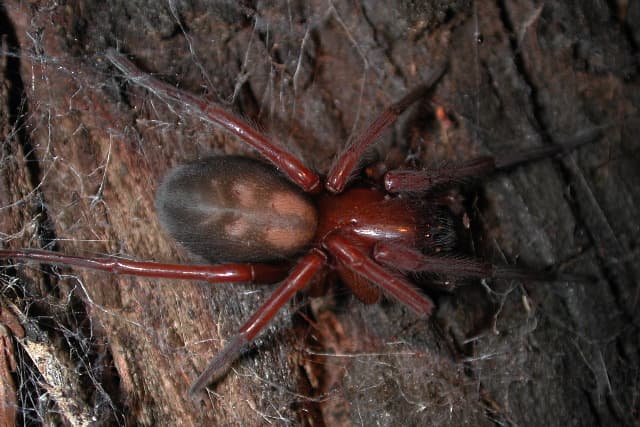
Amaurobiidae is a family of spiders characterized by their three-clawed feet and the presence of either a cribellum or its absence. These spiders are typically found in crevices, hollows, or under stones, where they construct retreats and are often captured in pitfall traps. While widespread, they can be challenging to distinguish from closely related spider families.
Anapidae
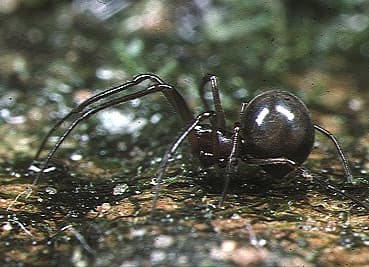
Anapidae is a diverse family of small spiders, with most species measuring less than two millimeters in length. These spiders are found worldwide, inhabiting leaf litter and moss in rainforest environments. A distinctive characteristic of many Anapidae species is their ability to build small orb webs, often less than three centimeters in diameter.