
Nesticidae
Nesticidae·Nesticidae·Many species are associated with caves or overhangs. Some, like Eidmannella pallida, can also be found in agricultural fields and other habitats away from these restricted areas.·https://upload.wikimedia.org/wikipedia/commons/thumb/2/2b/Nesticus_sp._%28cave_spider%29.jpg/1280px-Nesticus_sp._%28cave_spider%29.jpg
Nesticidae, commonly known as scaffold web spiders or cave cobweb spiders, are a family of araneomorph spiders closely related to tangle-web spiders. They are distinguished by a comb of serrated bristles on their hind tarsi, used to manipulate silk. This family comprises 16 genera and approximately 300 species, many of which inhabit caves and overhangs.
Key Facts
- ›Nesticidae spiders possess a comb of serrated bristles on their hind tarsi.
- ›This comb is used to pull silk bands from their spinnerets.
- ›The family contains 16 genera and about 300 described species.
- ›Many Nesticidae species are associated with caves and rocky overhangs.
- ›The genus Nesticus is the type genus for the family and is found globally.

Scaffold Web Spiders, Cave Cobweb Spiders
Worldwide, Texas Caves, Central Eurasia
Comb of Serrated Bristles On the Hind Tarsi
About Nesticidae
Scaffold Web Spiders (Nesticidae)
Scaffold web spiders, scientifically classified as Nesticidae, are a family of araneomorph spiders recognized for their close evolutionary ties to tangle-web spiders (Theridiidae). A defining physical characteristic of this family is the presence of a specialized 'comb' composed of serrated bristles located on the hind tarsi. These bristles play a crucial role in the spiders' silk manipulation, enabling them to draw silk bands from their spinnerets.
Diversity and Distribution
The Nesticidae family is a diverse group, currently encompassing 16 genera and approximately 300 known species. A significant portion of these species are notably associated with subterranean environments, frequently inhabiting caves and rocky overhangs. The genus Nesticus serves as the type genus for the family and exhibits a widespread distribution across the globe. Other genera, such as Eidmannella, have demonstrated significant speciation within specific geographic regions, like the caves of Texas, where some species are considered highly localized and potentially threatened. The species Eidmannella pallida, for instance, while often found in caves and under overhangs, also demonstrates adaptability to more varied habitats, including agricultural fields.
Taxonomy and Extinct Relatives
In addition to extant species, several extinct genera have been placed within the Nesticidae family, primarily known from fossilized remains in amber deposits. These include genera such as †Balticonesticus, †Eopopino, †Heteronesticus, and †Hispanonesticus, dating back to the Palaeogene and Neogene periods. This lineage highlights a long evolutionary history for this group of spiders.
Source: Wikipedia ↗
Frequently Asked Questions
What are scaffold web spiders?
Scaffold web spiders, also known as cave cobweb spiders, belong to the family Nesticidae. They are a group of araneomorph spiders closely related to tangle-web spiders.
What is distinctive about Nesticidae spiders?
A key characteristic of Nesticidae spiders is the presence of a comb of serrated bristles on their hind tarsi. This specialized structure is used to pull silk bands from their spinnerets.
Where are Nesticidae spiders found?
Many species within the Nesticidae family are associated with caves and overhangs. The genus Nesticus, in particular, is found throughout the world, while other genera like Carpathonesticus are found in central Eurasia.
How many species are in the Nesticidae family?
As of January 2026, the Nesticidae family includes sixteen genera and approximately 292 species. This number may vary as new species are discovered and classified.
What is the relationship between Nesticidae and Theridiidae?
Nesticidae are closely allied with the tangle-web spiders (Theridiidae). They share the characteristic comb of serrated bristles on their hind tarsi.
Related Spider species

Agelenidae
The Agelenidae, commonly known as funnel weavers, are a large family of spiders found globally. They are distinguished by their fast running speeds and the construction of flat sheet webs with a funnel-shaped retreat. While most species are solitary, some African species exhibit parasocial behavior, living in communal webs.
Amaurobiidae
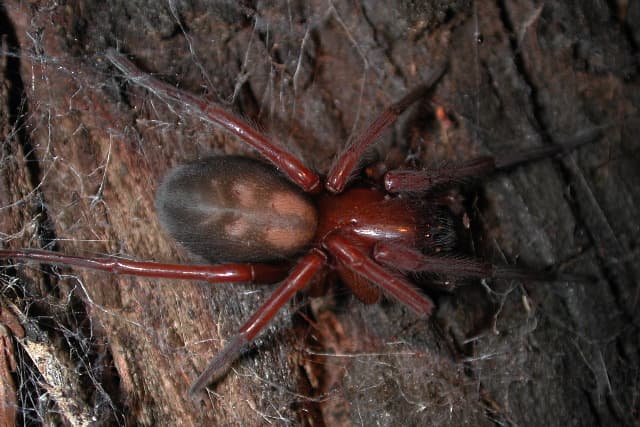
Amaurobiidae is a family of spiders characterized by their three-clawed feet and the presence of either a cribellum or its absence. These spiders are typically found in crevices, hollows, or under stones, where they construct retreats and are often captured in pitfall traps. While widespread, they can be challenging to distinguish from closely related spider families.
Anapidae
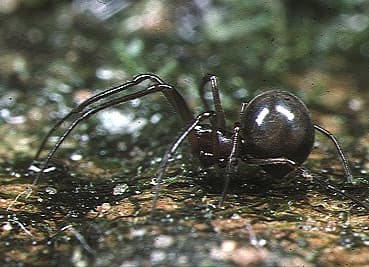
Anapidae is a diverse family of small spiders, with most species measuring less than two millimeters in length. These spiders are found worldwide, inhabiting leaf litter and moss in rainforest environments. A distinctive characteristic of many Anapidae species is their ability to build small orb webs, often less than three centimeters in diameter.