
Psechridae
Web builder, constructing funnel webs, horizontal lace webs, or pseudo-orbs.
Psechridae is a family of araneomorph spiders native to southeastern Asia and parts of Australia, known for being among the largest cribellate spiders. These spiders are distinguished by their funnel webs that can exceed one meter in diameter and their elongated, flexible legs. They exhibit brood care behavior and carry their egg sacs in their chelicerae, traits often seen in ecribellate spiders.
Key Facts
- ›Psechridae spiders are among the largest cribellate spiders.
- ›They construct large funnel webs, sometimes over 1 meter in diameter.
- ›Members of the genus Psechrus build horizontal lace webs, while Fecenia build pseudo-orbs.
- ›They are found in forests, rocky areas, and caves across southeastern Asia and northern Australia.
- ›Females carry their egg sacs in their chelicerae.
- ›The family belongs to the RTA clade of spiders.

India, Southeastern Asia, Solomon Islands, Northern Australia, Central China
- Among the Biggest Cribellate Spiders
- Greatly Elongated Legs With A Very Flexible Last Element
- Colulus With No Apparent Function
- Retrolateral Tibial Apophysis On the Male Pedipalp
Brood Care Behavior, Females Carry Egg-Sacs In Chelicerae
About Psechridae
Psechridae is a family of araneomorph spiders that encompasses approximately 60 known species distributed across two genera. These spiders are recognized as some of the largest cribellate spiders, capable of reaching body lengths of up to 2 centimeters. Their most striking feature is their impressive web-building capability, with funnel webs that can extend over a meter in diameter.
Distribution and Habitat
The natural range of Psechridae spiders spans southeastern Asia, extending from India in the west to the Solomon Islands in the east. Their distribution also reaches as far south as northern Australia and north into central China. These spiders are adaptable to various environments, being found in forests, rocky terrains, and caves, from low-lying areas up to altitudes exceeding 2,000 meters.
Physical Characteristics and Behavior
Psechridae spiders possess greatly elongated legs, with the final segment being notably flexible. They exhibit several characteristics typically associated with ecribellate spiders, including brood care behavior. A distinctive trait is that female Psechrus spiders carry their egg sacs within their chelicerae, a behavior also observed in their relatives, the Pisauridae family. The family belongs to the RTA clade, characterized by the presence of a Retrolateral Tibial Apophysis on the male pedipalp.
Web Construction
Web construction varies between the genera within Psechridae. Members of the genus Psechrus are known to build horizontal lace webs. In contrast, spiders of the genus Fecenia construct pseudo-orbs, which bear a resemblance to the orb webs characteristic of the Orbiculariae spiders, representing an instance of evolutionary convergence.
Source: Wikipedia ↗
Frequently Asked Questions
What is the typical size of Psechridae spiders?
Psechridae spiders are relatively large, with body lengths reaching up to 2 centimeters. Their webs are also substantial, with funnel webs often exceeding 1 meter in diameter.
Where are Psechridae spiders found?
These spiders are distributed across southeastern Asia, from India in the west to the Solomon Islands in the east, and as far south as northern Australia. They inhabit forests, rocky areas, and caves at various altitudes.
What types of webs do Psechridae spiders build?
Members of the genus Psechrus construct horizontal lace webs. In contrast, spiders of the genus Fecenia build pseudo-orbs, which are structures similar to the orb webs of other spider families.
Do Psechridae spiders exhibit parental care?
Yes, Psechridae spiders show brood care behavior, a characteristic often found in ecribellate spiders. Female Psechrus spiders are known to carry their egg sacs in their chelicerae.
What makes Psechridae spiders distinctive?
They are notable for their large size among cribellate spiders and their impressive funnel webs. Their elongated, flexible legs and brood care behavior also distinguish them.
Related Spider species

Agelenidae
The Agelenidae, commonly known as funnel weavers, are a large family of spiders found globally. They are distinguished by their fast running speeds and the construction of flat sheet webs with a funnel-shaped retreat. While most species are solitary, some African species exhibit parasocial behavior, living in communal webs.
Amaurobiidae
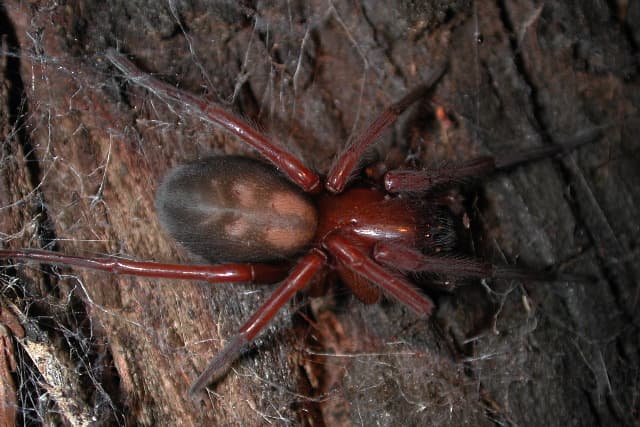
Amaurobiidae is a family of spiders characterized by their three-clawed feet and the presence of either a cribellum or its absence. These spiders are typically found in crevices, hollows, or under stones, where they construct retreats and are often captured in pitfall traps. While widespread, they can be challenging to distinguish from closely related spider families.
Anapidae
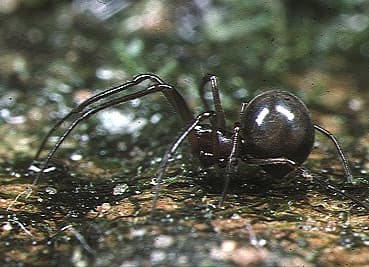
Anapidae is a diverse family of small spiders, with most species measuring less than two millimeters in length. These spiders are found worldwide, inhabiting leaf litter and moss in rainforest environments. A distinctive characteristic of many Anapidae species is their ability to build small orb webs, often less than three centimeters in diameter.