
Rhytidicolidae
Web builder (implied by 'tunnel-web spiders').
Rhytidicolidae, also known as golden tunnel-web spiders, is a small Neotropical family of mygalomorph spiders. First described by Eugène Simon in 1903, it was elevated to family status in 2022. The family currently comprises two genera and fifteen species.
Key Facts
- ›Rhytidicolidae are mygalomorph spiders native to the Neotropics.
- ›The family was originally described as a tribe by Eugène Simon in 1903.
- ›It was recognized as a distinct family in 2022.
- ›The family currently contains two genera.
- ›There are fifteen known species within the Rhytidicolidae family.

Golden Tunnel-Web Spiders
Neotropical Regions
Tunnel-Web Builders
About Rhytidicolidae
Rhytidicolidae, commonly known as golden tunnel-web spiders, represent a small family of mygalomorph spiders native to the Neotropics. This taxonomic group was first formally described by the renowned arachnologist Eugène Simon in 1903. Initially, Simon classified Rhytidicolidae as a tribe within a broader spider classification. For a period, it was considered a junior synonym of the subfamily Aporoptychinae, now part of the family Cyrtaucheniidae, as determined by Raven in 1985.
Taxonomy and Classification
A significant re-evaluation occurred in 2022, leading to the elevation of Rhytidicolidae to its own distinct family status. This recognition acknowledges the unique characteristics and evolutionary lineage of these spiders. The family currently comprises two recognized genera, which collectively house fifteen described species. Further research may expand our understanding of their diversity and distribution within the Neotropical realm.
Source: Wikipedia ↗
Frequently Asked Questions
What are golden tunnel-web spiders?
Golden tunnel-web spiders belong to the family Rhytidicolidae. This is a small group of mygalomorph spiders found in Neotropical regions. They are characterized by their tunnel-web building habits.
When was the family Rhytidicolidae first described?
The family Rhytidicolidae was first described by Eugène Simon in 1903. At that time, it was initially classified as a tribe.
How many genera and species are in the Rhytidicolidae family?
As of early 2026, the Rhytidicolidae family includes two genera. These genera encompass a total of fifteen species.
Where are Rhytidicolidae spiders found?
Rhytidicolidae spiders are found in Neotropical regions. This encompasses areas in the Americas, typically south of the United States.
Related Spider species

Agelenidae
The Agelenidae, commonly known as funnel weavers, are a large family of spiders found globally. They are distinguished by their fast running speeds and the construction of flat sheet webs with a funnel-shaped retreat. While most species are solitary, some African species exhibit parasocial behavior, living in communal webs.
Amaurobiidae
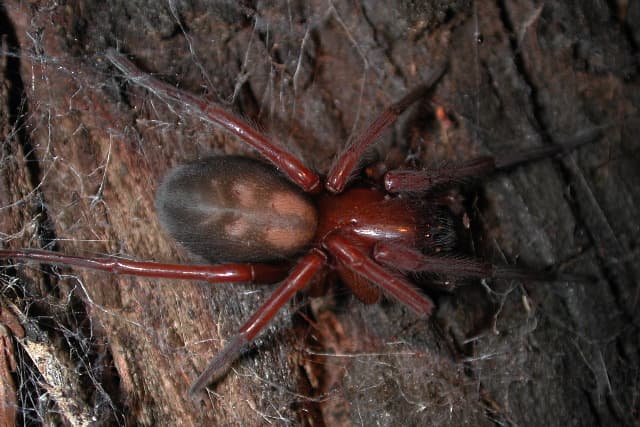
Amaurobiidae is a family of spiders characterized by their three-clawed feet and the presence of either a cribellum or its absence. These spiders are typically found in crevices, hollows, or under stones, where they construct retreats and are often captured in pitfall traps. While widespread, they can be challenging to distinguish from closely related spider families.
Anapidae
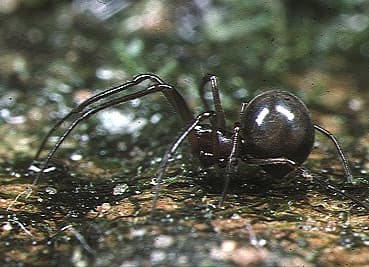
Anapidae is a diverse family of small spiders, with most species measuring less than two millimeters in length. These spiders are found worldwide, inhabiting leaf litter and moss in rainforest environments. A distinctive characteristic of many Anapidae species is their ability to build small orb webs, often less than three centimeters in diameter.